aMAIZing

aMAIZing

Zea Mays

When Colombus discovered the existence of corn (maize) in November 1492 on the island which today is called Cuba, he noted in his diary that “there are large cultivated areas which produce roots [cassava], a sort of bean [the haricot], and a sort of grain called maize.” He certainly had no idea that maize was already ruling the entire Americas, being under cultivation from southern Canada to lower South America. Mahiz is the phonetic name Colombus picked up from the natives. When European botanists began to list maize in their indexes, it became Zea Mays, Zea being a Greco-Latin generic name for wheat like grains and Mays the Latinized version of the original Taino name mahiz which means “life-giver”. How appropriate, maize being the most productive of the grasses but also the only cereal which cannot reproduce itself without the aid of men.

So how did maize become domesticated? Well, do not expect me to give you a precise explanation of the mysteries of the origin and domestication of maize when the “professionals” have been fighting over this issue for half a century. In her book The Story of Corn, Betty Fussel dedicates an entire chapter to the “Corn War” that started in the 50’s. One school, led by Havard Prize winner Paul Mangelsdorf, believed in — and searched for — the “primal ear,” convinced that the ancestor of cultivated corn was some kind of ur-corn. The other school, led by Nobel prize winner Georges Wells Beaddle, discovered through chromosomal interbreeding experiments that corn evolved from a kindred grass called teosinte, a wild grass still found south-west of Mexico City. This seems to be today’s consensus:

“Everybody agrees that domestic corn began about ten thousand years ago and that the place was Mexico and that present-day corn came, one way or another, from the interbreeding of teosinte and maize.”

Thus Garrison Wilkes of the University of Massachuset as interviewed by Betty Fussel. The explanation of how it happened is however still in the ground, and even though archeologists, scientists and botanists all believe that Mexico is the cradle of maize, the oldest — 7,000 years old! — carbon-dated trace was recently found in Panama.

What we do know for sure is the profound cultural/economic importance of maize. The Encyclopedia Britannica, for example, describes it as “the grain that built a hemisphere”. For the Incas, the Mayas, the Zapotecs, the Aztecs, the Zunis, the Iroquois — to only name a few — maize was also a core element of their spiritual life. As Eduardo Galeano was aware long ago:

Guatemala City, 1775
Nor do the Indians come to Mass. They do not respond to announcements of the bell. They have to be sought out on horse back in villages and fields and dragged in by force. Absence is punished with eight lashes, but Mass offends the Mayan gods and that has more power than fear of the thong. Fifty times a year, the Mass interrupts work in the fields, the daily ceremony of communion with the earth. For the Indians, accompanying step by step the corn’s cycle of death and resurrection is a way of praying; and the earth, that immense temple, is their day-to-day testimony to the miracle of life being reborn. For them all earth is a church, all woods a sanctuary.

The settlers called maize Indian Corn and when the grain reached Europe — 50 years after Columbus — it became known as Turkish Corn. At that time Turkey was often a convenient origin for unknown alien produce, flower or animal. There is a logical explanation though, as most of the New World produce entered the Old World from the eastern side of the Mediterranean basin and not as one might think through Spain, Portugal or Italy.

Since then the entire world diet depends on corn and the corn situation today would require several post. I intend to complete the article at some point.

The sweet corn that we enjoy throughout the summer should be eaten immediately after being picked because as soon as the ear is separated from the stalk the sugar begins to turn to starch. As Waverly Root writes in Food:

“Sweet corn is botanically green but gastronomically ripe…..Mark Twain recommended putting a kettle of water in the middle of the corn field, building a fire under it and, when the water begins to boil, picking the ears within reach and shucking them directly into the kettle”.

My favorite way of having sweet corn is a northeastern Native American recipe which I found in Cooking with Spirit by Darcy Williamson and Lisa Railsback:

“Pull husk halfway down ears of corn and remove silk and sprinkle with sea water. Pull husk back over and twist shut. Place over hot coals and turn frequently for about 12 minutes.”

Obviously, for those who do not live by the ocean, salted water will  have to do the trick. I use a bit of wire to keep the ear tightly shut. Don’t forget to turn it over frequently, then just add some butter and salt. After 12 minutes on the barbecue you will have the best corn ever.
Huaraches or Sandals!

Huaraches or Sandals!

Huaraches

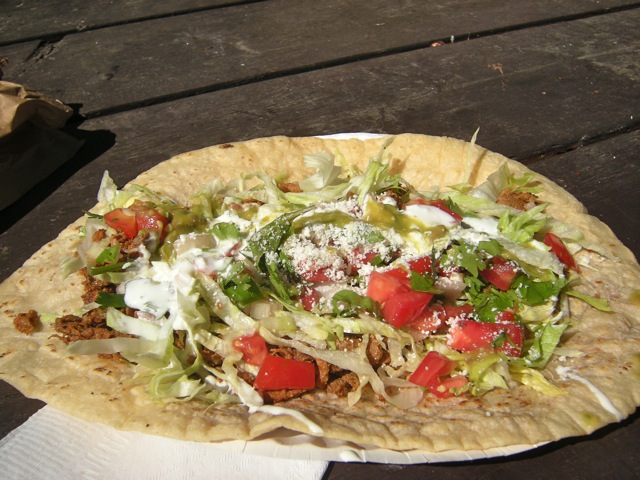
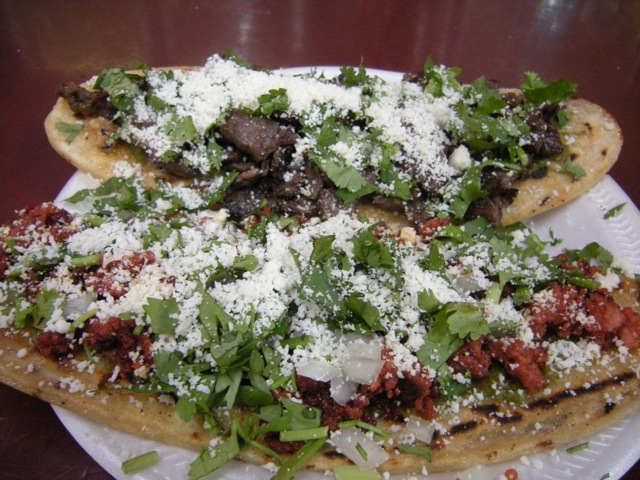
Thanks to Anne’s comment on the  papalo blog she sent me on the right track to find out more about huaraches. No wonder I couldn’t find any info I had the name wrong! I had understood guarachas. Anyhow I decided to depend my investigation and took a stroll to Guerrero Food Center in  Brooklyn Greenwood Heights where I had read they had good ones. They offer 3 kinds of Huaraches Regulares: cecina —marinated salted sliced pork; enchilada &  chorizo . I had a cecina and a chorizo. Overall taste was very salty, I ended up leaving some of the meat but finishing the thick and tasty bean filled  tortilla. The were topped with cilantro, and not papalo. Definitely not as good as the one I had  at the Poughkeepsie flee market.

Señora Carmen Gomez

According to the website of the Mexico city restaurant El Huarache Azteca the preparation was the creation of Señora Carmen Gomez. They also indicate that:
“luarache”, comes from the language of the Tarasco area where “cuarache” means sandal” (see original here)

And Jack Kerouac wore them while on the road:

I looked like a maniac, of course, with my hair all wet, my shoes sopping. My shoes, damn fool that I am, were Mexican huaraches, plantlike sieves not fit for the rainy night of America and the raw road night. (Jack Kerouac in On the Road, 1957)

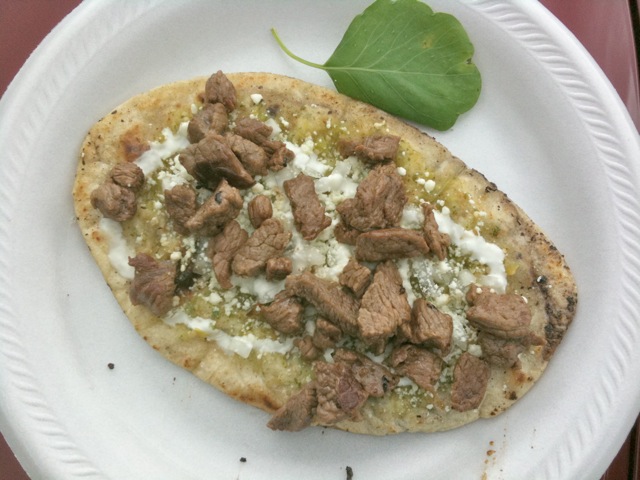
I am not as enthusiastic —or lucky, as the Village Voice about the huaraches of the  Guerrero Food Center . The one I ate (picture on top) were very salty and totally lacking “zestiness and sharpness”.  The Upstate huaraches had all these qualities and more…
My New-York huaraches investigation would be totally incomplete without paying a visit to the  famous Redhook park vendors. Redhook park is a great place to go hang out on week ends. Soccer on one side, baseball on the other & Latino food vendors all around! You can pick from Mexican, Guatemalan, Salvadorian, Chilean delicacies
, but go see for yourself I might forget some.

Red Hook Huaraches

Only one vendor was featuring huaraches. We got a pork one with all the works. Instead of the oblong sandal shape thick bean filled tortilla, this one was roundish and rather thin. The overall taste was satisfying despite the meat a bit dry, not enough salsa on the bottom —we  added some on top. The veggies were crisp. I could have used a little more cotijo cheese. The winner is definitely the Poughkeepsie flea market huaraches vendor. From what I have seen so far  it doesn’t look like papalo is commonly served  with huaraches but this is the way I am going to make mine.  Stay tune for my Pyreneen sandals!

Papalo Scallops & Corn

Papalo Scallops & Corn

scalopscornpapalo

When Miles (my younger son) came into the kitchen and asked quite intrigued: “What is that smell?” I pointed to the Papalo bunch sitting next to the sink.

Papalo is a native South American plant, also known as Papaloquite or porophyllum ruderale or macrocephalum. Its name comes from papalotl, —butterfly in Nahuatl and interesting (to me) in French butterfly is papillon!— The first time I encountered papalo was at a flea market Upstate New-York. A Mexican vendor was getting ready to sell Guarachas*—a dish I wouldn’t mind getting more info on. The women were setting up while the men were all sitting down having lunch. I noticed them picking leaves from the middle of the table and eating little bites with their grilled meat and tortillas.

guaracha

I ordered a Guaracha, I had to ask for the leaves as I wasn’t automatically given some. The lady was a bit surprised as she explained — nicely — that gringos didn’t usually care much for it. She was delighted I would try it as it was the way to eat this dish. It was love at “first bite!”; the grilled meat seasoned with lime, the green salsa, the Mexican cheese all topping a homemade corn tortilla —that looked to have had some beans worked into the dough, and the little bite of papalo to make it a truly “gastrorgasmic” moment. Papalo’s taste is condensed, pungent and close to be an entrancing flavor. It must be used appropriately and parsimoniously.

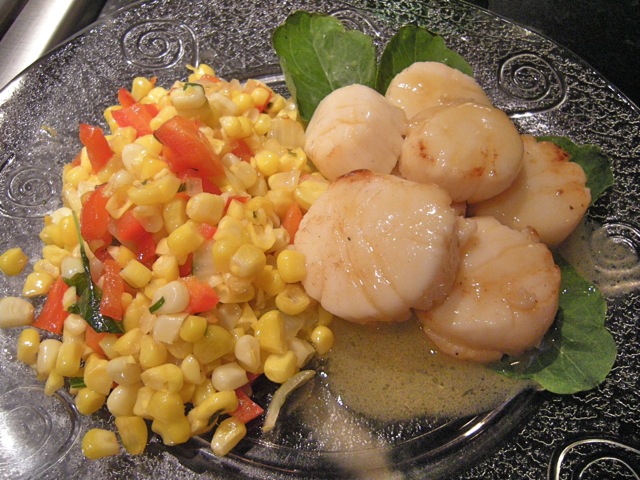
Harold from Carral FarmA few weeks ago I got some papalo from Harold, owner of Carral Farm and a regular vendor at the Bay Ridge Greenmarket. He also gave me some suggestion on how to use it and recommended to also get some  Anaheim peppers. I picked up a pound of fresh scallops at American Seafood (read previous blog on scallops here and here). And this is the recipe I will share with you today:

Scallops With Sautéed Corn and Papalo (for 3)

cornpepperpapalo

1 lb of fresh scallops
2 Tablespoon unsalted butter
1 lime juice
kernels of 2 fresh ears of corn
1/4 cup red bell peppers
1/4 cup sweet onions
1/8 cup green Anaheim peppers
9 leaves of fresh papalo
2 Tbsp brandy or Lillet
1 dollop butter at room temperature

Heat 1 Tbsp of olive oil and 1 Tbsp of butter in a stainless still or cast iron frying pan.

scallops

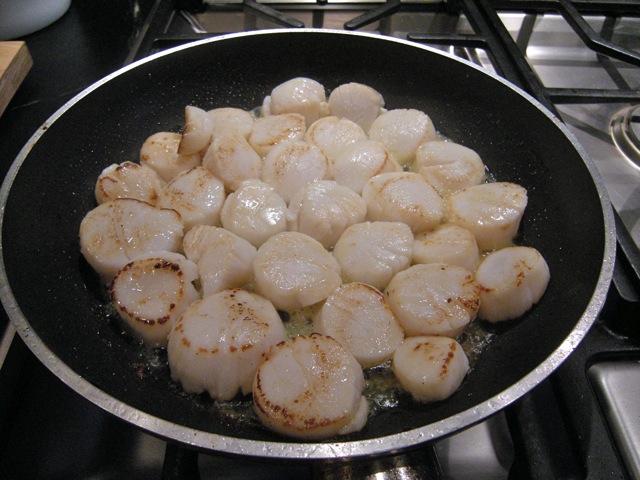
Sear scallops delicately  in the pan or about 3 minutes or so per side —it will depend how thick they are. Do not overcook them. Keep them warm between two plates and reserve until ready to serve.

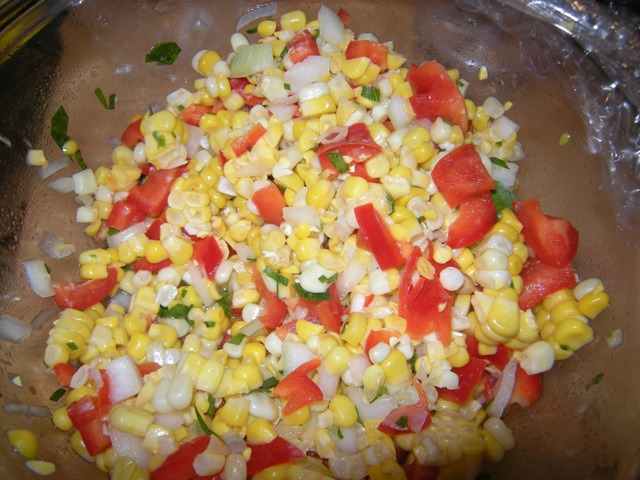
While the scallops are cooking, sautée all the vegetables (with only 3 leaves of papalo chopped) lightly with olive oil or/and butter (see picture above to see size of veggies).

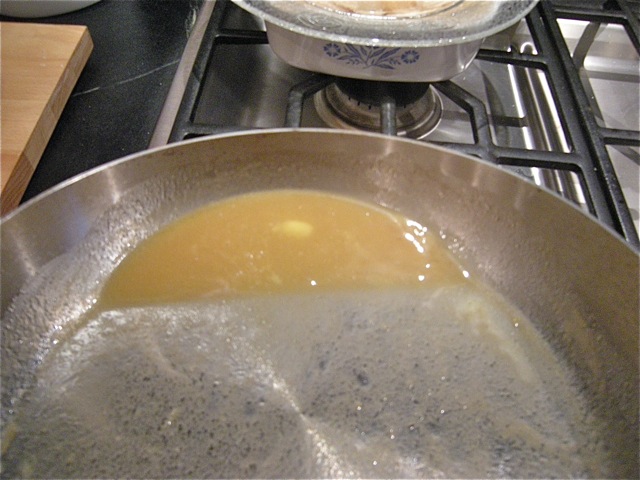
Déglaze the pan with some brandy or Lillet.  Add lime juice  and retrieve all the juice that have deposited in the scallop plate.

monter sauce

Add a dollop of soft butter and when only ready to serve  “monter la sauce au beurre” —that is to swirl in, until completely melted, a dollop of room temperature unsalted butter; it will give your sauce a velvety texture and a rich flavor. We have done it before, right? Add salt & pepper to taste and voilà!

*The guaraches turned out to be huaraches. See comments below and huraches blog.

Lost in Pepper!

Lost in Pepper!

Mushroom Salad

All I wanted to do was post a quick recipe for Labor Day:
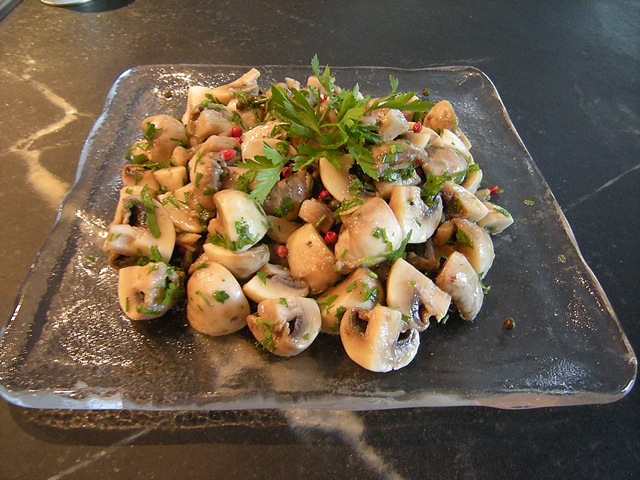
A raw mushroom salad marinated with pink & green peppercorns. Little did I know! I took the photo a week ago, the ‘shrooms are long gone but I am still marinating in pepper!

pink peppercorn

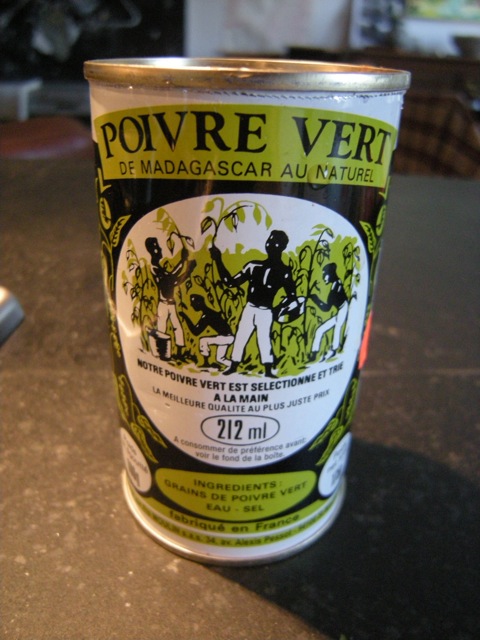
First, I confirmed that green pepper is the unripe Piper nigrum or black pepper that is mostly cultivated in Madagascar. Then I looked into pink peppercorn Schinus terebinthifolius: a faux poivre – a fake pepper. Originally from South America the Baies Roses plant is today cultivated on Reunion Island. And the last thing I was going to look into the “Dictionnaire Universel de Cuisine et d’Hygiène Alimentaire” by J. Favre — & there (re)appears the fascinating Monsieur Pierre Poivre.  Oui! le poivre, pepper in French, was named after Pierre Poivre.  In English that would be Mr. Peter Pepper. He was also known as Peter Piper or le missionaire des épices — the missionary of spices!

Pierre Poivre

Pierre Poivre was born in Lyon (France) in 1719 (where he also died in 1786). After studying botany and Latin he was sent to Paris to enter the Seminaire des Missions Etrangères (Foreign Mission Seminary) to become a priest. He thought his vocation was to evangelize the Far East —little did he know.  Before getting ordained he was sent on an initiatory voyage to China. The trip was more than eventful: it coincided with the Jesuits been kicked out of the country. He was arrested & sent to prison. In order to plead his case he learned Chinese. He was brilliant and officials ended up granting him permission to visit the country.  His taste for adventure put a serious damper to his religious vocation. He visited many places among them Cochin China (Vietnam), Macau, Canton and was totally fascinated by their botany, agriculture and commerce. In 1745 he had to return to France to get ordained but fate struck again. The English attacked the ship he was on, a cannonball hit his wrist and amputation of his forearm was inevitable once he landed on Batavia Island (Indonesia) where the Dutch helped him out. That ended his priesthood carrier and more sadly his painting carrier —though I haven’t yet found any samples of his work, he had the reputation of being an excellent painter. While recovering on Batavia Island, he studied the native plants and the idea came to him that the French should grow their own spices in order to bypass the Dutch monopoly.

Bourbon Islands

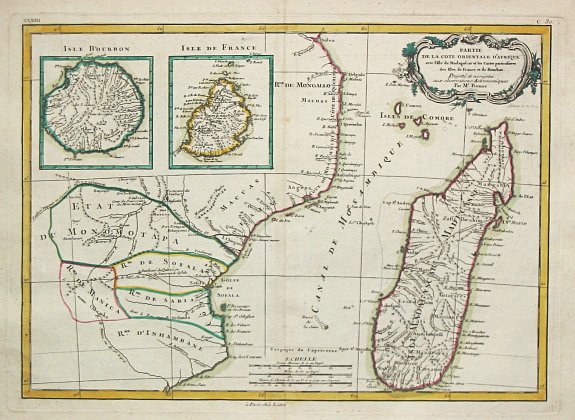
And that’s exactly what he did in 1767 when he became Intendant  des Isles de France et de Bourbon — the French colonies situated in the Indian Ocean south of Madagascar today called Mauritius & Réunion. One of his claims to fame was to transfer spice trees from the Dutch Indies (pepper, nutmeg, cinnamon, clove and many others) to the French colonies. Pierre Poivre was associated with the physiocrats (physis, nature, kratein, rule). The physiocrats are regarded as proto-French revolutionaries; they proposed to benefit agriculture by implementing a system of economic freedom. Poivre was against slavery and he is considered one of the first environmentalists who created and implemented the first environmental laws. Fear of climate change was already a concern and linked to deforestation. If you want to know more about the historic of environmental concerns read this Harvard Seminar on Environmental Values by Professor Richard H. Grove here.
Pierre Poivre married Françoise Robin, who was about 30 years younger than he,  and they had two daughters. It is interesting to note that nine years after Pierre Poivre passed away, Françoise Robin Poivre remarried Pierre Samuel du Pont de Nemours, who was the one who coined the term physiocrat —The du Pont family fled France for the USA during the revolution where Éleuthère Irenée du Pont, her second husband’s son, established the gunpowder manufacturer E.I. du Pont de Nemours & Company. Today Dupont is the second largest chemical company in the world.
Pierre Poivre's Book

Pierre Poivre wrote an extensive memoir:  “Voyage d’un philosophe ou Observations sur les moeurs ou les arts des peuples d’Afriques, de l’Asie et de l’Amérique” filled with acute observations, pertinent information and political & naturalist perspectives. As I stated above, Poivre is still regarded today as the avant-garde of environmentalism and his texts are still studied  —see Richard H. Grove article for more details.
In 1984 I visited Les Jardins de Pamplemouse on Mauritius Island.
Since then the garden that was constructed by Pierre Poivre was renamed SSR Botanical Garden. I remember the visit fondly, though at that time I had more scattered interests and didn’t pay enough attention.  I should still have pictures and recipe somewhere in storage and am tempted to go dig them out, even if they belong to a segment of my “romantic” life I don’t care much revisiting.
T
o be continued? Will see!

Meanwhile there is the recipe that you can adjust to your own taste:

green peppercorn1 lb of very fresh button/white mushrooms

1 lemon (juice)
1/2 cup extra virgin olive oil
2 teaspoon pink peppercorns
2 teaspoon green peppercorns
—dry or in can. If you use the canned ones you can add 1 teaspo0n of the vinegar they marinate in.
1/2 cup roughly chopped parsley
Salt & ….pepper? just a dash!

Prepare your marinade with all ingredients except the parsley.
Clean & cut the mushrooms in quarters (top only, use bottom in a sauce.)
Toss the mushrooms  in the marinade.
Save in the fridge for up to 48 hours.
Toss in parsley before serving.
Garnish with a sprig of parsley and a few pink peppercorns

Sax, Soup, Poetry & Voice

Sax, Soup, Poetry & Voice

SaxSoupPoetryVoice

THE DVD IS  OUT!
On November 7, 2007, Joe Girardullo, Pierre Joris & myself had molto fun presenting Sax, Soup, Poetry & Voice a multimedia performance at the The Sanctuary for Independent Media in Troy N.Y. The original description of the show was:

A Harvest Celebration with multimedia artist Nicole Peyrafitte, saxophonist Joe Giardullo & poet Pierre Joris. The trio will celebrate, harvest, and gather together non linear momentum through their music, poetry, voice, visuals and yes, a soup! Nicole, who recently moved to Brooklyn, will cook an “Inner-State” soup that will be shared with the audience.

The quality of this recording is stunning. They made us look and sound really good! & you ou can almost taste the “Inner State Soup!”

This DVD series is not a commercial venture and The Sanctuary for Independent Media is eager to have it distributed widely. For that reason we offer it through Ta’wil Productions store for a modest $5 to cover shipping and handling. Spread the word & the DVD!

Please view video sample here

This DVD is part of a prestigious series (see below), however at this point we are only able to offer our DVD.
Our deepest thanks to the producers, crew & volunteers of the Sanctuary.

A Message from The Sanctuary of Independent Media:

Free Jazz from the Sanctuary Launched!
A 13-part series of jazz performance videos featuring some of the world’s most talented improvisers, recorded live in concert at The Sanctuary for Independent Media, is now available online–just click the links below! Each show is (or soon will be) available on DVD; details are available under each band entry.

The Free Jazz from the Sanctuary series will soon be available for non-commercial broadcast distribution.
Contact us
for more information!

The Thirteenth Assembly
(Taylor Ho Bynum, Tomas Fujiwara, Mary Halvorson, Jessica Pavone)
Ethnic Heritage Ensemble
(Kahil El’Zabar, Ernest Dawkins, Corey Wilkes)
Fay Victor Ensemble
(Ken Filiano, Anders Nilsson, Michael TA Thompson, Fay Victor)
From Between Trio
(Michel Doneda, Tatsuya Nakatani, Jack Wright)
Michael Vlatkovich Quartet
(Christopher Garcia, Jonathan Golove, David Mott, Michael Vlatkovich)
Sax Soup Poetry and Voice
(Joe Giardullo, Pierre Joris, Nicole Peyrafitte)
Trio Tarana
(Sam Bardfeld, Ravish Momin, Brian Prunka)
The Ras Ensemble
(Clif Jackson, Dave Miller, Ras Moshe, Tor Yochai Snyder)
William Hooker
Empty Cage Quartet
(Ivan Johnson, Paul Kikuchi, Jason Mears, Kris Tiner)
Weasel Walter Trio
(Peter Evans, Mary Halvorson, Weasel Walter)
Splatto Festival Chorus
(Dave Barrett, Michael Bisio, Ed Mann, Todd Reynolds)
Amiri Baraka and Rob Brown

Free Jazz from the Sanctuary is a co-production of NY Media Alliance and the Arts Department at Rensselaer, made possible in part with support from the NYS Council on the Arts and the NYS Music Fund, established by the NYS Attorney General at Rockefeller Philanthropy Advisers.

Photographs of the show: Sax, Soup, Poetry & Voice  by Jon Flanders (11/07/07)

1 … 34 35 36 37 38 … 63