I Say Poubeau Cheeese!

I Say Poubeau Cheeese!

Poubeau Cheese

While in the Pyrenees, Miles Joris-Peyrafitte (my younger son) and I have two gigs at the mountain resort of Peyragudes. Our first one was last Thursday and the next one is this coming  Thursday (08/13/09). Peyragudes is located at the top of the Peyresourde pass (If you follow the Tour de France bike race you might have seen this breathtaking valley on TV, the pass has been part of the race since 1910).
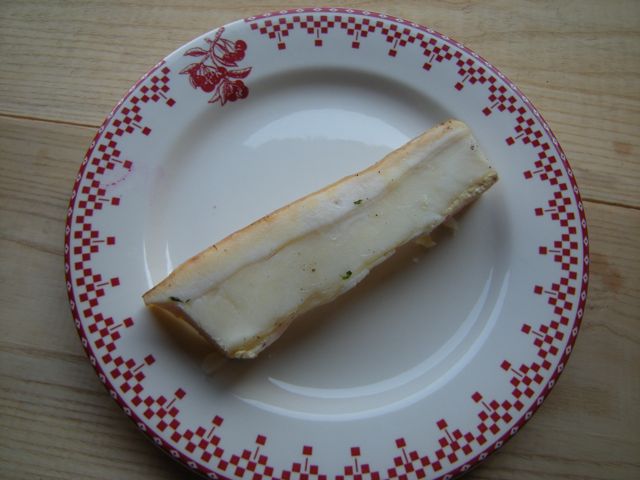
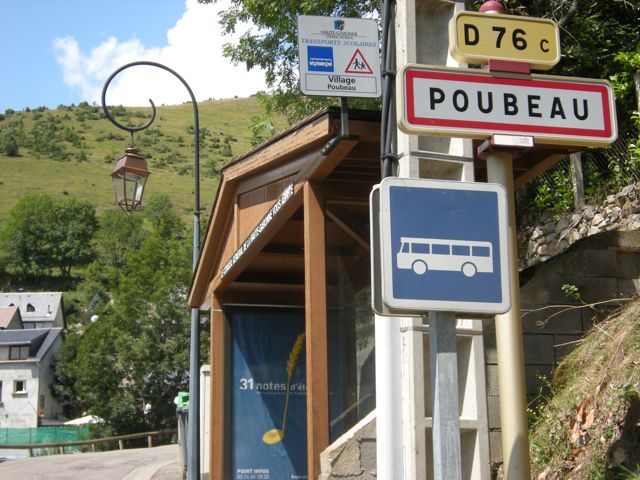
When we drove up for tech rehearsal Miles noticed a road sign pointing to “Poubeau”. He asked me if this village was related to the Poubeau cheese. “Yes Miles! and if we have time we should stop on our way down” I replied. Thanks to my brother Jean-Louis’ efficiency our session was smooth and short and we could stop in Poubeau on the way down.
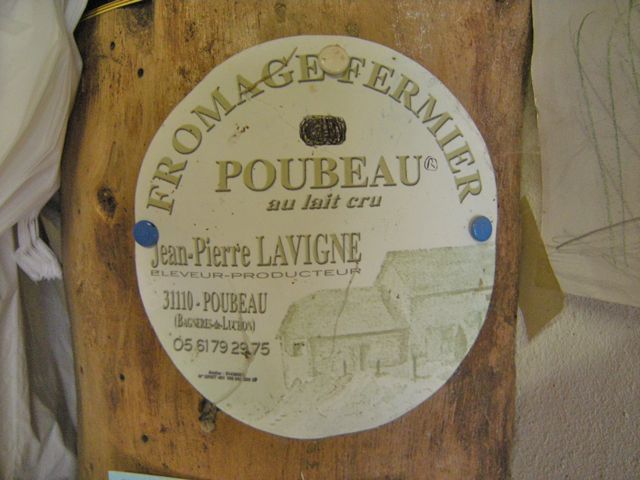
entree poubeauEtiquette


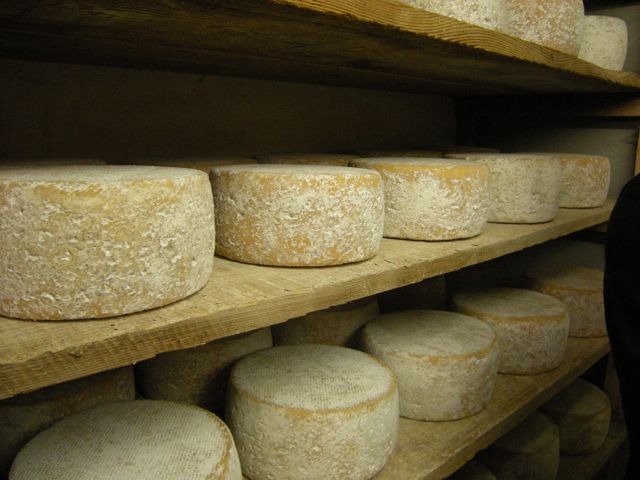
It was rush hour at the farm, the cows had been milked and many customers where lined up for fresh milk and cheese. Jean-Pierre Lavigne, the cheese maker with whom I was good friends when we were young, recognized me immediately and greeted me very warmly. We waited patiently for our turn while being entertained by the banter between Jean-Pierre and the customers. When our turn came we were brought to the cave to taste and pick our cheese. Jean-Pierre apologized for the lack of older cheese: “I got burglarized this winter and lost a lot of cheeses, so there is no way I can give you anything too aged, but this one should be good”. We got one wheel of cheese and 1½ liter of fresh milk. I promised Jean-Pierre that I would return before my departure to take more pictures and chat a little. On the way down Miles started drinking the milk out of the bottle and then asked:
“Is there another place where they make Poubeau cheese?”
“No, why do you ask?”
“You guys talk so much about this cheese that it is hard to believe it all comes from here!”
Miles grew up with the Poubeau cheese mythology. One year my mother managed to fool the US customs and sent an entire wheel through the mail for Christmas – that was before September 11th 2001. Another year our friend Eric Paul, then in charge of the dairy section at the Albany Food Coop, was determined to import Poubeau cheese.  A cheese distributor assured him he could get him some. Twice Eric called to urge me to come to the coop; the shipment had arrived and I should be the first tasting the Poubeau cheese. Sadly I had twice to tell him that it was not Poubeau cheese but a generic pasteurized Pyrenean cheese that was not remotely close to the Poubeau.
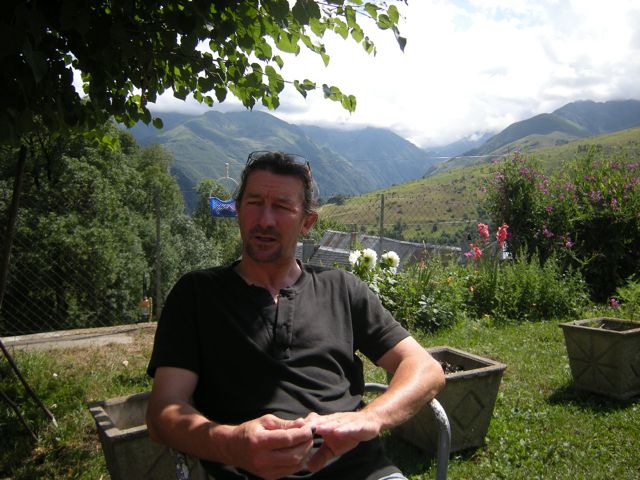
Jean Pierre Lavigne


I told the story to Jean-Pierre and he confirmed that there is no way his cheese could travel overseas via a distributor. As a matter of fact, he is not allowed to sell his cheese beyond a 80 kms radius. He went on to explain that his operation functions with a special dispensation. His mode of fabrication doesn’t comply with all the super cumbersome European Union norms. He sells about 1700 cheeses a year, mostly at the farm. He has 2 retailers in the town of Luchon and a couple of restaurants in the area.
Jean-Pierre minds a herd of 14 Brown cows and makes cheese every other day, he has one helper coming a few hours a day and hopes to be able to take one day a week off, once Gabriel –the new helper- is trained.

In winter, when the cows are stabled for most of the day, he supplements his income working at the Peyragudes ski resort. He works has a ski patrol/rescuer and loves the change of pace and action on the slopes. When Pierre and I went back to take pictures and talk to him I should have asked more practical question on how to make the cheese but we started reminiscing about the past and Jean-Pierre’s loved sharing his salsa dancing passion. One of thing we discussed though was that due to the lack of land available in the area, he had to buy land 70 kms away to be able to make enough hay to feed the cows in winter. The land that could be available for farming is slowly being taken over by the more lucrative business of tourism and second homes.  In order to buy the land mentioned above he went to see his banker to get a loan. The banker was being very demanding in terms of guarantees. Jean-Pierre appropriately pointed out to him that if he would walk right into a car dealer’s lot he would get instant credit to buy a 30 000 euro car (same amount of the loan he needed to purchase the land). How come he could get a car in one afternoon and not get land to feed his cows? It is not an easy life to be a farmer anywhere, but it sounds like the European system is applying a lot of the agri-biz policies the U.S is trying to recover from. One hope though is that José Bové was recently elected at the European parliament and is working on agricultural issues.
We returned to the valley with another cheese and left Jean-Pierre with his beautiful children who had been serving us the most beautiful pretend-food throughout our stay. If you want to taste Poubeau cheese you will have to visit the area, however Pierre and I  tried to describe it:
A fresh and clean cow milk taste, with a complex nutty undertone. The texture is supple and subtle. The rind is not too thick and I always eat it —I like tasting the mold of the aging layers.
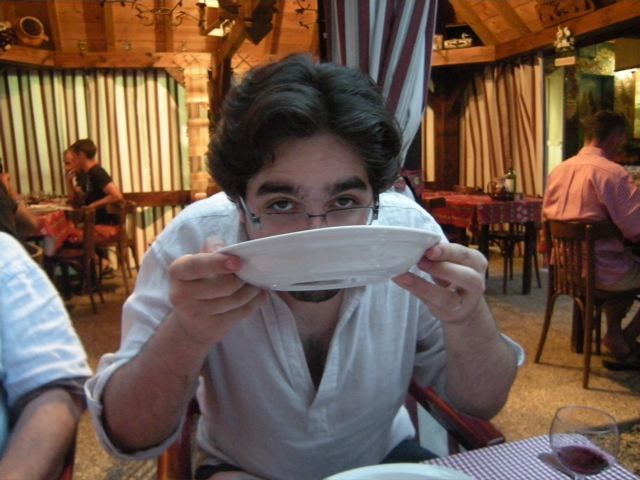
Chabro or Drunken Broth

Chabro or Drunken Broth

DSCN3651

Faire chabro is an ancient custom that is still very much in practice in the Southwest of France. It consists in adding about 1/3 of a glass of red wine to your soup plate once you have eaten two thirds of your broth. The proportions are very subjective to your taste, however you need to know that it would be totally unappropriate to pour your full glass of wine into the full plate of soup! Chabro needs, and is best with, a pungent broth. It is divine with the broth of a pot roast, a poule au pot, a strong consommé or a garburo. It is very important to drink it the way it is demonstrated by my older son Joseph (above) and my husband Pierre Joris, (below) — that is, to sip directly from the plate.
Frederic Mistral gives a Latin origin to the expression faire chabro. It would come from  cabroù (goat in provencal) derived from the Latin capreolus and would mean: to drink like a goat. In our family we always observe this tradition but only when the broth is  worth it and no matter where we are.

This specific occasion occurred at the excellent traditional hotel-restaurant La Rencluse is Saint-Mamet, where their broth (and food in general) is always outstanding. Jean-Marc and Françoise Chaléon are long time friends and very dedicated hoteliers-restaurateurs. Jean-Marc’s father, Pierrot Chaléon, had also apprenticed with my grandfather Joseph Peyrafitte. To this day there is still some reminiscing tastes of my grandfather’s recipes. I usually make several visit to their restaurant and mostly eat the menu du jour. It is a great deal and always good. Joseph and Yoori had some of the à la carte dishes. Yoori loved her escargots and Joseph the smoked salmon oeuf cocotte. Enjoy the pix and if you come to visit la Rencluse tell them Nicole sent you! I urge you to try to faire chabro if you haven’t already. Ah! & one more thing: it is very important to add one, or two, twists of fresh ground pepper before sipping it.


Beans & Saint

Beans & Saint

DSCN4030

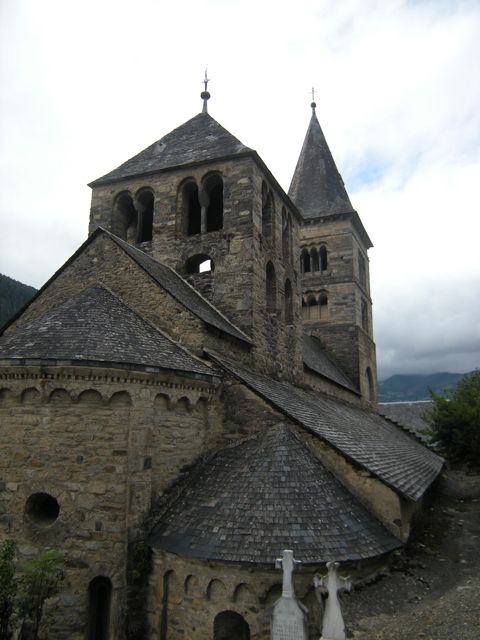
A little culture before briefing you on more food extravaganzas. We are getting ready to go to Pierre Joris’ induction into the “Ordre Pacifique et Souverain de Tastos Mounjetos” or in short: The Pacific Order of the Bean Eaters! My father is a founding member and I was inducted in  1992. This year I will be the godmother of Mr. Brunet who is a scholar in local history. We will certainly report more on the event; meanwhile enjoy the beautiful engraving of a Romanesque gem. The induction starts with a parade in the streets of the town at 4PM and is followed by a banquet attended by more that 300 people. For sure we will eat the “Pistache” — a bean stew with mutton and fresh porc rind.

This is one of the most beautiful Romanesque Churches (11th – 12th cent.) of the Central Pyrenees. It is situated in the village of Saint Aventin about 7 kms west of Luchon on the road going towards the Col de Peyresourde that you might remember if you follow the Tour de France.

There is a version of the legend:
Saint Aventin was an 8th century hermit who had been imprisoned by the Sarrasin invaders in the tower of Castel-Blancat situated on the facing slope of the valley. He freed himself and jumped over the valley to land on the site where the church is established today. He was recaptured and this time decapitated. He picked up his head and walked to the place where is tomb is said to be today. His cult is also celebrated on the Spanish side of the Pyrenées.

Pyrenean Fast Food!

Pyrenean Fast Food!

DSCN4004

The other evening we fell into an aperitif trapère! We stopped at our favorite local bar-restaurant “Le Faisant Doré” to meet my brother Jean-Louis to have an apéritif (before dinner drink) before making our way back up to the montains with our good friends Peter Cockelberg and his wife Delphine Grave for dinner. The one drink turned out to be a round per person. Jean-Louis was already sitting there with his 2 good buddies, that made a total of 7!  Thanks god I was drinking small ballons de rosé & managed to skip a few. It is always one of my great pleasure to hang out with my bro, he is the funniest and the most entertaining guy. Not really a politically correctest dude, but I adore him and put up with his most salacious & sarcastic comments!

Anyhow we safely returned to the mountains and managed to cook dinner in a flash. Again, no time to wait for the fire to make enough embers to slowly cook the beautiful slab of veal from chez Jammes. I pulled out my frying pan and cooked it all on the open fire.

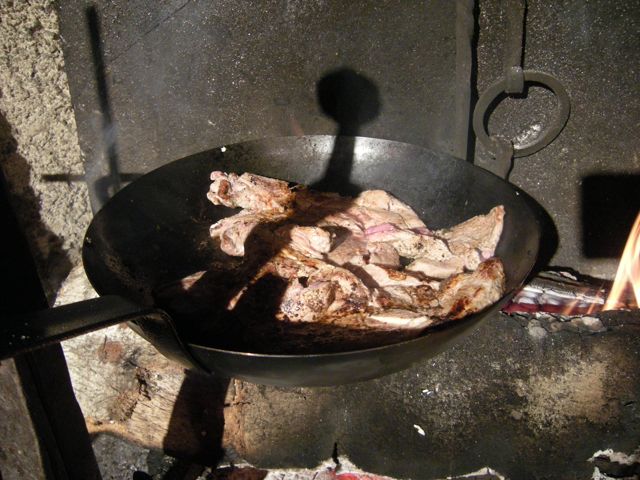
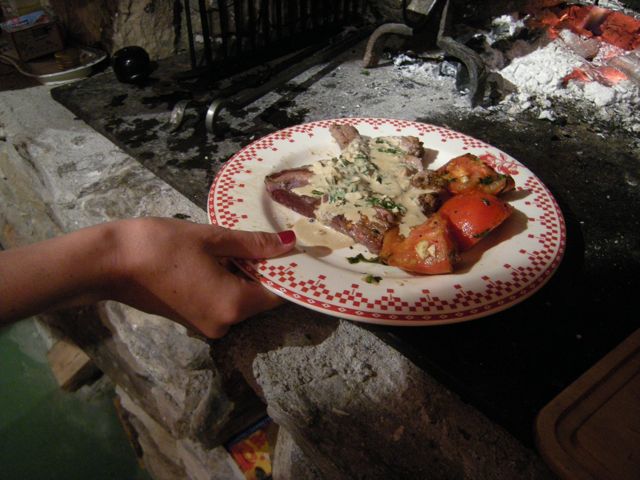
Tranche de Veau Sauce à l’Ail et au Basilic
Pan fried veal with basil & garlic cream sauce
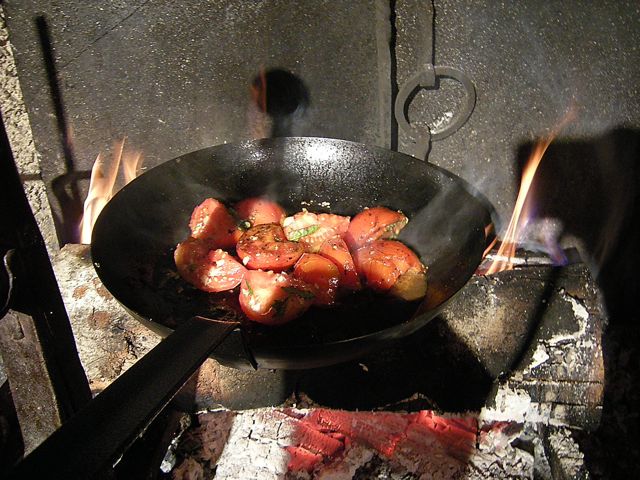
Tomates Provençales
Pan fried tomatoes with persillade

DSCN4000

Render enough fatback (see previous blog) to lightly coat the pan and cook the meat medium. Reserve and keep covered in a hollow dish.

In the same pan render a little more fatback add the tomatoes cut in half or quartered, depending on their size. Add the persillade when the tomatoes are almost done, sauté a few minutes and reserve.

DSCN4005

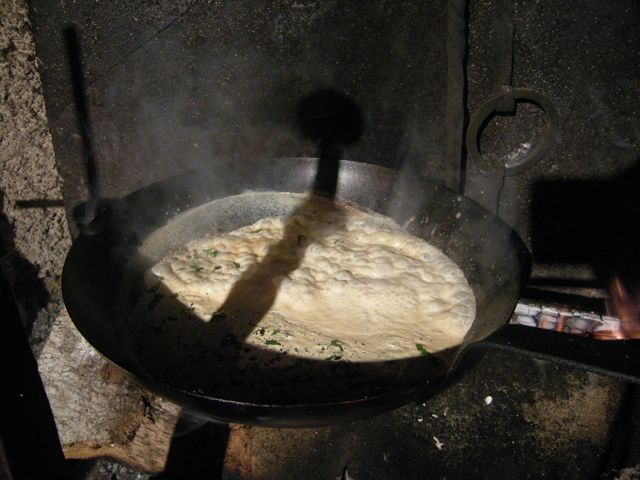
Still in the same pan, add some brandy and flambé. Add the juices that have rendered in the meat dish. Add one cup of heavy cream, the garlic and let boil on the fire. Once the cream starts thickening add the freshly (at the last minute or it will darken) chopped basil. Boil a few more seconds, add salt, pepper and some ground piment d’Espelette (see last blog). Pour the sauce over the meat and voilà! Eat and lick your plate!

Veal Tomates

Duck Hearts, Trouts, Kanoon & More

Duck Hearts, Trouts, Kanoon & More

kanoun

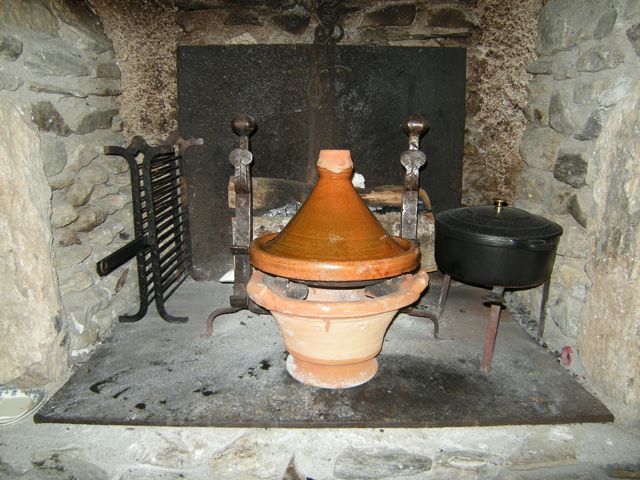
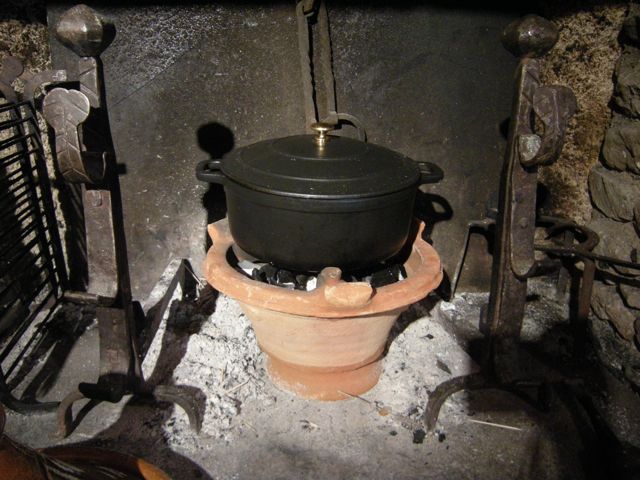
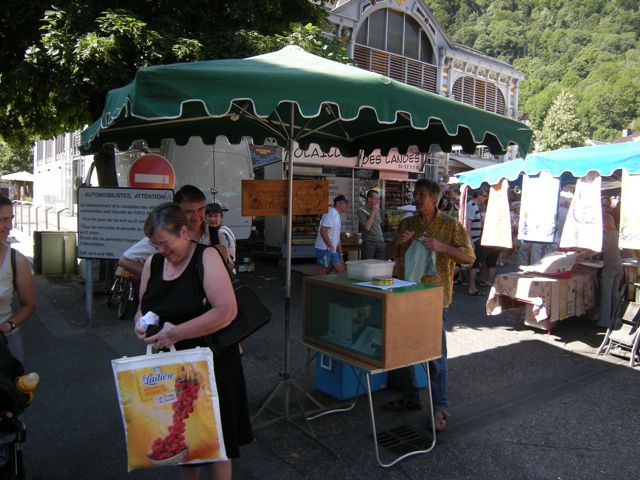
A few years back Pierre and I bought a kanoon — from the arabic:  قانون, kanoûn,  qanoûn or kanun— at a Luchon street fair. It is a North African clay brasero for cooking with charcoal. It makes great tagines and it is very convenient when we have no time to make a big fire in the fire place or when the weather is really hot.  Monday I used it to cook our entire meal that consisted of local offerings from the Luchon market:
Hors d’Oeuvres:
Hure de porc or pig’s head paté (Martial Vargas)
Paté de truite with chives (Pisciculture d’ Oô)
First Course:
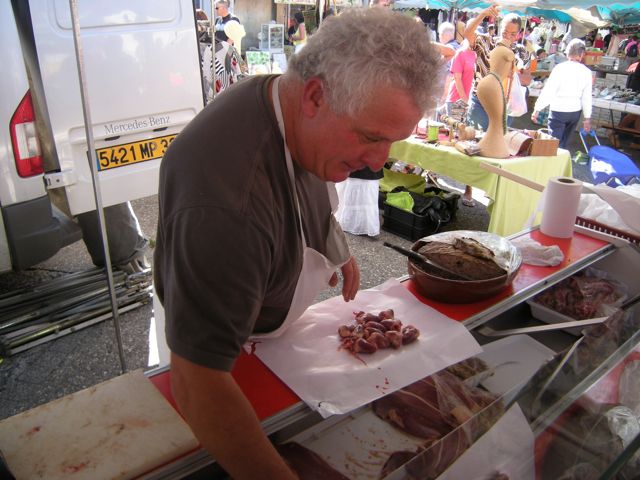
Hearts of duck salad (Lazorthes, a.k.a. “Caniche”)
Purchasing duck hearts at Mr. Lazorthes standduck hearts
DSCN3996

Main Course:
Mountain trout from the pisciculture de Oô (see last year’s post for another recipe made with these excellent trout)
DSCN3953DSCN3954
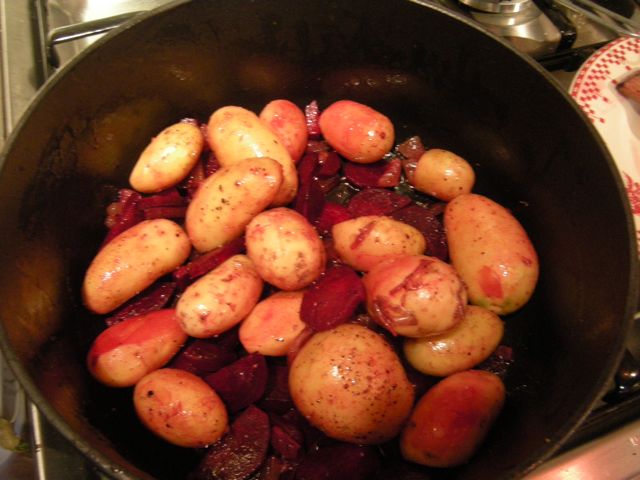
Potatoes, beets & broad beans  (Madame Fondeville)
DSCN3957on the kaloon

Cheese & Dessert:
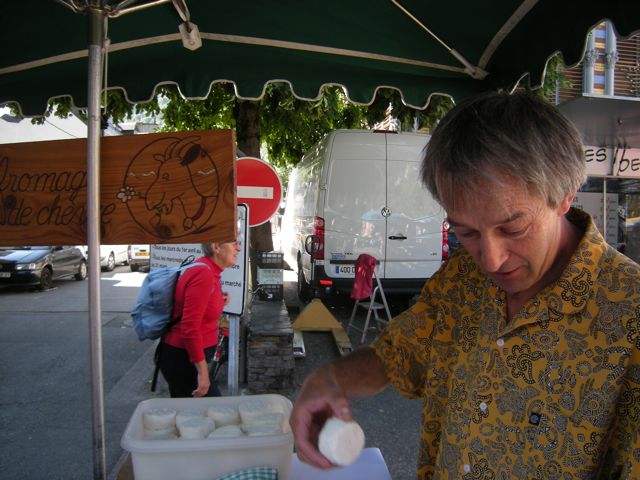
Goat cheese (Alain Garcia a.k.a  Emingo)
Mara des bois strawberries in red wine & honey
DSCN3978Alain Garcia
Pierre fired the kanoon with lots of charcoal to have enough to cook the whole meal in it.
First I cooked the veggies in a cast iron pot. Instead of using oil I used the incredibly tasty salted fatback the Jammes gave
me as a present when I went to get the lamb (see previous post).
Fat back from bourg d'oueil
I rendered half a cup of fat and added potatoes, beets, salt & lots of black pepper and set it on the kanoon for about ½ hour. I added the beans later, as they take less time. When cooked, I reserved the veggies and set them aside.
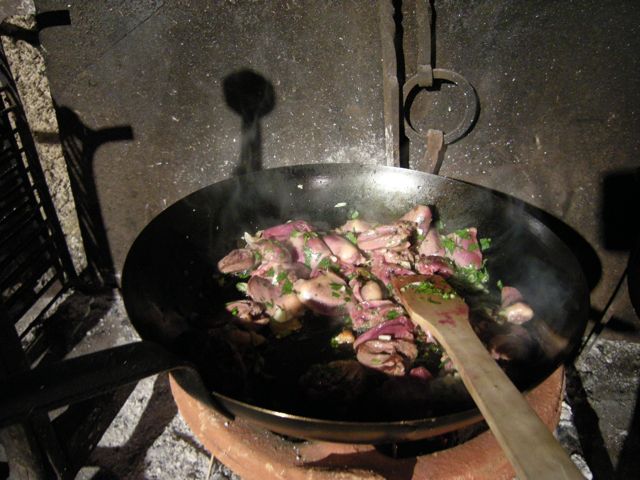
Meanwhile I had cut the duck hearts in half. These hearts where beautiful. They were bright red & so fresh. I placed my special open fire frying pan on the kanoon and again melted some fatback. Once the fat had rendered and the pan was very hot I added the hearts and fried them until cooked but still pinkish. Be careful: overcooked hearts get unpleasantly rubbery. At the end I added a generous persillade and served them warm on top of a very lightly dressed salad.
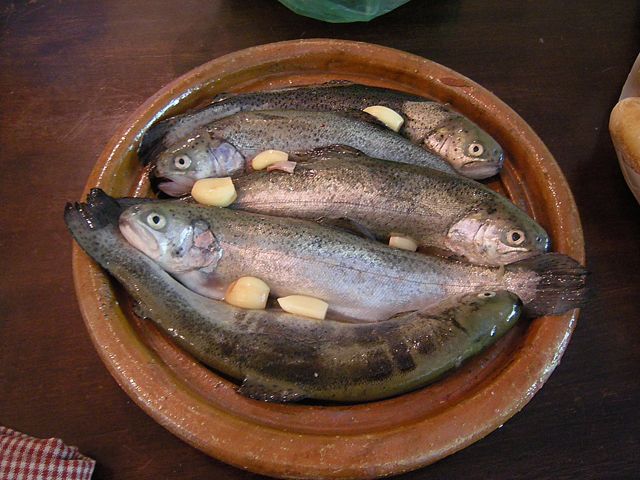
While we ate the salad I tightly fit five trouts in the tagine dish. I coated the trouts with olive oil in which I had soaked garlic cloves and added the cloves too. I topped the whole thing with “new” onions, one quartered lemon, salt and & piment d’Espelette —that is, a very popular chili that grows in the the Basque country and is fragrant and not too spicy. The trout cooked while we ate the  delicious hearts of duck salad. We waited for them a little, but who cares when the Tariquet Rosé & the conversation are flowing!
I very much like the combination of the hearty veggies and the delicate trouts, thought the trouts could have been a little spicier.
We opened the red Saint Mont wine to accompany my favorite local goat cheese made by my good friend Alain Garcia (see picture above). The dessert was a nice conclusion to our meal — sorry I didn’t take any pictures but I was too involved with the company!
Voilà! for now as I am off to visit my dad (87!) at the local physical rehab center where he just arrived after  successful complex back surgery that
will hopefully  allow him to walk better… I teased him today that if he keeps progressing as fast as he does, he might even be ready for soccer season! (before being an hotelier & a politician — mayor & senator — he was the regional star soccer player)!
More soon and thanks for following our summer adventures!

1 … 36 37 38 39 40 … 63