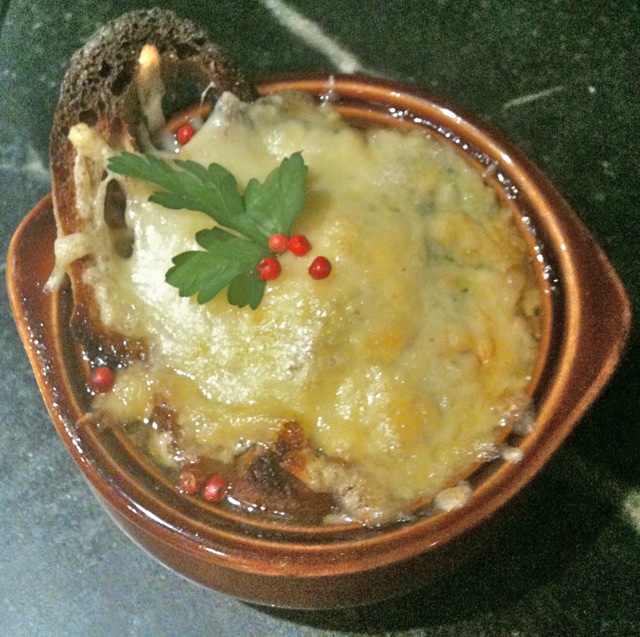
My dad always calls it a gratinée, but it is generally called une soupe à l’oignon, here in the USA it is mostly known under the name “French onion soup.” Whatever you call it, it is a delicious and incredibly restorative soup. Actually they used to serve it at my dad’s night club at the wee hours when many customers would have it to soak up the booze and line their stomach for more drinking. I used to make it on New Years eve when we had a party at the house and serve is at 1 or 2 am. It really makes a difference in the quality of your hangover — trust me!
Well, this time it was not about a hang over but about the carcass of a roasted chicken that had been picked clean of all its meat and was sitting in the fridge. I threw it in a pot, covered it with water, 1 onion, 1 carrot , 1 bouquet garni. When it came to a boil, I let it simmer for 1 hour, then strained the broth and let it cool. This type of broth can be used as a base for many soups or sauces, but tonight as we were waiting for another snow storm I was craving my onion soup. (You can substitute the homemade broth for some store bought stock & if you are vegetarian you can use an Organic Mushroom Broth)
Recipe for two:
In a soup pot melt 3 tablespoons of unsalted butter with 1 tablespoon of olive oil.
Meanwhile slice 2 large sweet onions very thin.
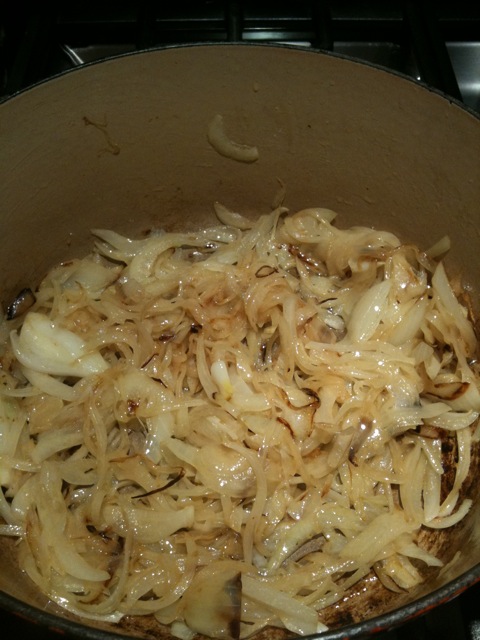
Cook the onions over moderate heat until they are golden & almost caramelized. At this point some recipes call for sprinkling a tablespoon of flour to give the soup a thicker consistency. I don’t, because I like my onion soup lighter, plus I feel that the bread that will be on top provides plenty of thickness & starch once you mix it in with the soup, but I though I’d mention it as so many recipe do.
Add about 2 1/2 cup of broth, 2 teaspoons of brandy or white wine —that is my secret!
Season with salt, fresh ground pepper and let simmer for about 1/2 hour.
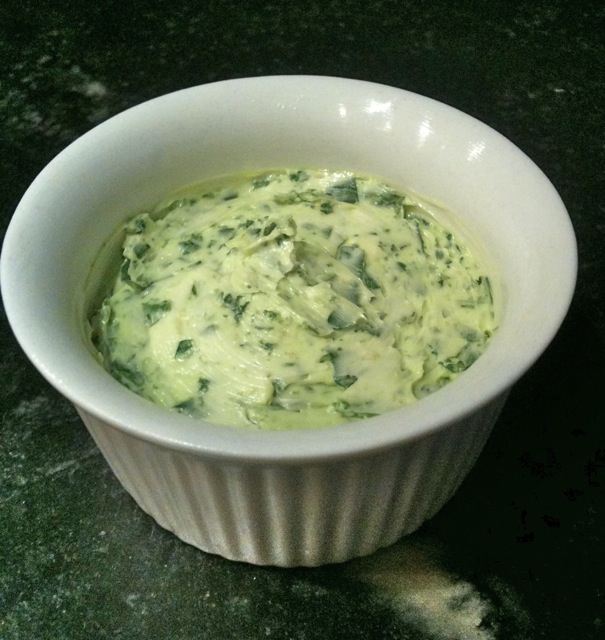
Meanwhile make parsley & garlic butter. In a food processor add 1/2 stick of butter, 2 cloves of garlic, blend well and add 1 cup of chopped parsley, mix it in for just a few seconds, do not over blend once the parsley is in. Fill a little ramekin and save in the fridge. Cut a few slices of good country french bread, butter generously with the parsley & garlic butter. Fill two individual soup tureens with the onion soup, place the buttered bread on top, & top generously with grated —in order of preference— Gruyère, Emmental or Swiss cheese. Place the bowls under the broiler until the cheese is golden and bubbly. Garnish with a few pink pepper corn and a spring of parsley and Bon Appetit!
“Pensées” Oil on Canvas- 36X40 (at the Chancelerie du Consulat de France NYC)
On Saturday December 4th, I participated to the event “Poetry-Sound-Music Intersections” at A Gathering of the Tribes organized by Chicagoan poet/trumpet Dan Godston. The performers included:
1st set: Kristin Prevallet (poetry) and Edmund Mooney (electronics)
2nd set: Nicole Peyrafitte (vocals, poetry), David Boykin (reeds), Dan Godston (trumpet).
It was a very fun gig. David and Dan created great music, I enjoyed weaving my texts through their complex and adventurous sounds. You can have the proof of the cream (no pudding here!) & listen to the first segment uploaded by Dan Godston here. Thanks to audience member and dear friend Paige Mitchell, we have a video of the event and I invite you to watch the last piece of our set at the end of this message… really, don’t miss it!
Whats cooking next? Voilà zee program for next week:
Monday, December 27 · 7:00pm – 10:00pm
Evolving Music / Evolving Voice
The Local 269
269 East Houston Street (corner of Suffolk)
New York, NY
7pm – Vocal Improv Session # 7
Nora McCarthy (voice), Andrea Wolper (voice), Nicole Peyrafitte (voice), Francois Grillot (Double Bass) 8pm – Jason Mears Group
Erika Dagnino (poetry), Steve Dalachinsky (words), Jason Mears (sax and clarinet), Ken Filliano (bass), Satoshi Takeishi (drums) 9pm – Grassroots
Darius Jones (alto sax), Alex Harding (bari sax), Sean Conly (bass), Chad Taylor (drums) 10pm – Steve Dalachinsky & Ken Filiano Duo
Steve Dalachinsky (poetry), Ken Filiano (bass)
January 1st 2011
We will wish you Happy New Year at: 37th ANNUAL NEW YEAR’S DAY MARATHON READING
This year Pierre Joris, Nicole Peyrafitte & Miles Joris-Peyrafitte will be performing as a trio. We are scheduled between 3 & 4PM.
Also, I have done for the past three years, I will be making crêpes in the back and this year I will also make a soup ! Why make it simple when it can be complicated, right! The event starts at 2PM and goes until past midnight and below is the impressive list of poets & performers:
The Poetry Project
St. Mark’s Church 131 East 10th Street
New York, NY 10003
Poets and Performers for 2011 include: John Giorno, Patti Smith, Lenny Kaye, Philip Glass, Suzanne Vega, Taylor Mead, Eric Bogosian, Anne Waldman & Ambrose Bye, Vito Acconci, Foamola, Anselm Berrigan, Ariana Reines, Peter Gizzi, Liz Willis, Ted Greenwald, Bruce Andrews & Sally Silvers, The Church of Betty, Thom Donovan, Tim Griffin, Todd Colby, Tom Savage, David Shapiro, Jonas Mekas, Josef Kaplan, Judith Malina, Albert Mobilio, Alex Abelson, Maria Mirabal, Bill Kushner, David Freeman, David Kirschenbaum, Diana Rickard, Don Yorty, Dorothea Lasky, Douglas Dunn, Alan Gilbert, Alan Licht w/ Angela Jaeger, Charles Bernstein, Christopher Stackhouse, Citizen Reno, Cliff Fyman, Corina Copp, Aaron Kiely, Adeena Karasick, Bill Zavatsky, Bob Holman, Robert Fitterman, Rodrigo Toscano, Brenda Iijima, Brendan Lorber, Brett Price, Corrine Fitzpatrick, Curtis Jensen, Dael Orlandersmith, David Vogen, Derek Kroessler, Diana Hamilton, ARTHUR’S LANDING, CAConrad, Akilah Oliver, Douglas Piccinnini, John S. Hall, Samita Sinha, Sara Wintz, Secret Orchestra with special guest Joanna Penn Cooper, Shonni Enelow, Bob Rosenthal, Brenda Coultas, John Yau, Julian T. Brolaski, Evelyn Reilly, Filip Marinovich, Douglas Rothschild, Drew Gardner, Eleni Stecopoulos, Elinor Nauen, Eve Packer, Jo Ann Wasserman, Joanna Fuhrman, Dustin Williamson, E. Tracy Grinnell, Ed Friedman, Edwin Torres, Eileen Myles, Elliott Sharp, Emily XYZ, Erica Hunt, Erica Kaufman, Evan Kennedy, Joe Elliot, Joel Lewis, Frank Sherlock, Gillian McCain, Greg Fuchs, Janet Hamill, Jeremy Hoevenaar, Jessica Fiorini, Jibade-Khalil Huffman, Jim Behrle, Julianna Barwick, Julie Patton, Michael Lydon, Lisa Jarnot, Maggie Dubris, Marcella Durand, Marty Ehrlich, Merry Fortune, Michael Cirelli, Kristen Kosmas, Laura Elrick, Lauren Russell, Leopoldine Core, Nina Freeman, Paolo Javier, Patricia Spears Jones, Paul Mills (Poez), Michael Scharf, Mike Doughty, Karen Weiser, Lewis Warsh, Linda Russo, Penny Arcade, Peter Bushyeager, Rebecca Moore, Mónica de la Torre, Murat Nemet-Nejat, Nathaniel Siegel, Nick Hallett, Nicole Peyrafitte, Pierre Joris & Miles Joris-Peyrafitte, Kathleen Miller, Katie Degentesh, Kelly Ginger, Ken Chen, Kim Lyons, Kim Rosenfield, India Radfar, Tonya Foster, Stephanie Gray, Susan Landers, Tony Towle, Tracie Morris, Valery Oisteanu, John Coletti, Rachel Levitsky, Edmund Berrigan, Jamie Townsend, Macgregor Card, Wayne Koestenbaum, Will Edmiston, Yoshiko Chuma, Nicole Wallace, Arlo Quint, Stacy Szymaszek and more T.B.A
General admission $20/Students & Seniors $15/Members $10.
And last, but not least, 4 large paintings and two framed collages are now at the Chancellerie of the French New York Consulate. If you are French and need to renew your passport or any other admin stuff you will see them. I am very grateful to our consul, Mr Philippe Lalliot, to have taken the initiative to have contemporary art instead of posters! Merci to Mr. Le Consul and merci to his team for having my work displayed in their work space where 15 000 people come through each year. I have set up a webpage for information on the paintings here.
Voilà! And now Joyeux Noël and enjoy the whipping!
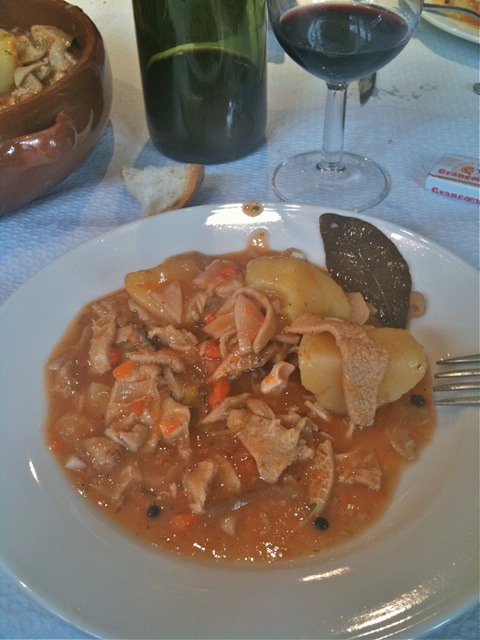
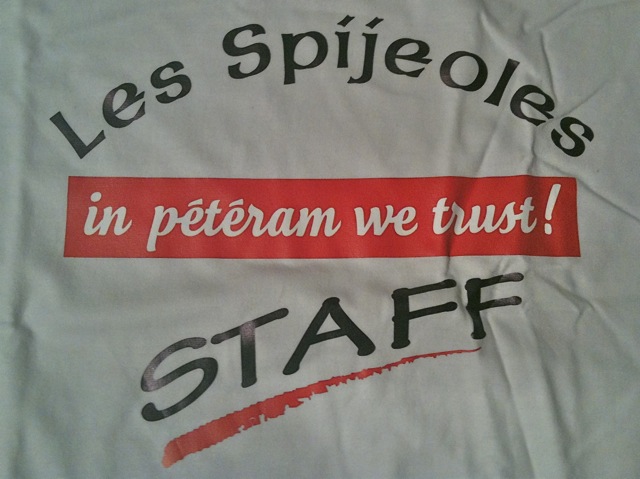
In the county of Luchon (where I was born and raised) we are really serious about Pétéram. Pétéram is an ancient localdish made froma combination of tripe (intestine & pluck), lamb & veal feet, ham, carrots & onions. During my last visit home I had to have my fix of Pétéram; so one Sunday, part of the family took off to the village of Oô, where the restaurant “Les Spigeoles” serves one of the best Pétéram. Jean-Pierre Oustalet, a friend & the chef-0wner of the establishment, is a very creative man always up to something fun. Recently he printed a series of t-shirts with the motto he coined himself: “In Peteram We Trust!”.
This summer a Flemish TV from Belgium came to film Jean-Pierre’s Pétéram for one of their shows. Though the video is in Flemish & French I urge you to watch it: Touristique: de pétéram.
Tripe dishes are cooked around the world (list here), and as we know these less desired cuts were left for the poor. It was the same for Pétéram, I don’t think it appeared on restaurant menus in Luchon until the 20th century and my family restaurant was certainly one of the first to offer it. Though I don’t know the exact etymology of the word, one can read its the humble origins through the Gascon language : petar— French translation: “crever” or in English:”to die” or “to be famished” and hame— in French “faim” or in English “hungry”. ThusPétéram can be interpreted as “a dish for the famished” or as a dish that will kill hunger! Then again this may be an invented etymology (much work remains to be done on the Gascon language, and especially certain of its regional versions, such as that spoken in the Luchonais.) On the other hand, to quote my husband, the poet Pierre Joris, “are any etymologies really ‘false’?”
I used to make Pétéram when I was working at the family restaurant (other posts related to the family hotel here) and though we received “clean” tripe from the butcher, the smell was still strong and the tripe would require extensive blanching in order to get rid of the offensive smell. I got used to it and it didn’t bother me, except this one time. In the late fall of 1981, I had to cut a big pile of intestines and honeycomb for my Pétéram and that time, for some reason I was to discover a few days later, I couldn’t bear the smell. Two days later I found out I was pregnant with my son Joseph. Throughout my pregnancy I had to stay away from tripes.
Jean Pierre Oustalet’s Pétéram is as good as it gets. He achieves the difficult task of making a tripe dish light. The texture of the tripe still firm but tender. The sauce, in which the tripe have cooked for over twelve hours, release the rich and comforting aromas of all the ingredients. The creamy potatoes that have been added late in the cooking provide the perfect starching effect. Some places serve it as a first course, though we had it as a main course. We had soup to start with, then a plate of artisan salamis & cured ham, followed by the Pétéram as the main course. Then we had a slice of delicious mountain cheese, a slice of apple pie and voilà! we sure were full and happy! Below are a few pictures of the fun outing where you can see my parents : Jean & Renée Peyrafitte ( 88 and 81 years old!) in the gorgeous village of Oô. This village is also very dear to me because I premiered my performance The Bi-Continental Chowder /La Garbure Transcontinentale there in 2005. One of the reason is that one of the main Romanesque female figures featured in the show is from the village; you can hear the song related to it here.
The recipe is a translation of the family recipe transmitted by my grandfather Joseph Peyrafitte & typed by my mother Renée Peyrafitte:
for 5/6 people:
1 lamb stomach & 6 feet 1 kg veal honeycomb & 2 feet
3 carrots whole 1 tablespoon of tomato paste
1 ham bone
1 bouquet garnis of thym, laurel & parsley 1 cup of ham prosciutto like— diced
2 onions
1/2 cup dry white wine
1 quart chicken stock
1 kg potatoes
Hachis (50 gr garlic & 50 gr fatback grounded together)
1/3 cup Armagnac
Blanch and scrape the tripes thoroughly. Cut the stomach & honeycomb in trips of about 1 x 0.5 inches. Place is all in a stew-pot with a ham bone.
Add 3 whole carrots, the bouquet garnis, 1 tablespoon of tomato paste, 1 cup of ham, 2 onions whole, salt, pepper & a touch of nutmeg. Add wine wine & chicken stock so tripes are immersed and “swimming”.
Bring it to a boil, cover the pot and let cook for 10 hours, one hour before serving add potatoes peeled and quartered.
When ready to serve add hachis and the Armagnac.
I am back from a wonderful trip to the Pyrenees and a short visit to Paris. I arrived just in time to dive into the kitchen to prepare our Thanksgiving dinner. Husband, older son & daughter in law had been very efficient on getting all the necessary ingredients. They also took charge of brining & smoking our 14 lbs organic turkey — it turned out delicious. Joseph —the older son— made the best oyster dressing he ever made for us; he has been improving the recipe we have used for a few years and I will pass it on one of these days. I will not get into all the details of our dinner as I have a few deadlines coming up, but the one thing I will share from our 2010 menu is our Three Sisters Soup. There are many ways of making this soup, and I have made it many times, but I do think this year’s version is the best so far.
First, a little light on the origin of the name. The soup is named after the Native American technique of growing maize, beans & squash together:
In one technique known as companion planting, the three crops are planted close together. Flat-topped mounds of soil are built for each cluster of crops. Each mound is about 30 cm (1 ft) high and 50 cm (20 in) wide, and several maize seeds are planted close together in the center of each mound. In parts of the Atlantic Northeast, rotten fish or eel are buried in the mound with the maize seeds, to act as additional fertilizer where the soil is poor.[1][2] When the maize is 15 cm (6 inches) tall, beans and squash are planted around the maize, alternating between beans and squash. Milpas are farms or gardens that employ companion planting on a larger scale.[3]
The three crops benefit from each other. The maize provides a structure for the beans to climb, eliminating the need for poles. The beans provide the nitrogen to the soil that the other plants utilize and the squash spreads along the ground, blocking the sunlight, which helps prevent weeds. The squash leaves act as a “living mulch“, creating a microclimate to retain moisture in the soil, and the prickly hairs of the vine deter pests. Maize lacks the amino acidslysine and tryptophan, which the body needs to make proteins and niacin, but beans contain both and therefore together they provide a balanced diet.
Native Americans throughout North America are known for growing variations of three sisters gardens. The Anasazi are known for adopting this garden design in a more xeric environment. The Tewa and other Southwest tribes often included a “fourth sister” known as “Rocky Mountain bee plant” (Cleome serrulata), which attracts bees to help pollinate the beans and squash.[4]
2009 Native American dollar reverse with Three Sisters on it
In the past I made three different soups and served them together. This year I decided to make only the back bean and the butternut squash soups and serve the corn as a garnish on top. This added a pleasant texture to the dish.
Black Bean Soup:
I had some cooked black beans in my freezer. I sauteed one diced onion, added one jalapeno, salt, and a dash of Melinda sauce (for the chipotle pepper taste), added the beans and water. Let it cook for one hour. Then I blended it with cooking liquid. The consistency should be a little thinner than a smoothie.
Butternut Squash Soup:
I peeled a butternut squash and cooked it in salted water. Meanwhile I prepared a bechamel sauce:
Melt the butter over low heat in a heavy sauce pan. Add all the flour, move away from heat and stir briskly until smooth. Add the milk & put back on the stove, stir continually with a wire whisk to prevent any lumps —this is a basic sauce that you can use for many other recipes like macaroni and cheese, or any other gratins, lasagnas etc.
Once the squash is cooked, blend it in a food processor with enough cooking liquid to obtain a thick consistency. Return to a pan and add as much bechamel as you like. Season with salt & pepper.
Corn kernels:
In a pan melt 1 tablespoon of butter. Add 2 cups of corn kernels, salt & pepper. Glaze them until golden and a little crunchy.
Keep your soups and the corn warm — I do keep everything in a chef pan double boiler mode— prepare the other garnish: cilantro, whipped cream & finely chopped jalapenos for the people who can handle it.
Once you are ready to sit down to dinner set up your plates.
1- Pour the butternut squash soup first.
2- The bean soup in the middle of the squash soup
3- Add a dolop of whipped cream, cilantro, chopped jalapeno and voilà! & bon appetit!