Coque or Gâteau à la Broche

Coque or Gâteau à la Broche

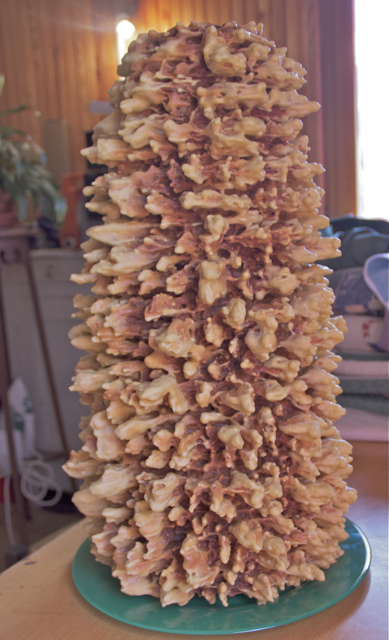
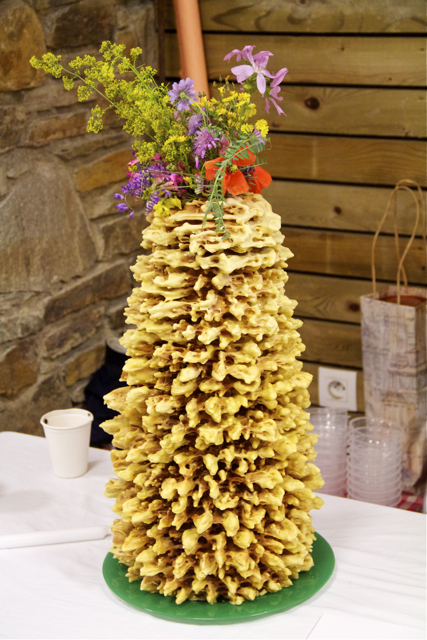
This was a dream come true. Since I was a little girl I have admired & loved this cake.  It is made for very special occasions like weddings, christenings, special birthdays or anniversaries. I found an entry for “coque” in an old Gascon dictionary that says “qu’èm invitats a la còca” meaning “we are invited to the christening.”
It takes hours to complete this cake and needless to say it is a very special present to be given one. When I spoke about Pierre’s birthday menu to my friend & neighbor Roland Jamme I couldn’t believe he offered to make one with his wife Simone. Not only were they going to make it, but I could be there the whole time! This incredible ancient cake takes over 5 hours to make and requires the constant participation of 2 people who will endure intense heat. As you will see below, someone has to sit in front of the fire at all times.
After consulting with Simone, Roland they set up the cake making date for Saturday July 9 at 8:30 am., i.e. 6 days before the party,  which would be perfect as the cake needs to age before being served.
I was instructed to show up in Garin —where Simone’s family home is— on time and with all the ingredients .

Thus I showed up very excited and armed with 72 eggs, 3 kgs of flour, 3 kgs of sugar, 3kgs of butter, 15 packed of vanilla flavored sugar, 1/2 litre of rum Negrita & a roll of parchment paper. I was finally going to see the gâteau à la broche made from scratch like it as been done for hundreds of years! So, voilà le photo-reportage of the making –and do not miss the short video. I want to thank Simone & Roland from the bottom of my heart for this incredible day.
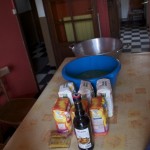
  

All the ingredients are placed on the table in order not to forget anything.
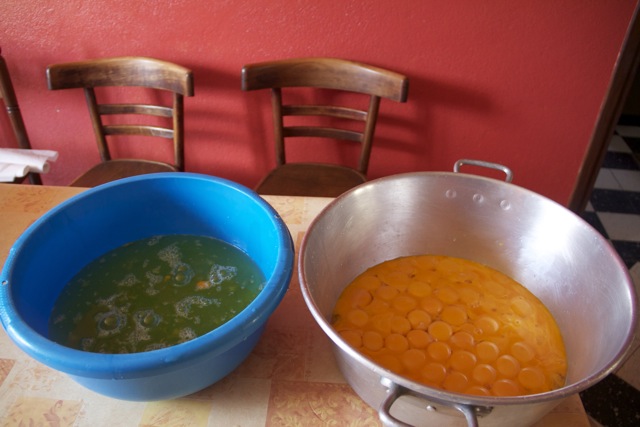
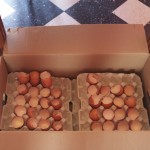
Then all the 72 super fresh eggs are carefully separated.
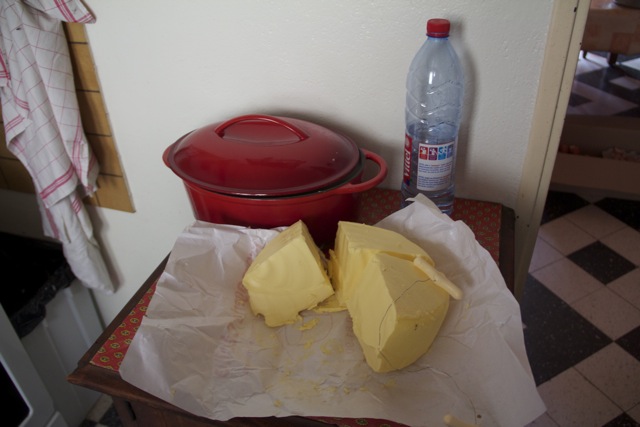
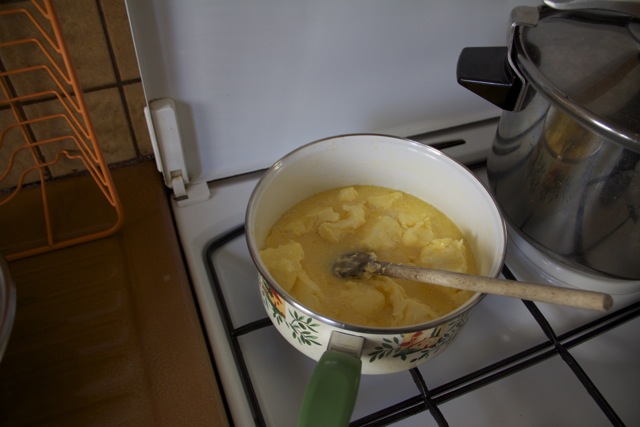
  

I was entrusted with slowly melting the butter in a pan while Roland started whipping the egg whites.
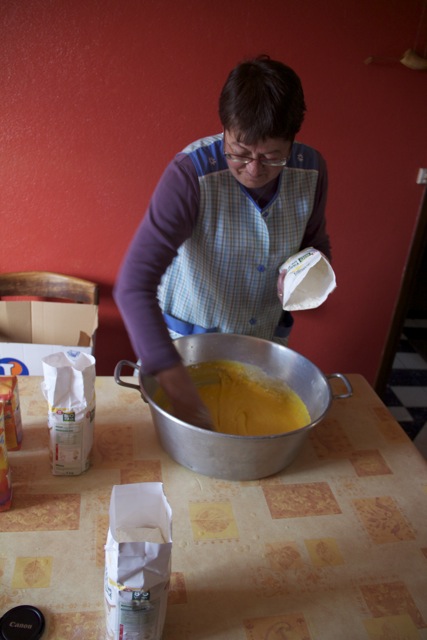
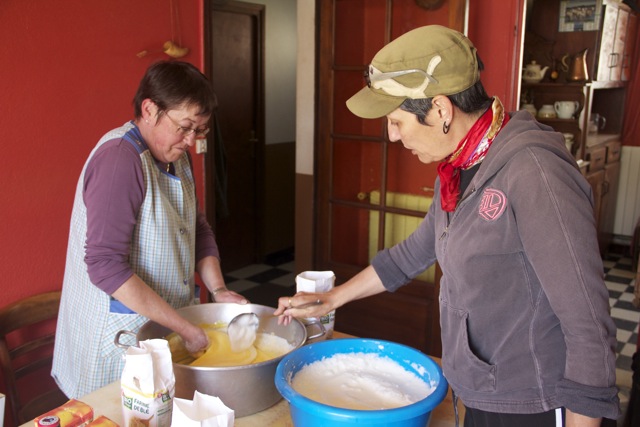
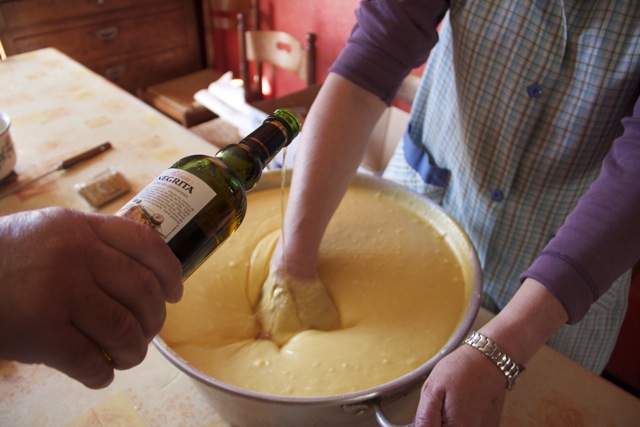
Simone hand mixes all the ingredients expertly; the rum is the last one to go in.
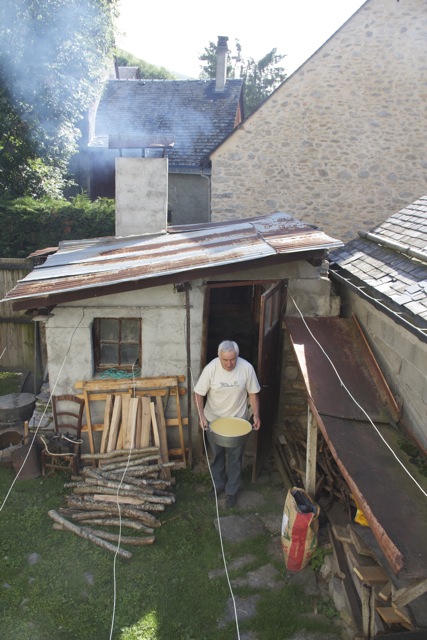
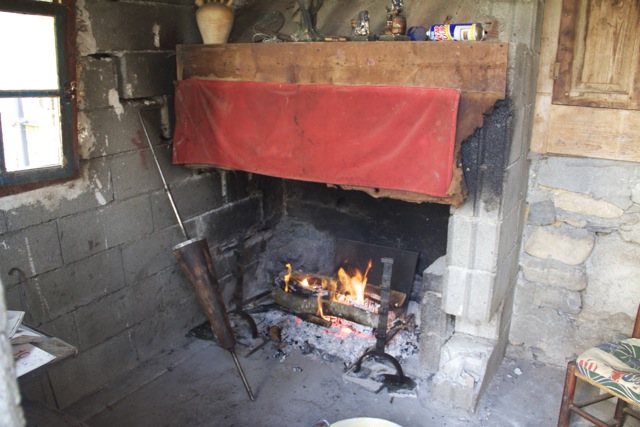
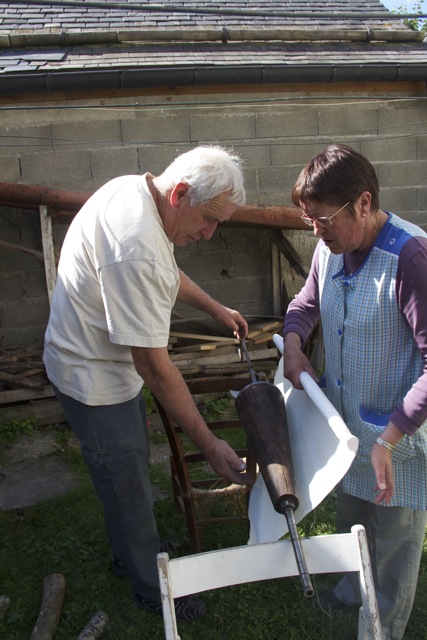
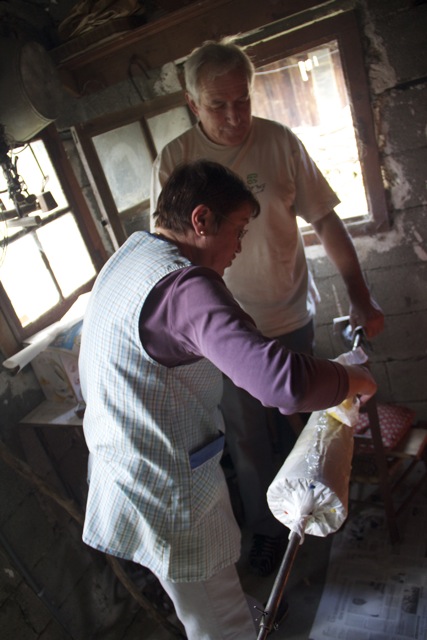
Roland had started the fire before I arrived. Once the batter is done, the ancient wooden mold is warmed up then wrapped in parchment paper.
.

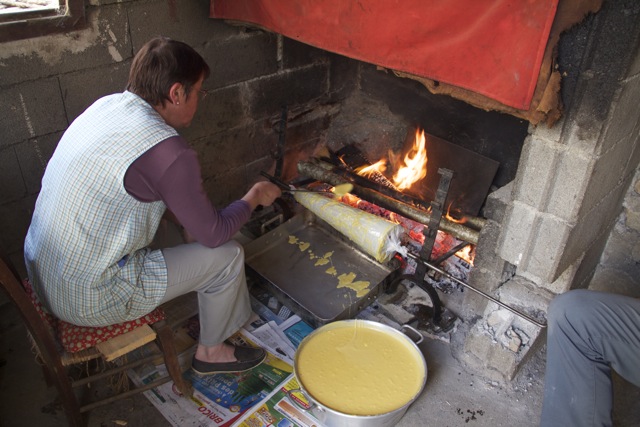
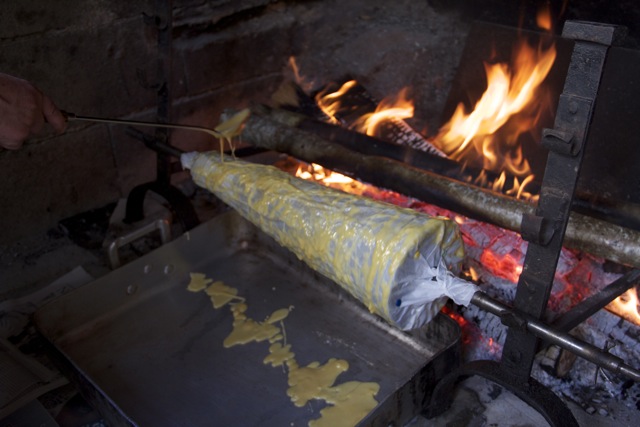
The wrapped mold is warmed up again and lathered with butter. Now the cooking part can begin. Simone takes her position in front of the hearth and starts pouring the batter while Roland turns the handle. Simone & Roland have mentioned several time that the starting of the cake is a crucial moment in order to make it sturdy. The main fear is always to break the cake and this fear is only lifted once it has been delivered to the party place!
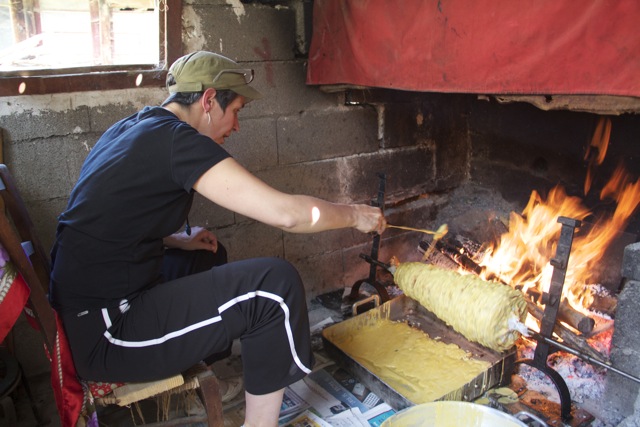
Slowly but surely the pouring & cooking continue. Closely supervised, I anxiously got to relieve Simone at pouring a few times and Roland at turning. As the cake becomes heavier the turning/cooking  gets trickier. The conversations are continuously interrupted by comments or commands like: “Il faut mettre – put some on,” ” tourne plus vite – turn faster,”  “attention le pied – watch the bottom,” “attend!  les piques brillent encore – Wait, the peaks are still shining.”
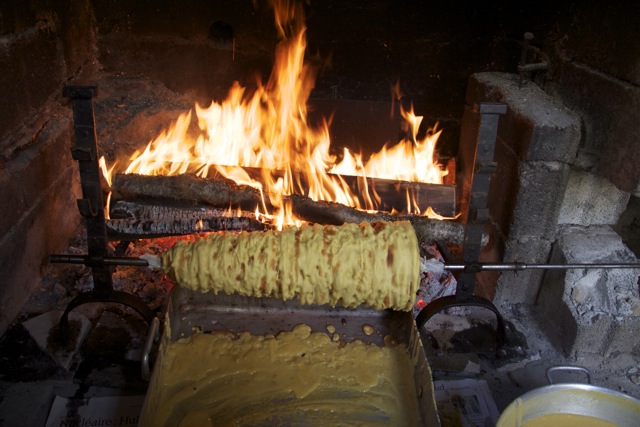
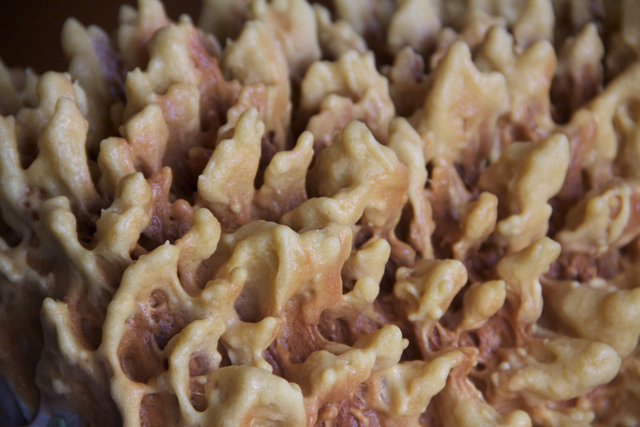
Roland keeps feeding the fire with long logs that he and his nephew Fabrice have cut for the occasion. Each log is carefully picked as the fire needs to be highly controlled. Logs & embers are moved according to where most heat is needed.  Here we can see the cake shaping up. The “peaks” are starting to form. One of the conversation around the fire was about the length of the peaks, the pride of the cake makers, though Simone points out that she favors the taste over the shape and I agree.
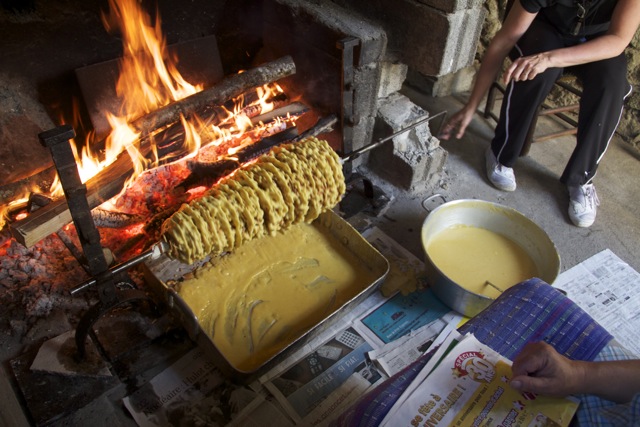
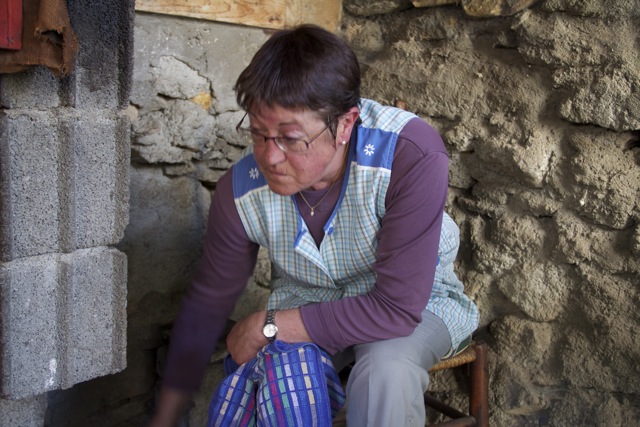
As the batter in the basin diminishes slowly, Simone is wiping the sweat off her face more often. I try to relieve her as much as I can, but her expert hand is needed to “mettre” properly as it is getting more difficult; due to peak formation the batter sticks less and less so the spooning over has to be more frequent and the batter dripping in the pan needs to be quickly collected —that is before it cooks– and spooned back on too the cake (see video below).
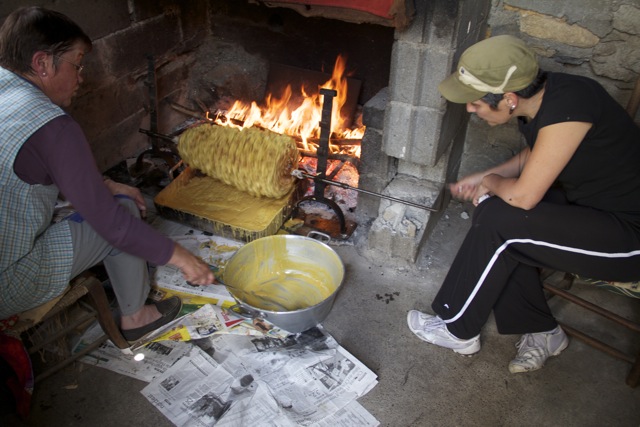
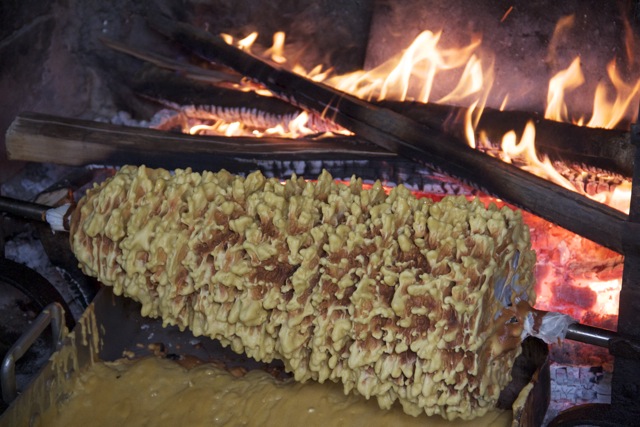
 

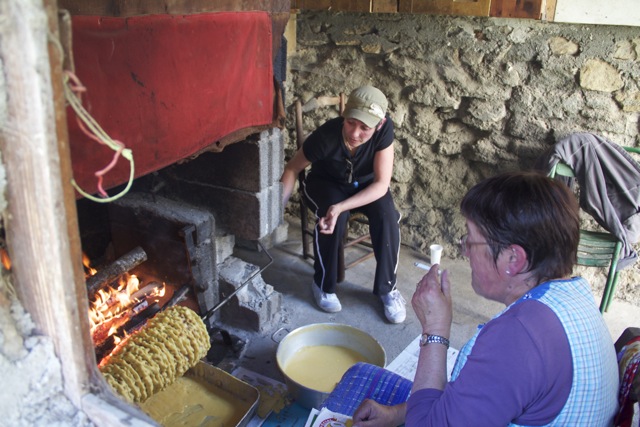
Here we go! many hours later finally the last spoon of batter! The cake is perfect, just a little more cooking to give it the final golden look.
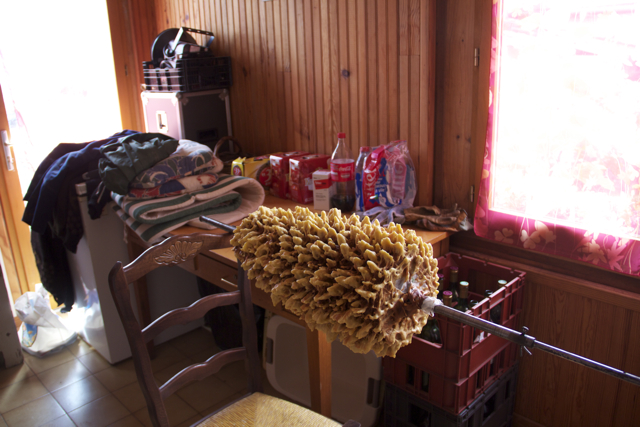
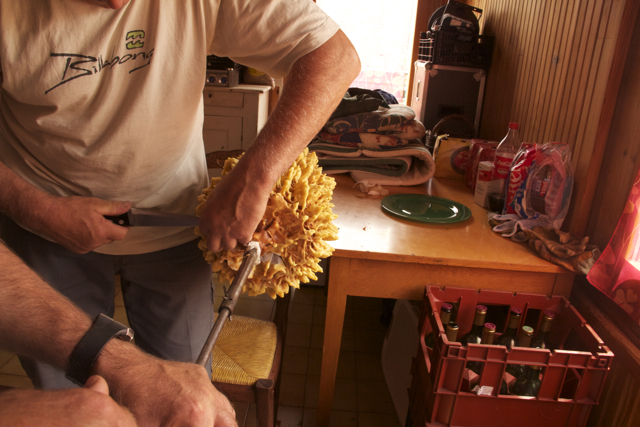
The cake is brought inside to cool off while resting between two chairs. After lunch Roland, with the help of Simone’s brother Jean-Claude, the mold is removed with a mallet! That part is very scary and you can sense the how everyone is tense in order to execute the appropriate move in order not to break the cake.

The cake was delivered by Roland & Simone on the morning of the party on July 14. We served it for dessert accompanied by crème paysanne —aka crème anglaise— that my mother, Marie-Jeanne Jamme & Robi Castbrunet made.  What a gift! I am so thankful to Roland and Simone for their generosity, time, expertise & hospitality at her family home. Watch the video and stay tune for the rest of the menu!

For your information a very similar cake, called Šakotis, is make in Lithuania, another close cousin is the German Baumkuchen.

Photos Credit: Nicole Peyrafitte & Roland Jamme
Video: Nicole Peyrafitte
Flower arrangement on the cake: Sylvia Gorelick
Poached Salmon Brunch

Poached Salmon Brunch

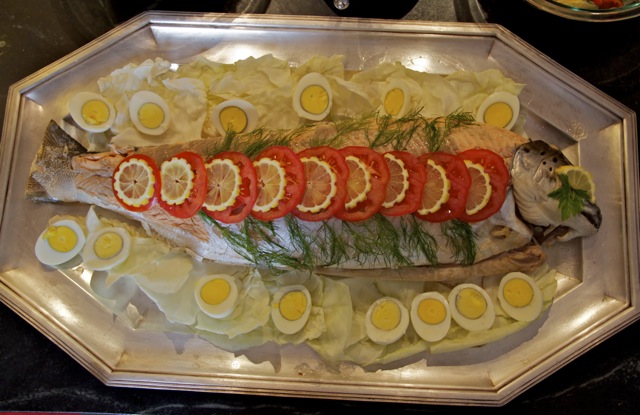
A simple & elegant dish for brunch lunch or buffet dinner that can be poached the day before. I use a  Norpro Stainless Steel Fish Poacher and find it quite useful though the  10 pounder salmon  (whole, gutted and scales scraped — I keep head and tail on) was almost too big!
For the court-bouillon:
1 onion & 1 carrot sliced, 1 branch of leafy celery, 1 bouquet garni w/2 bay leaves & parsley,
whole pepper corns & salt to taste (not if you have used soy sauce).
This time I used soy sauce, mirin, soju, rice vinegar, but white wine and lemon is also appropriate.
Fill the poacher with enough water so the fish will be fully covered.

Add the salmon to the cold liquid, bring to a slow boil. I cooked the 10lbs salmon for 35 minutes at a very slow simmer. Let the salmon cool off completely in the court bouillon — that will keep it moist.

Once cooled, peel the skin delicately and decorate. I used  hard boiled eggs, tomatoes, parsley, lemon wedges because this is what I had and was a bit in a rush, but you can glaze it with a fish gelée with gelatin and add sliced olives and/or cucumbers..etc.

I  served it with a home made olive oil mayonnaise on the side:
Combine 1 large egg yolk* (room temperature), 1/4 teaspoon Dijon mustard + 1 dash of white wine vinegar & whisk the mixture vigorously in a large stainless steel or glass bowl (I make mine by hand, but you can use an electric whisk). Add the olive oil (total of 1 cup) very, very slowly and gradually,  a few drops at a time is the safest.  The start is crucial, you need to reach thickness and avoid that the emulsion separates. (If it does separate there is a way of saving it: get another egg yolk, whisk it lightly and add slowly to the result of your first attempt, and that should do the trick!)

Voilà, Bon Ap!

*I strongly suggest not only organic eggs, but very very fresh.

Loose in Toulouse

Loose in Toulouse

I left my hometown of Luchon this morning to travel back to Paris. I had a 5 hours lay over in Toulouse in order to catch the cheap €29.29 iDTGV.  I locked my belongings at the “consigne” and took off.

I lived in Toulouse in two occasions: In the mid 70’s while being a student at Lycée Raymond Naves and in 1983-84 while trying to be an actress. These times were certainly not the rosiest of my life. As a student I lived at the home of an extremely rigid & dark family where I felt inadequate & stupid most of the time. As a pretending actress the situation was no better, despite landing a small role at the famous Grenier de Toulouse. I had troubles hiding my accent, I was  bold —in many ways as I shaved my head at that time— untrained, uneducated and I was also mostly focused on my son Joseph then a toddler.  I had separated from his father when he was less than two years old and my pride was to take care of him myself. I was 24 years old had already been a clerk at a pharmacy, a chef/restaurant owner, a door to door vacuum cleaner salesperson, but wanted my dream was to be an actress as I had done a lot of acting in high school. Well it didn’t work the way I had envisioned though my first, and only, professional role at the Grenier was to be a waitress in the Arnold Wesker play The Kitchen! That might explain why I wasn’t fit for it…I thought I knew how to be a perfect waitress and could carry it on stage, but I totally missed the point it was not about being “real” but about to be theater real and I was certainly not prepared for that.

Anyhow I have returned to Toulouse many times since then, & performed several of my shows there: Deplacements with Pierre Joris, Ninon at the Cave Poésie & The Bi-Continental Chowder/ La Garbure Transcontinentale at the Festival Occitania. Toulouse is also the inevitable transit hub to Luchon —about 1h 1/2 south, straight toward the high pics.

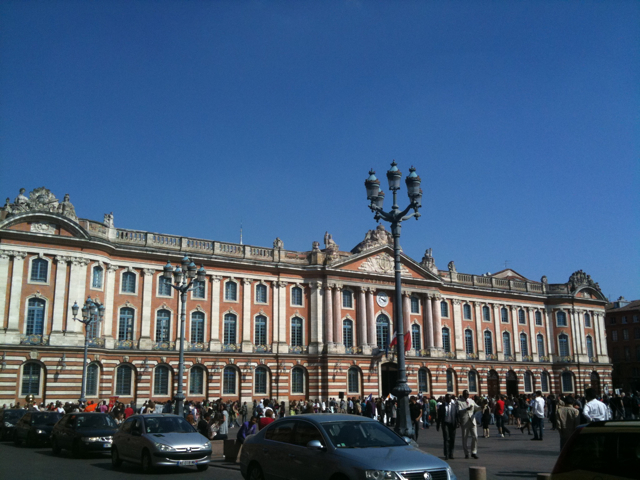
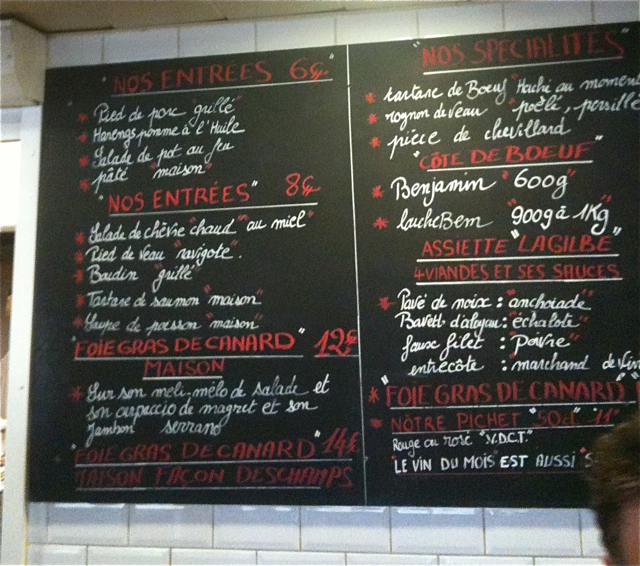
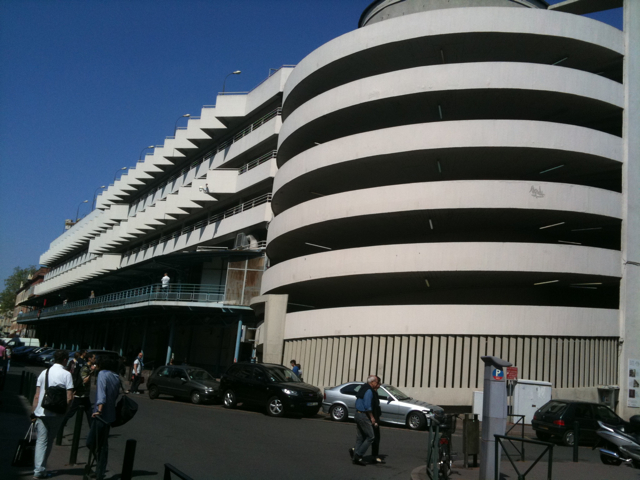
Today was the first time in years I was there alone. I had no friends nor family scheduled to see & a very strong desire to let the city carry me. The day was beautiful, I walked along the Canal du Midi for a while and then directed myself towards downtown thinking that I might enjoy getting some lunch on a terrasse around place Wilson. When I crossed the boulevard I noticed the sign for Marché Victor Hugo and followed it. I love markets and this one is very special. Unfortunately as it was around 1h30 PM it was closing time. I still got a glance at the beautiful meat displays, so fresh, so perfect. I also remembered that there was great restaurants on the mezzanine above the market and last I stopped there in 2007 I bumped into a childhood friend, Christian Lazorthes,then known as Kiki, he worked at Le Louchebem.

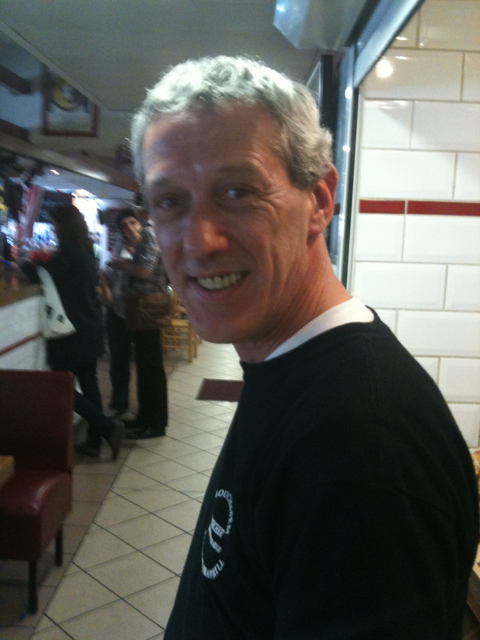
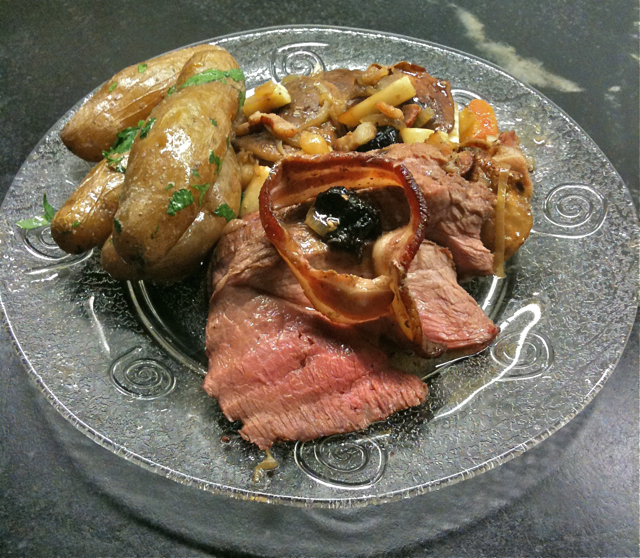
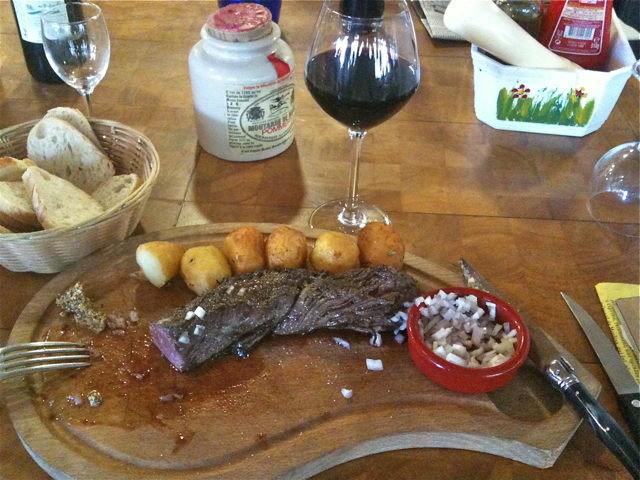
Christian LazorthesSure enough he was still there, I spotted him out right away, set myself at the bar, he also recognized me immediately & that is alway reassuring! I asked him for a spot and he sat me in his section of the communal table. He brought me a glass of Tariquet for apperitif and advised me to eat a piece of onglet roti —hanger steak— with raw shallots & round new potatoes, I made sure I wasn’t getting frozen fries — as in the USA, most of the french restaurant now serve frozen fries, please help me put pressure on the abolition of frozen fries!—. While I was waiting for my plate a man sat across the table from me. We exchanged a few banalities, that ended up not being so banale because something made me understand that he spoke occitan. I asked him about it and he said yes of course. After that almost our entire conversation was conducted in his beautiful perfect occitan and in my broken pyrenean gascon. While eating the most delicious hanger steak with Mustard of Meaux, I found out that we had many common acquaintances. Once of them the occitan scholar/philosopher Alem Surre-Garcia, I have been very inspired by his work and was glad to find out that he had two new books out: ARCHIPELS ET DIASPORA : ESSAI D’ÉMANCIPATION La théocratie républicaine & LA THÉOCRATIE RÉPUBLICAINE Les avatars du Sacré. I went to buy them at Ombres Blanches (Best bookstore in Toulouse and maybe in France) as soon as lunch was over.

My new acquaintance, Jacme Delmas, turned out to be a radical occitan writer author of the blog: http://democraciaoccitania.blogspot.com/ and contributing editor at El Triangle an independentist Catalan newspaper. A very passionate man that has put a lot of thinking and practice of being an occitan. I had a great time, it was energizing to be able to feel the depth of my culture and feeling totally inside of it even though I Iive so far away from it. Once again my favorite mantra “Things fall where they lie” & my identity as a Gasco-Rican were confirmed! Mercés Jacme per la conversacion, eth partatge de la passion del país e espèri que me mande al puslèu l’explicacion dera prononciacion de Jacme.  Adishatz!


Petit Rôti de Wild Boar

Petit Rôti de Wild Boar

As I was picking  meat for the week at the Park Slope Food Coop, the “Wild Boar Mini Roast,  Distributed by d‘Artagnan” looked like the perfect piece for Pierre and I to make into one of our  celebration dinner sfor our 21st anniversary month —neither of us remembers the exact date, so that’s a good excuse to have a few celebration throughout the month of January.

It would have been better if I had let the cute little roast marinate for a day or even a few hours, but when I came home after shopping I sat at my desk and didn’t get up until 7:30 pm. Pierre said: “It takes about three days to make one of the boar recipe from Luxembourg.” Well, I took on the challenge and with great anxiety I turned it into one of my fast dinners. I first went to the d’Artagnan website to check out the product information:

The D’Artagnan Wild Boar Mini-Roast is made from the knuckle and is pre-tied to hold its shape and allow for even cooking temperature. Simply brown in a hot sauté pan with sliced garlic and rosemary to seal. Then place in the oven about 375F to finish the cooking or until internal temperature reaches 155-160F. Remove from oven and let rest before slicing. Serve either hot or cold. Great on sandwiches!

D’Artagnan Wild Boar come from a large free-range ranch outside of Quebec. The animals graze freely on nuts, acorns, and grasses while being supported at times of need by whole grains. You’ll find the meat leaner than large-farm pork and richer in taste, but smooth and succulent in texture.

Alright, sounds good, though I don’t like the “pre-tied” device, which is an elastic trussing net. I discarded it  and replaced it with some d’Artagnan bacon and decided to just braise it in the oven. Voilà the procedure:

Preheat oven to 375F.
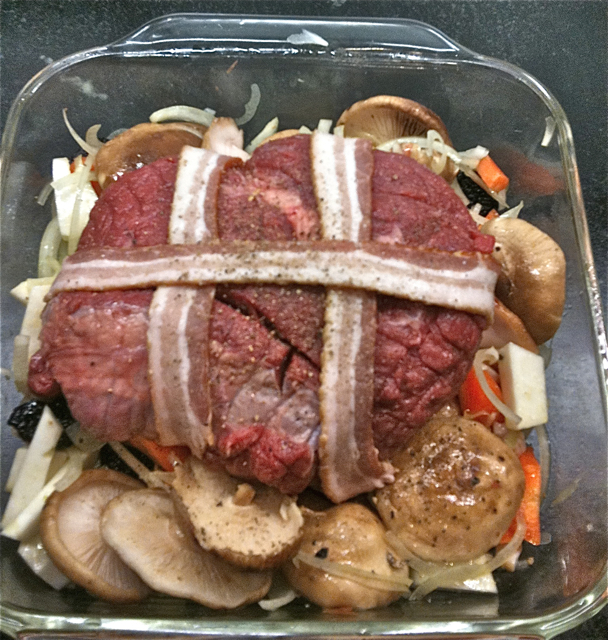
Take one sliced onion, 1 cup of sliced celery root, 1 sliced carrot, 6 slices of chopped  bacon, one cup of unsweetened cherries and about a dozen heads of shitake mushrooms, and place it all in a roasting dish. Generously coat if with olive oil, add salt pepper. Mix  well.

Boar Roast

Boar Roast

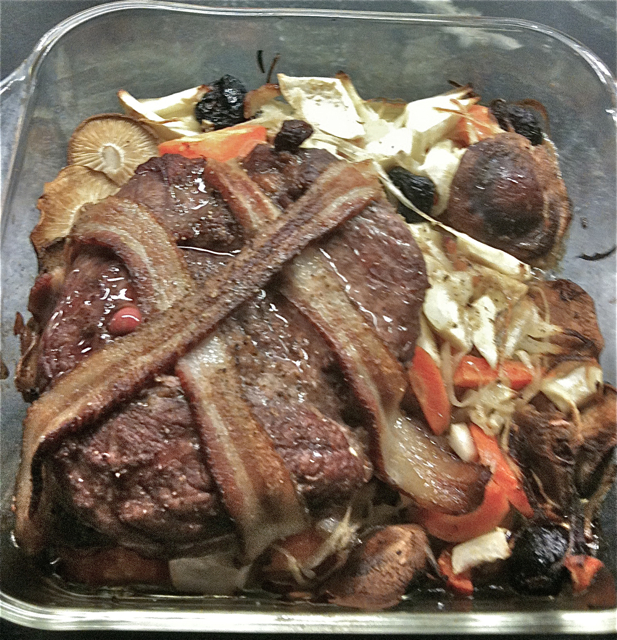
Coat the meat with oil, salt pepper. Wrap with  uncured apple wood smoked bacon. Place roast on top of the veggies and that’s how it goes into the oven.  As we read above, the legit internal cooking temperature is 155-160F, but that is too much for me. Our roast was 1.31lb, I cooked it for 40mn, the temperature reached 144F and this was a little over cooked for us, but that is a matter of taste and choice. In the same oven cook fingerling potatoes in another roasting pan,  lightly coated with oil and seasoned with salt and pepper.

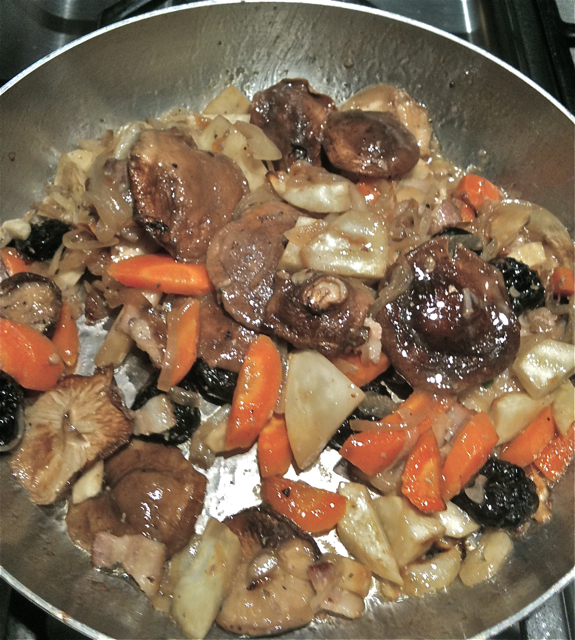
Once the meat is cooked to your liking, let it rest and transfer the vegetables & cooking juices into a sauté pan with one tablespoon of melted butter and a dash of oil. Sauté the veggies and flambé with  Armagnac.

Boar Roast

Finish up the fingerlings potatoes with fresh butter and parsley.
Slice the meat, keep it warm, pour the juice into the veggie pan, add  another dollop of butter in the pan to give it a shine!
Set up you plate and serve quickly.
Really simple, delicious and if you are a Park Slope Food Coop member, not  expensive either ($10.10 for the roast, a little more if you order at d’Artagnan but you don’t have to work for the discounted price and it can be delivered to your house!). Though very tasty with a rich and lightly gamy taste, I have to confess that the meat was a little tough, the marinade would have certainly ‘cured’ the problem, but other than that it was amazing. The hints of tartness (unsweetened dry cherries) combined with the distinguished taste of celery root, the shitake mushrooms’ texture, the sweetness of the carrots & onions, the mildly wild taste of the boar and the hint of Armagnac, plus the bottle of the inexpensive, but good Côte du Rhône Les Garrigues to wash it down, made it a very pleasing experience indeed.

It took me only 15/20 minutes to prepare it, 40 minute to roast it, and 10 minutes to finish it up. We had a few slices left over that will make a great sandwich for lunch. Enjoy le sanglier!


Feierstengszalot or Flintstone Salad

Feierstengszalot or Flintstone Salad

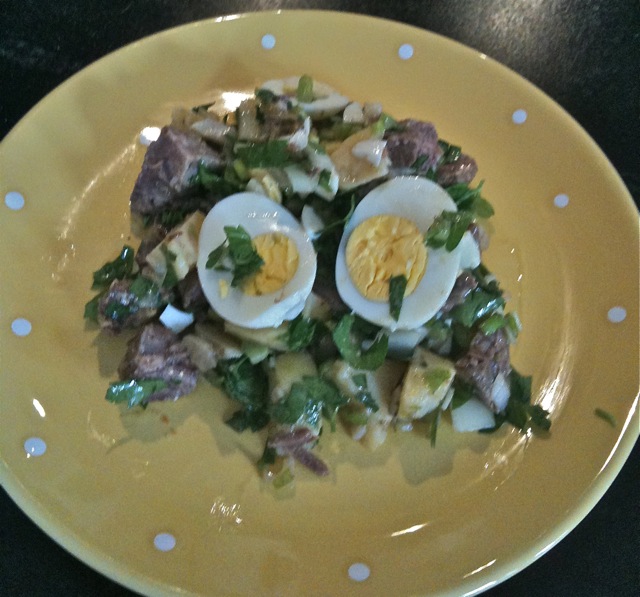
Feierstengszalot this what they call this delicious salad in the Grand-Duchy of Luxembourg. As a literal translation in English it means: Flintstone salad, or in French une salade de silex! I can assure you it tastes better than it sounds. But why does this delicious salad made out of left overs of pot roast bear this name? Certainly an investigation I will conduct during my next trip to Luxembourg. My husband, Pierre Joris a native of Luxembourg,  doesn’t know either but he made it for lunch yesterday and it was truly delicious. A few nights ago I had made a Pot au Feu —pot roast— and he used the leftovers to compose his version of the Feierstengszalot. So yes, first you  have to make a pot roast, which I highly recommend it in this season and you can find my recipe here.

Pierre’s Feierstengszalot

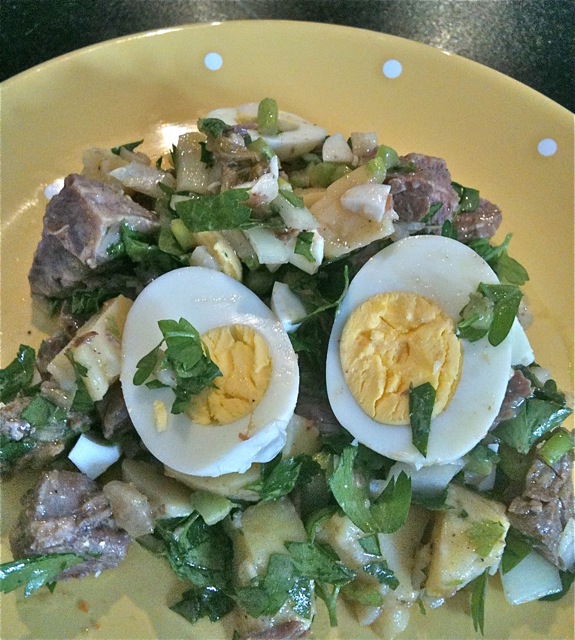
Cut the leftover of the pot roast meat into small pieces— (maybe the meat was tough and black in the old day and might have looked and tasted like flint-stones?
Add diced raw celery,  diced boiled potatoes, a lot of finely chopped onions and lots of chopped parsley
.
Dress with a Dijon mustard vinaigrette: 1 tbsp mustard, 1 tbsp wine vinegar, 3 tbsp oil of olive oil, 1 crushed garlic clove.
Garnish with slices of hard boiled egg.

In the French version they add left over of cooked carrots, turnips and  diced cornichons. Capers, watercress, shallots, chives, dill & tarragon are in the original Luxembourgian recipe but we didn’t have any so Pierre made due with what was available. In cooking, unlike in baking or pastry, there is always for creativity & adaptation!

1 … 21 22 23 24 25 … 63