Papalo Scallops & Corn

Papalo Scallops & Corn

scalopscornpapalo

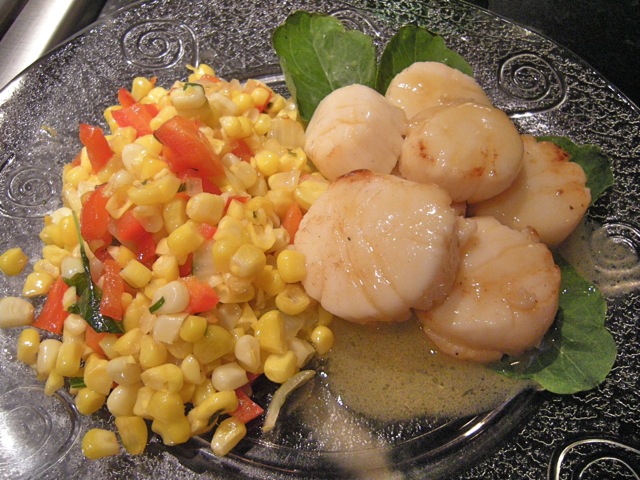
When Miles (my younger son) came into the kitchen and asked quite intrigued: “What is that smell?” I pointed to the Papalo bunch sitting next to the sink.

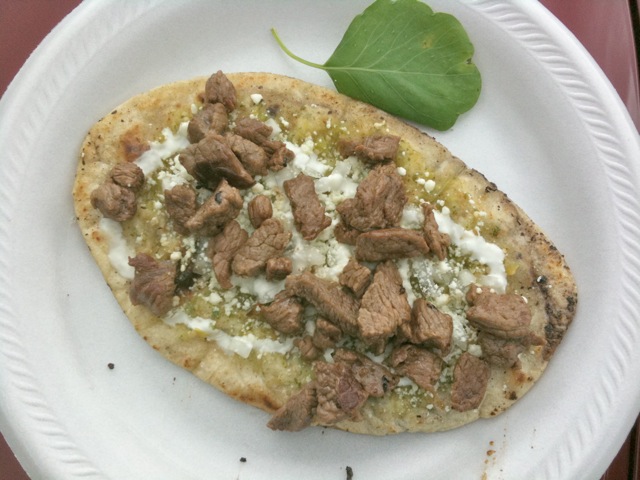
Papalo is a native South American plant, also known as Papaloquite or porophyllum ruderale or macrocephalum. Its name comes from papalotl, —butterfly in Nahuatl and interesting (to me) in French butterfly is papillon!— The first time I encountered papalo was at a flea market Upstate New-York. A Mexican vendor was getting ready to sell Guarachas*—a dish I wouldn’t mind getting more info on. The women were setting up while the men were all sitting down having lunch. I noticed them picking leaves from the middle of the table and eating little bites with their grilled meat and tortillas.
guaracha

I ordered a Guaracha, I had to ask for the leaves as I wasn’t automatically given some. The lady was a bit surprised as she explained — nicely — that gringos didn’t usually care much for it. She was delighted I would try it as it was the way to eat this dish. It was love at “first bite!”; the grilled meat seasoned with lime, the green salsa, the Mexican cheese all topping a homemade corn tortilla —that looked to have had some beans worked into the dough, and the little bite of papalo to make it a truly “gastrorgasmic” moment. Papalo’s taste is condensed, pungent and close to be an entrancing flavor. It must be used appropriately and parsimoniously.

Harold from Carral FarmA few weeks ago I got some papalo from Harold, owner of Carral Farm and a regular vendor at the Bay Ridge Greenmarket. He also gave me some suggestion on how to use it and recommended to also get some  Anaheim peppers. I picked up a pound of fresh scallops at American Seafood (read previous blog on scallops here and here). And this is the recipe I will share with you today:

Scallops With Sautéed Corn and Papalo (for 3)
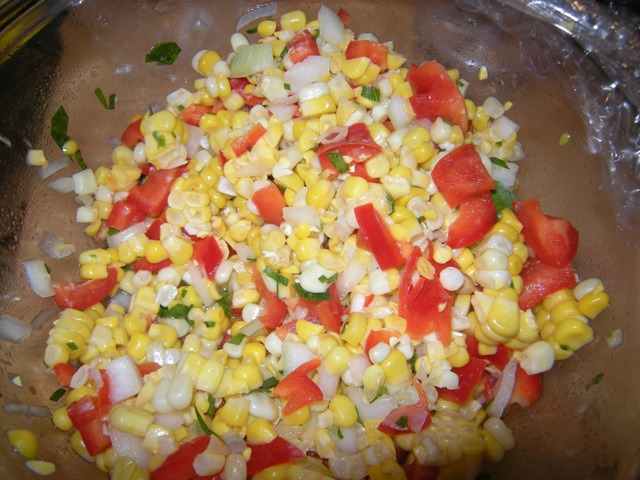
cornpepperpapalo

1 lb of fresh scallops
2 Tablespoon unsalted butter
1 lime juice
kernels of 2 fresh ears of corn
1/4 cup red bell peppers
1/4 cup sweet onions
1/8 cup green Anaheim peppers
9 leaves of fresh papalo
2 Tbsp brandy or Lillet
1 dollop butter at room temperature

Heat 1 Tbsp of olive oil and 1 Tbsp of butter in a stainless still or cast iron frying pan.
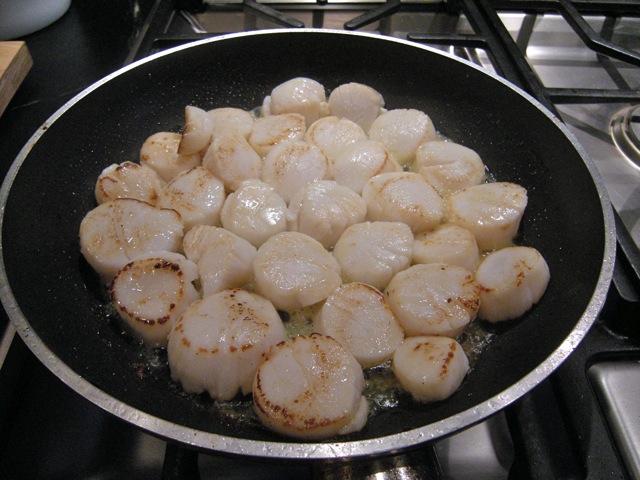
scallops

Sear scallops delicately  in the pan or about 3 minutes or so per side —it will depend how thick they are. Do not overcook them. Keep them warm between two plates and reserve until ready to serve.

While the scallops are cooking, sautée all the vegetables (with only 3 leaves of papalo chopped) lightly with olive oil or/and butter (see picture above to see size of veggies).

Déglaze the pan with some brandy or Lillet.  Add lime juice  and retrieve all the juice that have deposited in the scallop plate.
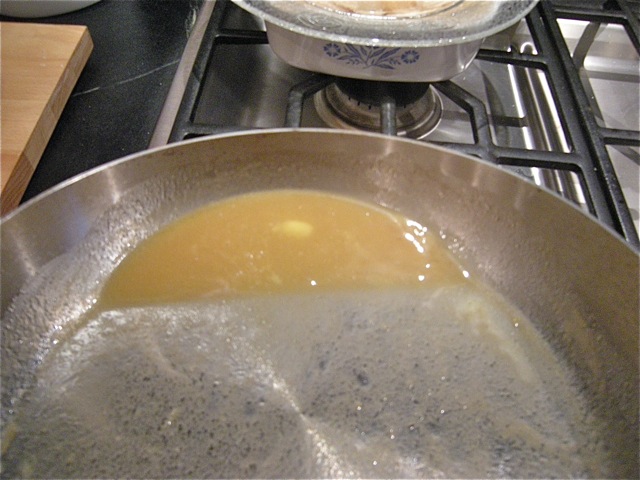
monter sauce

Add a dollop of soft butter and when only ready to serve  “monter la sauce au beurre” —that is to swirl in, until completely melted, a dollop of room temperature unsalted butter; it will give your sauce a velvety texture and a rich flavor. We have done it before, right? Add salt & pepper to taste and voilà!

*The guaraches turned out to be huaraches. See comments below and huraches blog.
Lost in Pepper!

Lost in Pepper!

Mushroom Salad

All I wanted to do was post a quick recipe for Labor Day:
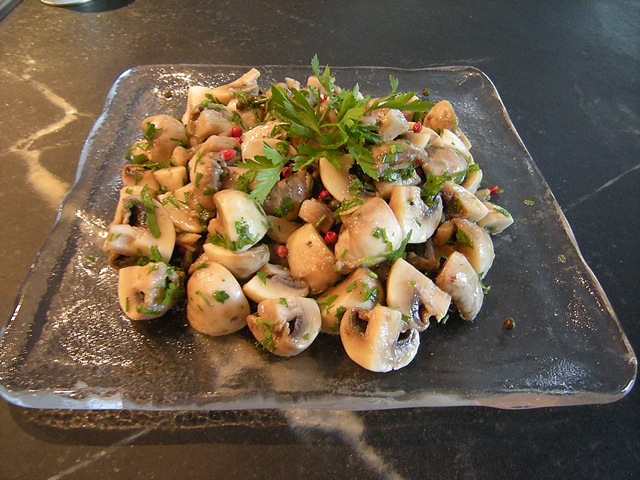
A raw mushroom salad marinated with pink & green peppercorns. Little did I know! I took the photo a week ago, the ‘shrooms are long gone but I am still marinating in pepper!

pink peppercorn

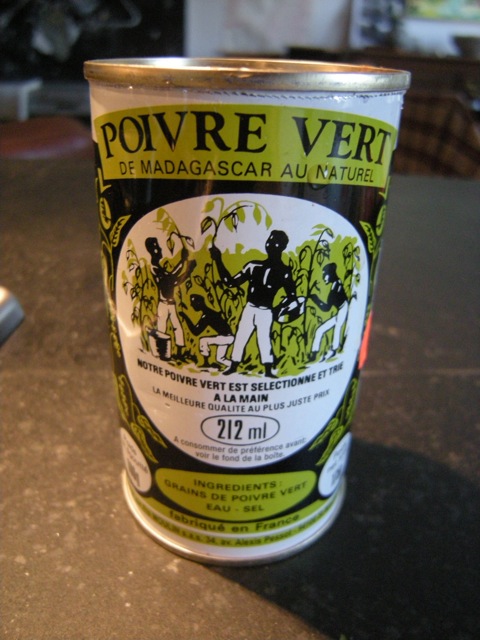
First, I confirmed that green pepper is the unripe Piper nigrum or black pepper that is mostly cultivated in Madagascar. Then I looked into pink peppercorn Schinus terebinthifolius: a faux poivre – a fake pepper. Originally from South America the Baies Roses plant is today cultivated on Reunion Island. And the last thing I was going to look into the Dictionnaire Universel de Cuisine et d’Hygiène Alimentaire” by J. Favre — & there (re)appears the fascinating Monsieur Pierre Poivre.  Oui! le poivre, pepper in French, was named after Pierre Poivre.  In English that would be Mr. Peter Pepper. He was also known as Peter Piper or le missionaire des épices — the missionary of spices!

Pierre Poivre

Pierre Poivre was born in Lyon (France) in 1719 (where he also died in 1786). After studying botany and Latin he was sent to Paris to enter the Seminaire des Missions Etrangères (Foreign Mission Seminary) to become a priest. He thought his vocation was to evangelize the Far East —little did he know.  Before getting ordained he was sent on an initiatory voyage to China. The trip was more than eventful: it coincided with the Jesuits been kicked out of the country. He was arrested & sent to prison. In order to plead his case he learned Chinese. He was brilliant and officials ended up granting him permission to visit the country.  His taste for adventure put a serious damper to his religious vocation. He visited many places among them Cochin China (Vietnam), Macau, Canton and was totally fascinated by their botany, agriculture and commerce. In 1745 he had to return to France to get ordained but fate struck again. The English attacked the ship he was on, a cannonball hit his wrist and amputation of his forearm was inevitable once he landed on Batavia Island (Indonesia) where the Dutch helped him out. That ended his priesthood carrier and more sadly his painting carrier —though I haven’t yet found any samples of his work, he had the reputation of being an excellent painter. While recovering on Batavia Island, he studied the native plants and the idea came to him that the French should grow their own spices in order to bypass the Dutch monopoly.

Bourbon Islands

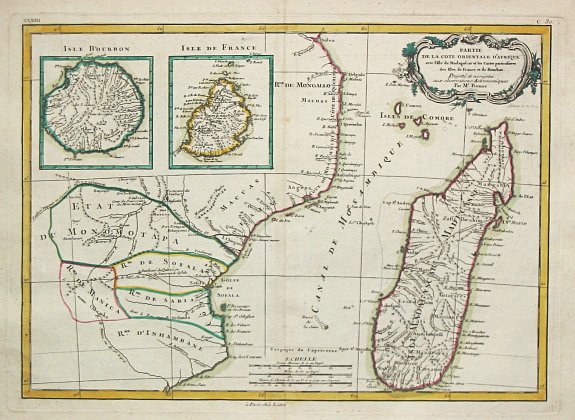
And that’s exactly what he did in 1767 when he became Intendant  des Isles de France et de Bourbon — the French colonies situated in the Indian Ocean south of Madagascar today called Mauritius & Réunion. One of his claims to fame was to transfer spice trees from the Dutch Indies (pepper, nutmeg, cinnamon, clove and many others) to the French colonies. Pierre Poivre was associated with the physiocrats (physis, nature, kratein, rule). The physiocrats are regarded as proto-French revolutionaries; they proposed to benefit agriculture by implementing a system of economic freedom. Poivre was against slavery and he is considered one of the first environmentalists who created and implemented the first environmental laws. Fear of climate change was already a concern and linked to deforestation. If you want to know more about the historic of environmental concerns read this Harvard Seminar on Environmental Values by Professor Richard H. Grove here.
Pierre Poivre married Françoise Robin, who was about 30 years younger than he,  and they had two daughters. It is interesting to note that nine years after Pierre Poivre passed away, Françoise Robin Poivre remarried Pierre Samuel du Pont de Nemours, who was the one who coined the term physiocrat —The du Pont family fled France for the USA during the revolution where Éleuthère Irenée du Pont, her second husband’s son, established the gunpowder manufacturer E.I. du Pont de Nemours & Company. Today Dupont is the second largest chemical company in the world.
Pierre Poivre's Book

Pierre Poivre wrote an extensive memoir:  “Voyage d’un philosophe ou Observations sur les moeurs ou les arts des peuples d’Afriques, de l’Asie et de l’Amérique” filled with acute observations, pertinent information and political & naturalist perspectives. As I stated above, Poivre is still regarded today as the avant-garde of environmentalism and his texts are still studied  —see Richard H. Grove article for more details.
In 1984 I visited Les Jardins de Pamplemouse on Mauritius Island.
Since then the garden that was constructed by Pierre Poivre was renamed SSR Botanical Garden. I remember the visit fondly, though at that time I had more scattered interests and didn’t pay enough attention.  I should still have pictures and recipe somewhere in storage and am tempted to go dig them out, even if they belong to a segment of my “romantic” life I don’t care much revisiting.
T
o be continued? Will see!

Meanwhile there is the recipe that you can adjust to your own taste:

green peppercorn1 lb of very fresh button/white mushrooms

1 lemon (juice)
1/2 cup extra virgin olive oil
2 teaspoon pink peppercorns
2 teaspoon green peppercorns
—dry or in can. If you use the canned ones you can add 1 teaspo0n of the vinegar they marinate in.
1/2 cup roughly chopped parsley
Salt & ….pepper? just a dash!

Prepare your marinade with all ingredients except the parsley.
Clean & cut the mushrooms in quarters (top only, use bottom in a sauce.)
Toss the mushrooms  in the marinade.
Save in the fridge for up to 48 hours.
Toss in parsley before serving.
Garnish with a sprig of parsley and a few pink peppercorns

Sax, Soup, Poetry & Voice

Sax, Soup, Poetry & Voice

SaxSoupPoetryVoice

THE DVD IS  OUT!
On November 7, 2007, Joe Girardullo, Pierre Joris & myself had molto fun presenting Sax, Soup, Poetry & Voice a multimedia performance at the The Sanctuary for Independent Media in Troy N.Y. The original description of the show was:

A Harvest Celebration with multimedia artist Nicole Peyrafitte, saxophonist Joe Giardullo & poet Pierre Joris. The trio will celebrate, harvest, and gather together non linear momentum through their music, poetry, voice, visuals and yes, a soup! Nicole, who recently moved to Brooklyn, will cook an “Inner-State” soup that will be shared with the audience.

The quality of this recording is stunning. They made us look and sound really good! & you ou can almost taste the “Inner State Soup!”

This DVD series is not a commercial venture and The Sanctuary for Independent Media is eager to have it distributed widely. For that reason we offer it through Ta’wil Productions store for a modest $5 to cover shipping and handling. Spread the word & the DVD!

Please view video sample here

This DVD is part of a prestigious series (see below), however at this point we are only able to offer our DVD.
Our deepest thanks to the producers, crew & volunteers of the Sanctuary.

A Message from The Sanctuary of Independent Media:

Free Jazz from the Sanctuary Launched!
A 13-part series of jazz performance videos featuring some of the world’s most talented improvisers, recorded live in concert at The Sanctuary for Independent Media, is now available online–just click the links below! Each show is (or soon will be) available on DVD; details are available under each band entry.

The Free Jazz from the Sanctuary series will soon be available for non-commercial broadcast distribution.
Contact us
for more information!

The Thirteenth Assembly
(Taylor Ho Bynum, Tomas Fujiwara, Mary Halvorson, Jessica Pavone)
Ethnic Heritage Ensemble
(Kahil El’Zabar, Ernest Dawkins, Corey Wilkes)
Fay Victor Ensemble
(Ken Filiano, Anders Nilsson, Michael TA Thompson, Fay Victor)
From Between Trio
(Michel Doneda, Tatsuya Nakatani, Jack Wright)
Michael Vlatkovich Quartet
(Christopher Garcia, Jonathan Golove, David Mott, Michael Vlatkovich)
Sax Soup Poetry and Voice
(Joe Giardullo, Pierre Joris, Nicole Peyrafitte)
Trio Tarana
(Sam Bardfeld, Ravish Momin, Brian Prunka)
The Ras Ensemble
(Clif Jackson, Dave Miller, Ras Moshe, Tor Yochai Snyder)
William Hooker
Empty Cage Quartet
(Ivan Johnson, Paul Kikuchi, Jason Mears, Kris Tiner)
Weasel Walter Trio
(Peter Evans, Mary Halvorson, Weasel Walter)
Splatto Festival Chorus
(Dave Barrett, Michael Bisio, Ed Mann, Todd Reynolds)
Amiri Baraka and Rob Brown

Free Jazz from the Sanctuary is a co-production of NY Media Alliance and the Arts Department at Rensselaer, made possible in part with support from the NYS Council on the Arts and the NYS Music Fund, established by the NYS Attorney General at Rockefeller Philanthropy Advisers.

Photographs of the show: Sax, Soup, Poetry & Voice  by Jon Flanders (11/07/07)

Look at me Porgy!

Look at me Porgy!

DSCN4286

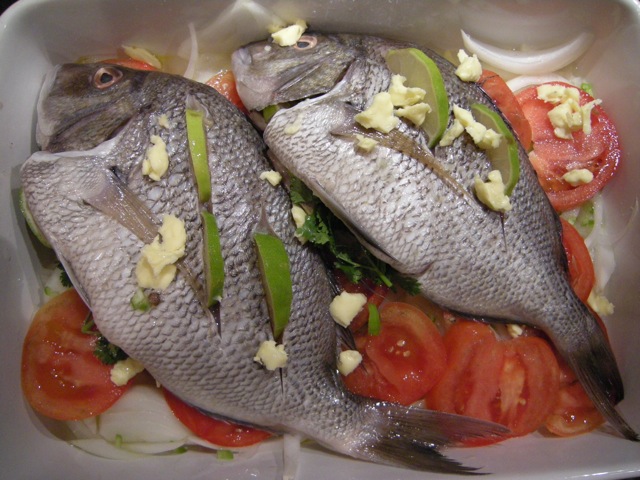
Last night we ate porgies. I bought them at the Bay Ridge Greenmarket from the excellent Long Island Sound based American Seafood stand. I prefer whole fish to fillet or steak. One of the reasons is that I like to look the fish in the eye. If the eye is clear, bright with dense black pupil & looking back at me I see/hear “buy me!” If the eye is cloudy, dry and sunken, the message is that this fish has been on display away from the water for too long. Other general indicators of fish freshness are:
The skin must be moist and shiny.
The gills need to be bright red or pinkish red. When pressed with the finger, flesh should bounce back and leave no indentation.
Fresh fish smells like fresh seaweed, any strong odor is suspicious. If the fish smells, even slightly, like ammonia discard it —I once worked with a chef who asked me to “bathe” the fillet we were to serve as “specials” that night in vinegar & water to make the smell disappeared! I refused.

porgy

As you can see my porgies were beautiful and cost me $5. Buying a whole fish is much cheaper by the pound. Yes! it is more work as you will have to debone it yourself.  There is also more waste, but what about a fish soup with the bones? I will give you that recipe later. Also, below you will find a quick homemade video on how to serve your fish. I would appreciate if you have a few minutes to give me feedback on the specific questions.
Meanwhile, voilà today’s recipe:

2 Porgies (1 guted & scaled fish per person of 1/2 lb or so)
1 sweet onion peeled and sliced very thin
1 Italian or Jalapeño pepper, inside seeds and rib removed and chopped very small
1 bunch of fresh cilantro
2 ripe tomatoes
1 glass of dry white wine
1 or 2 limes
Salt
½ cup olive oil ¼ cup of butter
Preheat oven to 375º.
Coat the bottom of an ovenproof dish with olive oil. Arrange the onions & hot peppers.

stuffing porgies with cilantro

Add the tomatoes.
Add white wine. Make 2 slits on the fish.
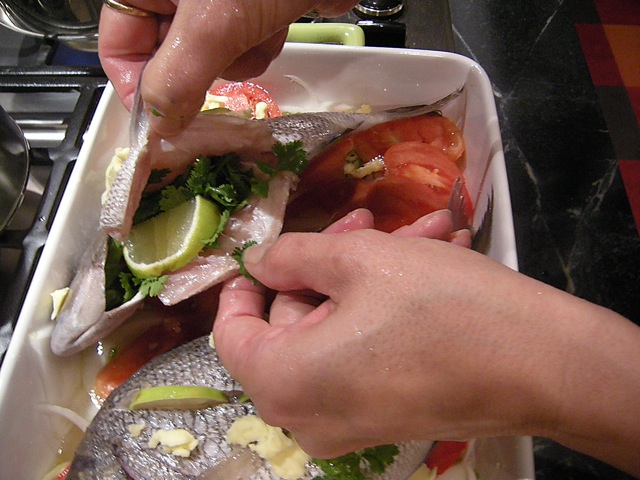
Salt the inside of the fish, squeeze some lime into it & stuff with a few sprigs of fresh (well washed) cilantro.
Insert slices of lime into the slits on the fish.
Pour the juice of ½ a lime over. Scatter tiny pieces of butter on top of the fish.
Put in the oven for 25/30 minutes.
Baste the fish every 10 minutes with the liquid in the pan.

We ate them with corn on the cob and a beet salad. More details on the video on how to serve it.

How to serve the whole fish family style:


Please take the survey below if you have a minute.
To do so copy & paste the question in an email or in the comment box.

Is this video helpful to you?
Did you know how to deal with a whole fish before?
If not are you going to try it now?
Did the “homemade” quality of the video bother you?
Do you want more videos on the blog?
If yes, what do you want to see?
How long?

Bonus question:
Add any personal comments :

M E R C I !

Barked Memories

Barked Memories

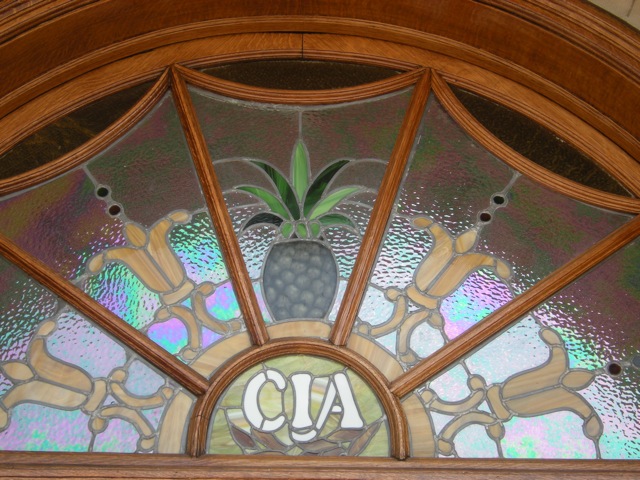
cia
August 21st 2009 / Lunch Time
Culinary Institute of America
The American Bounty Room

I am back in the Mid-Hudson Valley to accompany Miles for the last three days of the Muttnik shoot. I cannot resist returning to the C.I.A. This time I’ll have lunch at one of the “big” restaurants, preferably at the “Escoffier” or the “Villa de Medici.” No, I didn’t make a reservation and therefore I will not be “accommodated” in either of these rooms. Now my choices are: the “American Bounty Room” or return to the “Apple Pie Bakery Café.” No hesitation, I am on my way to the “American Bounty room.” I am ushered to a table for two facing the open kitchen. The setting before me is removed; I sit on the banquette across the “Julia Child Rotisserie Kitchen.” Two rows of antique rolling pins frame the sign. Below it, two impeccable pastry students are busy setting up dessert plates. The reverent & courteous student/waiter brings me the menu and offers cocktails. A quick look confirms that I will have the Dr. Frank Rkatsitelli, Vinifera 2006 from the Finger Lakes. I have read the online wine and lunch menu; it is easy for me to scan through and to decide on:

Sautéed Halibut ($16)
Sweet Manila Clams, Soffrito Rice, white Wine Broth
(sorry no pix, remember? not allowed inside the school)

And then starts an annoying conversation with two of my selves (I’m a Gemini):
Moi 1: “I am really overindulging by coming twice for lunch at the CIA in the same week.”
Moi 2: “But, I am here for a reason.”
Moi 1:“Oh! Yeah and what is the reason?”
Moi 2:“ Well, I’m gonna write about it on my blog!”
Moi 1: “Again?”

Don’t get me wrong, I do enjoy writing the blog, but sometimes it feels like self-inflicted homework. English is not my first language and I am not a born writer. Why do I do it then? In different ways, whether I draw, sing or write, I find myself doing the same thing: I dwell on a particular situation and seek its “essence.” Using the blog gives a very convenient format, as it allows for all my interest to converge. But today feels like having a “still day.” I put my pen down, close my notebook and sip my wine.

Yum! the wine is crisp, clean & light. It reminds me some of the wines from Luxembourg. Rkatsitelli is an ancient grape from Georgia (Old world not USA!). I had it once before and liked it.  Dr. Konstantin Frank wines are always interesting.

What is that human barking coming out of the kitchen? Every time one of the kitchen doors opens — there is one on each side of the kitchen window, one to get in & one to get out — we can hear the “aboyeur” (literal translation: the barker) dispatching orders. In this case an “aboyeuse” as it is a female announcing the orders to the appropriate station of the kitchen.  This is a strategic position in a brigade system kitchen. Wow! I am having a flashback, and next thing I know I pick up pen and notebook:

I am a little girl in the corridor of the “office” of the family hotel. The “office” was the upstairs kitchen where some dessert and cold foods were prepared and most of all where the manual dumb waiter delivered the food from the downstairs kitchen. The orders were shouted into a speaker-phone. Then one copy of the order slip was sent down, the first carbon copy pinned on to the board next to “le passe” —that’s how we called the dumb waiter— , the third carbon copy was kept by the waiter to add any supplements and then sent out to the cashier to make the bill.

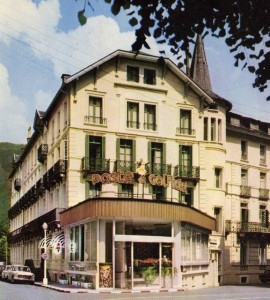
Hotel Poste & GolfI was born in this hotel, in my parents’ bedroom just above the action and almost in the midst of it. It was June 18, 1960 at noon; the restaurant was running at full capacity. There was a banquet for a 100 top, the annual banquet luncheon for the Master Accountant Guild of the Southwest France region. The interesting fact is that my maternal grandfather, Maurice Gallot, was the president of the guild! My father didn’t get to see me until after the banquet was under control. My mother and I were in good hands between the midwife and her uncle who was a surgeon. My mother still remembers that my maternal grandfather bought champagne for the entire party! As far as the memory of the birth itself is concerned, she would always say: “C’est le mal joli,  quand c’est fini on rit!” “It’s the pretty pain — once it’s over one laughs!.” She is always very positive! In case you are curious to know what was served the day of my birth, here it is taken from my grandfather  agenda/menu book. The left side of the page  is the regular Menu du Jour and the right side is the menu for the banquet.
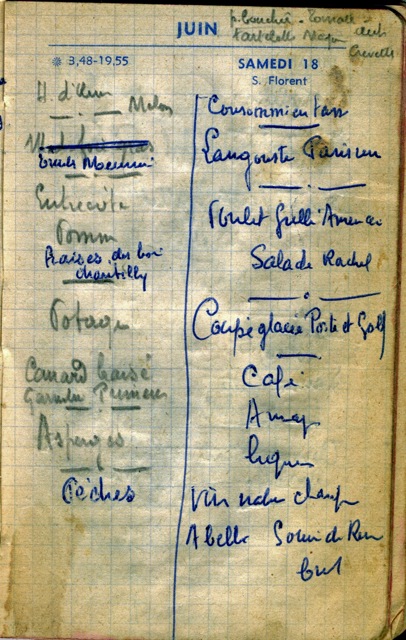
Menu June 18th 1960

Page left:
Lunch:
Hors d’Oeuvres (I have a post on this here) & Cantaloup
Trout Meunière
Entrecôte & Pommes Frites
(always served with Beurre Maître d’Hôtel)
Wild Stawberries & Fresh Cream

Dinner:
Soup du Jour
Braised duck with Garniture Printanière (diced spring veggies)
Asparagus (most likely served with hollandaise sauce)
Peaches

Page right:
The Banquet Menu
Consommé en tasse — cold consommé served in porcelain cup.
Langouste à la Parisienne — rock lobster in a sort of aspic glazed or a.k.a chaudfroid
Grilled chicken à l’Américaine — chicken crapaudine that is first grilled, then covered in a mustard sauce, then breaded and finished in the oven.
Salade Rachel — according the Escoffier cookbook: Equal parts of truffle shavings, rooster kidneys, celery ribs cut into thick julienne, asparagus tips. Light liaison with a thin mayonnaise.
Coupe Poste & Golf It could be anything my grandfather felt like making! probably some sort of home made ice cream with liquor a fruits topped Chantilly and served with a cookie)

Café/Armagnac/ Liquors
Vin Nature de Champagne Abelé Sourire de Reims

I would like to make that menu for one of my birthdays! maybe for the big 50!
By the way I thank you very much for your comments about the blog on Facebook, but I would really appreciate if you would comment directly on the blog. Merci!

1 31 32 33 34 35 60