Purple Cabbage & Gromperen Plaâ

Purple Cabbage & Gromperen Plaâ

Red Cabbage Salad

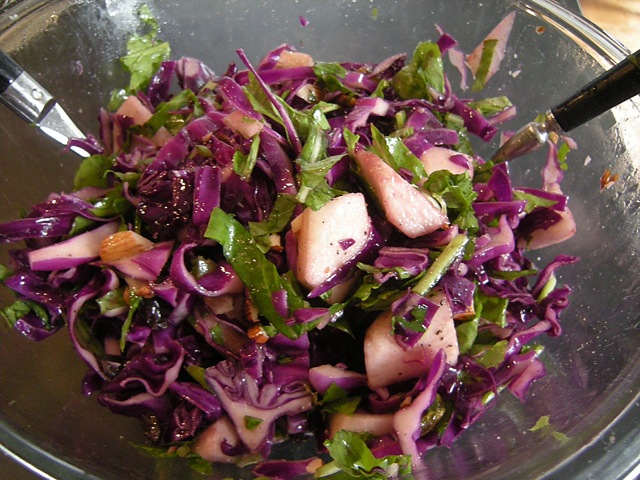
When we took off for France in mid-July I left a purple cabbage (red cabbage is actually never “red”) in the fridge. I was pretty confident it would keep until our return. It was a beautiful purple cabbage from our CSA share and I actually wrote a post and took pictures about that particular share — click here for details. It was a very firm,  bright, shiny and freshly picked purple cabbage.  I must say I was a little surprised to find it in the CSA box so early in the season.  When we returned mid-August, the cabbage was holding great, no obvious signs of aging. It was not wrapped, or in the crisper, but just decorating the middle shelf of the fridge. I still was not ready to eat it; summer veggies were still plentiful and I assimilate cabbage more with a fall/winter food. I became so used to see it in the fridge that I almost forgot to eat it.  But a few nights ago I pulled it out of the near empty fridge to accompany Pierre’s Bay Ridge version of a Luxembourgish dish: the Gromperen plaâ. Only the first layer of the cabbage leaves where a little limp, the rest was still crisp. Before I tell you a little more about the Gromperen  plaâ this is how I made the cabbage salad:
1/2  red/purple cabbage head sliced thinly
1 diced onion
1 diced apple
1 diced celery rib
Chopped walnuts and/or almonds

Moisten all the ingredients with olive oil. Drizzle with vinegar — it can be: apple cider, or rice or light wine vinegar. Add a dash of sesame oil —very little, the goal is to use it to outline the ingredients  not to really taste it (do you  know what I mean?). Then add  fresh  chopped Italian parsley, salt & pepper to taste.

Pierre was supposed to give me the detailed recipe of the Gromperen plaâ but as you can check on his blog he is not home very much these days. In Luxembourgish Gromper means potato & plaâ means dish —plat in French. This is the first dish Pierre’s sister Michou makes when we visit. All the ingredients go into a terrine or a lasagna type dish. As I indicated I don’t have an exact recipe but I think I am right to say that Pierre never really follows one either. This is the kind of dish that is adjustable to what you have and how you feel. I personally encourage this kind of cooking and would like to have the guts to write such a cook book! Now here are the indications for you to make your own potato dish:

Butter  the bottom of the pan.
Line with one layer of sliced parboiled potatoes.
Sprinkle with  diced sautéed onions.
Cut slices of Mettwurscht the “national” sausage of Luxembourg.
In Bay Ridge we don’t have Mettwurscht so Pierre decided to make the Gromperen plaâ with the Turkish sausage sujuk— a beef sausage usually spiced with cumin, sumac, garlic, paprika and other red pepper —we always get it at Aunt Halime’s Halal Meat Market on 3rd avenue and Ovington in Bay Ridge.
Repeat layers until there is no more room in the dish.
Then fill the dish with seasoned
heavy cream—with salt, pepper and a touch of freshly grated nutmeg—  until the top of the pan is barely covered.
Top with a generous layer of shredded
cheese – can be Swiss , Emmental , Gruyère or even cheddar! 
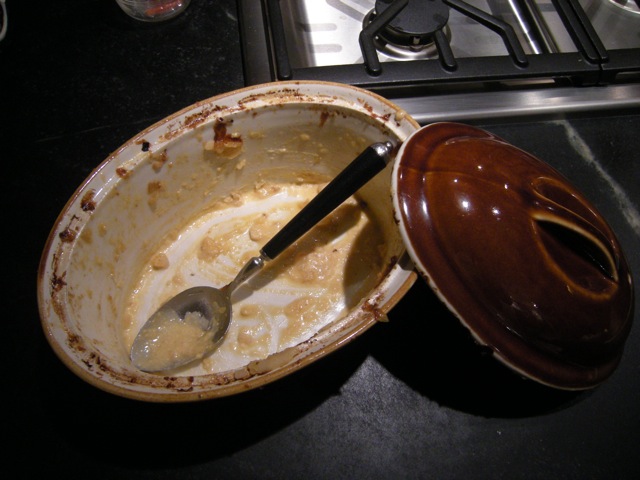
The result was superb; I had forgotten to take a picture of the dish before we started digging into it and next thing we knew is that the three diners around the table cleaned it up in a flash! The combination of the textures and tastes were perfect. Thanks Pierre and this menu is a keeper! The only disappointment Pierre had is that he thought he was going to have some left over for lunch. Sorry!

Gromper Pla

Back!

Back!

Aspet gardens-Saint Gaudens National Historic Site

What I miss most when I travel is cooking my own food. During my trip to Boston, Springfield (MA) & Cornish (NH) nothing I hate was memorable, though all very decent. The highlight was definitely a vegetable chowder and a lobster roll at the Windsor (VT) train station.  The focus on my trip was not food at all, but more research on Augustus Saint Gaudens (1848-1907). My first involvement with the American sculptor began in 2005 when I was commissioned to create a multimedia performance for the 2007 hundredth anniversary of his death. Augustus Saint Gaudens and I share common Gascon origins. Augustus’ father, Bernard St-Gaudens, was born in Aspet (French Pyrenees) in 1816 —the  village of Aspet is next to my hometown. Bernard St-Gaudens (they spelled their names differently) was a shoemaker, he left Aspet very young, moved to Salies du Salat, Carcassonne, Paris, London and settled in Ireland where he married Mary McGuiness in 1841. Together and with their 6 month old  son Augustus, they emigrated to the USA in 1848. There is currently a show at the Metropolitan Museum on the museum collection of the artist. Anyhow I will not get into details now, but I will leave you with the photograph of a funny article that I found in the archives at the Rauner Special Collections at Dartmouth. More soon!

Rauner Special Collections Dartmouth

ASG studio-Saint Gaudens National Historic Site- Cornish NHAdams memorial head-Saint Gaudens National Historic Site- Cornish NHAspet-Saint Gaudens National Historic Site- Cornish NHShaw Memorial-Saint Gaudens National Historic SiteSaint Gaudens National Historic Site- Cornish NHSaint Gaudens National Historic Site- Cornish NHSaint Gaudens National Historic Site- Cornish NHDiana in ASG studio Aspet-Saint Gaudens National Historic Site

Green Tomatl Salsa

Green Tomatl Salsa

DSCN4472

As a seasonal occurrence let’s taste another distinguished native American food: the tomatillo, miltomate or husk-tomato.  Pierre had bought the 2 lbs of them I had ordered last week  —a good thing that they keep well— and today I finally got to make a salsa verde.  This green-husked fruit is a close relative to the tomato. Also member of the Solanacea family, it’s Latin name is Physalis philadelphica. The Latin name for what we know as tomato today is: Solanum lycopersicum. Both fruits’ names (yes! they are fruits) derive from the Nahuatl word: tomatl. Sophie Coe in her book America’s First Cuisine gives an important precision:

Tomatillo

“Nahuatl is an agglutinating language, which means that the root of the words were modified by adding prefixes and suffixes. To find out exactly which plump fruit was being eaten one must distinguished between a miltomatl, a xitomatl, a coyotomatl and many other kinds of tomatl. Some Europeans, who did not understand the structure of the language they were dealing with, thought they were simplifying things by shortening the name of the larger fruit which we know as the tomato from xitomatl, meaning plump things with a navel to plain tomato”

I have read that Tomatillo husks are used to help retain the bright green color of the cactus when boiled with the latter. But this is not something I have yet tried; if you have, please share your experience.
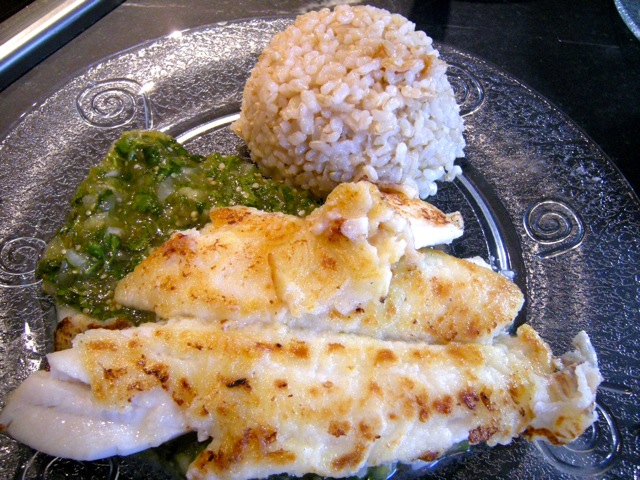
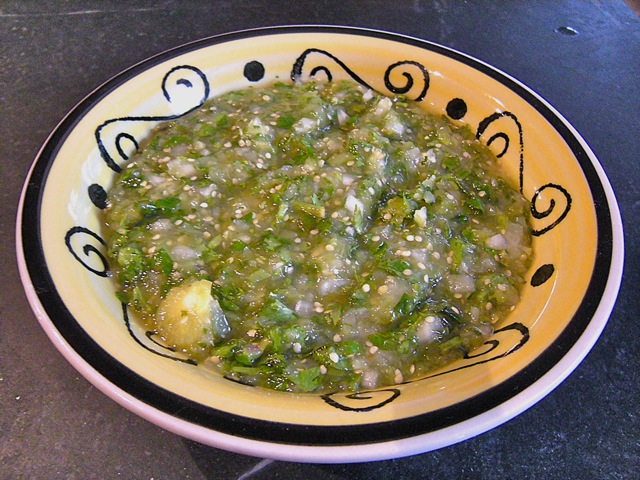
The Salsa Verde recipe I made today is very simple and can be used in many ways. The picture shown above is a pan fried fillet of sole with Salsa Verde & brown rice.  I made enough salsa to serve tomorrow with chips and cocktails. I also froze a container for later in the season.

Recipe:
2lbs of TomatillosSalsa Verde
Remove the husk.
Wash thoroughly with hot water to remove the slightly slimy coat.
Meanwhile boil water & blanch the tomatillos for 30 seconds.
While they cool:
chop 1 onion very small.
1 jalapeño pepper
1 bunch of fresh cilantro (fresh coriander)
Salt to taste
Optional: lime juice, olive oil.
Blend your tomatillos in food processor or chop by hand.
Add your chopped veggies.
Keep in the fridge until serving time, or save at room temperature if you are going to serve it with fish or poultry.
How to cook your fillets:
Heat your pan coated with a dollop of butter and a table spoon of olive oil.

Dip your fillet in milk, drain excess and dredge in lightly salted flour, drain excess.
Cook your fillet about 3/4 minutes each side over medium heat.
Remove and serve over a bed of green salsa and steaming brown rice.

Yum! Healthy, fast and tasty!


aMAIZing

aMAIZing

Zea Mays

When Colombus discovered the existence of corn (maize) in November 1492 on the island which today is called Cuba, he noted in his diary that “there are large cultivated areas which produce roots [cassava], a sort of bean [the haricot], and a sort of grain called maize.” He certainly had no idea that maize was already ruling the entire Americas, being under cultivation from southern Canada to lower South America. Mahiz is the phonetic name Colombus picked up from the natives. When European botanists began to list maize in their indexes, it became Zea Mays, Zea being a Greco-Latin generic name for wheat like grains and Mays the Latinized version of the original Taino name mahiz which means “life-giver”. How appropriate, maize being the most productive of the grasses but also the only cereal which cannot reproduce itself without the aid of men.

So how did maize become domesticated? Well, do not expect me to give you a precise explanation of the mysteries of the origin and domestication of maize when the “professionals” have been fighting over this issue for half a century. In her book The Story of Corn, Betty Fussel dedicates an entire chapter to the “Corn War” that started in the 50’s. One school, led by Havard Prize winner Paul Mangelsdorf, believed in — and searched for — the “primal ear,” convinced that the ancestor of cultivated corn was some kind of ur-corn. The other school, led by Nobel prize winner Georges Wells Beaddle, discovered through chromosomal interbreeding experiments that corn evolved from a kindred grass called teosinte, a wild grass still found south-west of Mexico City. This seems to be today’s consensus:

“Everybody agrees that domestic corn began about ten thousand years ago and that the place was Mexico and that present-day corn came, one way or another, from the interbreeding of teosinte and maize.”

Thus Garrison Wilkes of the University of Massachuset as interviewed by Betty Fussel. The explanation of how it happened is however still in the ground, and even though archeologists, scientists and botanists all believe that Mexico is the cradle of maize, the oldest — 7,000 years old! — carbon-dated trace was recently found in Panama.

What we do know for sure is the profound cultural/economic importance of maize. The Encyclopedia Britannica, for example, describes it as “the grain that built a hemisphere”. For the Incas, the Mayas, the Zapotecs, the Aztecs, the Zunis, the Iroquois — to only name a few — maize was also a core element of their spiritual life. As Eduardo Galeano was aware long ago:

Guatemala City, 1775
Nor do the Indians come to Mass. They do not respond to announcements of the bell. They have to be sought out on horse back in villages and fields and dragged in by force. Absence is punished with eight lashes, but Mass offends the Mayan gods and that has more power than fear of the thong. Fifty times a year, the Mass interrupts work in the fields, the daily ceremony of communion with the earth. For the Indians, accompanying step by step the corn’s cycle of death and resurrection is a way of praying; and the earth, that immense temple, is their day-to-day testimony to the miracle of life being reborn. For them all earth is a church, all woods a sanctuary.

The settlers called maize Indian Corn and when the grain reached Europe — 50 years after Columbus — it became known as Turkish Corn. At that time Turkey was often a convenient origin for unknown alien produce, flower or animal. There is a logical explanation though, as most of the New World produce entered the Old World from the eastern side of the Mediterranean basin and not as one might think through Spain, Portugal or Italy.

Since then the entire world diet depends on corn and the corn situation today would require several post. I intend to complete the article at some point.

The sweet corn that we enjoy throughout the summer should be eaten immediately after being picked because as soon as the ear is separated from the stalk the sugar begins to turn to starch. As Waverly Root writes in Food:

“Sweet corn is botanically green but gastronomically ripe…..Mark Twain recommended putting a kettle of water in the middle of the corn field, building a fire under it and, when the water begins to boil, picking the ears within reach and shucking them directly into the kettle”.

My favorite way of having sweet corn is a northeastern Native American recipe which I found in Cooking with Spirit by Darcy Williamson and Lisa Railsback:

“Pull husk halfway down ears of corn and remove silk and sprinkle with sea water. Pull husk back over and twist shut. Place over hot coals and turn frequently for about 12 minutes.”

Obviously, for those who do not live by the ocean, salted water will  have to do the trick. I use a bit of wire to keep the ear tightly shut. Don’t forget to turn it over frequently, then just add some butter and salt. After 12 minutes on the barbecue you will have the best corn ever.

Huaraches or Sandals!

Huaraches or Sandals!

Huaraches

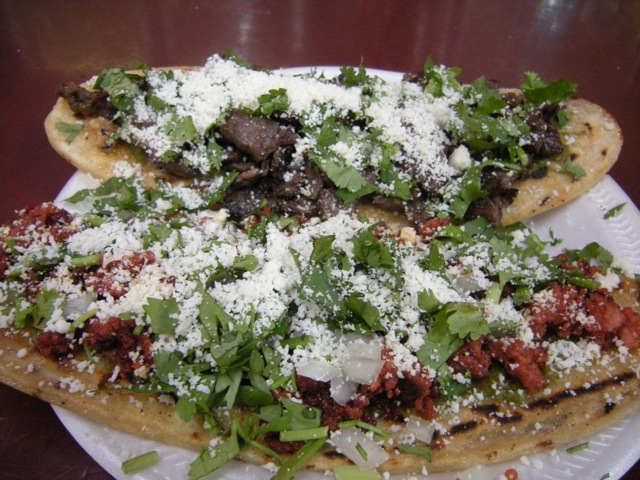
Thanks to Anne’s comment on the  papalo blog she sent me on the right track to find out more about huaraches. No wonder I couldn’t find any info I had the name wrong! I had understood guarachas. Anyhow I decided to depend my investigation and took a stroll to Guerrero Food Center in  Brooklyn Greenwood Heights where I had read they had good ones. They offer 3 kinds of Huaraches Regulares: cecina —marinated salted sliced pork; enchiladachorizo . I had a cecina and a chorizo. Overall taste was very salty, I ended up leaving some of the meat but finishing the thick and tasty bean filled  tortilla. The were topped with cilantro, and not papalo. Definitely not as good as the one I had  at the Poughkeepsie flee market.

Señora Carmen Gomez

According to the website of the Mexico city restaurant El Huarache Azteca the preparation was the creation of Señora Carmen Gomez. They also indicate that:
“luarache”, comes from the language of the Tarasco area where “cuarache” means sandal” (see original here)

And Jack Kerouac wore them while on the road:

I looked like a maniac, of course, with my hair all wet, my shoes sopping. My shoes, damn fool that I am, were Mexican huaraches, plantlike sieves not fit for the rainy night of America and the raw road night. (Jack Kerouac in On the Road, 1957)

I am not as enthusiastic —or lucky, as the Village Voice about the huaraches of the  Guerrero Food Center . The one I ate (picture on top) were very salty and totally lacking “zestiness and sharpness”.  The Upstate huaraches had all these qualities and more…
My New-York huaraches investigation would be totally incomplete without paying a visit to the  famous Redhook park vendors. Redhook park is a great place to go hang out on week ends. Soccer on one side, baseball on the other & Latino food vendors all around! You can pick from Mexican, Guatemalan, Salvadorian, Chilean delicacies
, but go see for yourself I might forget some.

Red Hook Huaraches

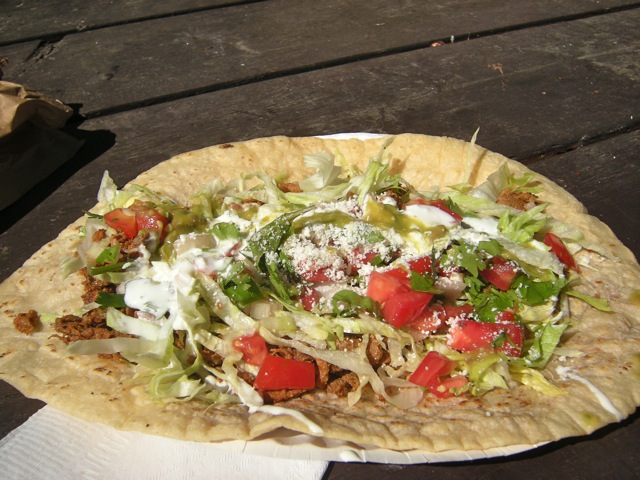
Only one vendor was featuring huaraches. We got a pork one with all the works. Instead of the oblong sandal shape thick bean filled tortilla, this one was roundish and rather thin. The overall taste was satisfying despite the meat a bit dry, not enough salsa on the bottom —we  added some on top. The veggies were crisp. I could have used a little more cotijo cheese. The winner is definitely the Poughkeepsie flea market huaraches vendor. From what I have seen so far  it doesn’t look like papalo is commonly served  with huaraches but this is the way I am going to make mine.  Stay tune for my Pyreneen sandals!

1 30 31 32 33 34 60