Fear Factor Nov. 3, 2004 painting by N.P
(part of the Angoulème performance)
I really miss writing the blog regularly but a couple of deadlines have kept me totally busy. One of them is the preparation of the performance with Pierre Joris & Miles Joris-Peyrafitte that will happen this coming Thursday in Angoulême (France). No Thanksgiving for us! We are off tomorrow and below is the info about the show in case you are around this area. This is my first trip to the Poitou-Charente region and I am looking forward to discover their food specialties and have some of the delicious Pineau des Charentes — a mix of wine and cognac. It will be my pleasure to report if I have any time to do so. But right after, I am off to the Pyrenees for more work on Augustus Saint Gaudens. I am leaving you with a few posts from last year, and please do dig into the archives and the categories.
Thursday November 25th 2:30Pm
L’art, L’éducation et le politique
Colloque International, Angoulême
Salle Nemo
Description of the show:
A multimedia performance of texts, videos, music, paintings commenting the “years of lead” (2000-2008) in the USA and examining the relation beetween art, politic & education. Pierre Joris, Nicole Peyrafitte & Miles Joris-Peyrafitte propose individual and communal attempts at resisting & criticizing the “Pax Americana.”
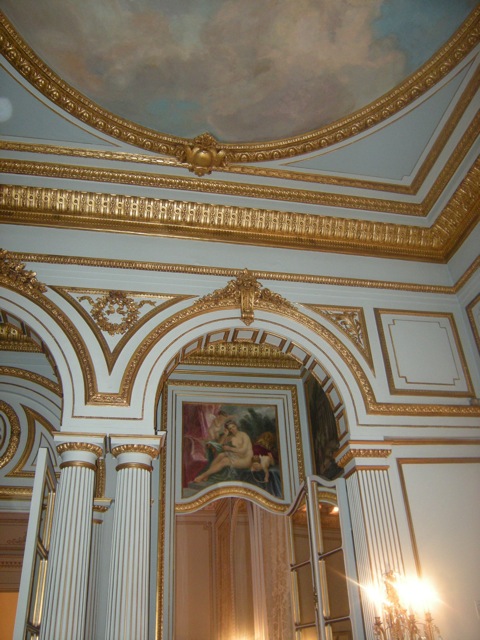
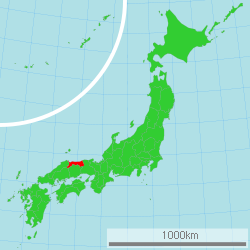
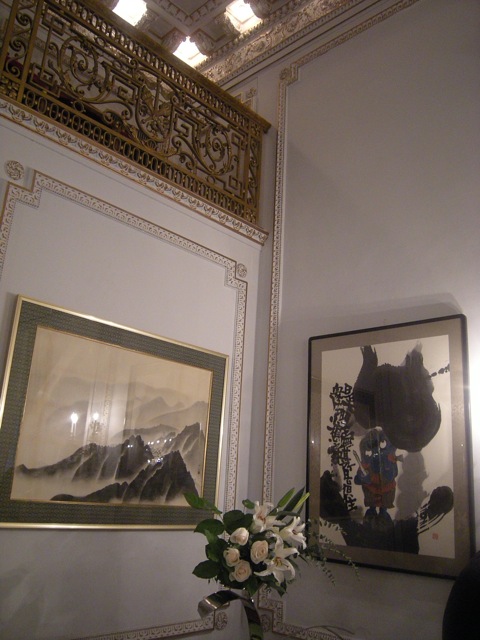
It was great fun to be a guest at the Official Residence of the Consul General of Japan in NYC to celebrate the Capital of Japanese Food (self declared): the Tottori prefecture. Under a grey and crying sky ready to fall on my head I was more than happy to take refuge in the Carrère & Hasting early 20th century building for a gastronomic & cultural escapade. While being searched to the beat of light salsa music, the gaudy French Louis the something or other décor and the delicate Japanese paintings indicated a delightful juxtaposition of cultures. I knew nothing about the Tottori region, but I’m ready to go visit! To quote Wikipedia:
According to the brochures, the Tottori region offers an amazing variety of landscapes, natural resources & ancient cultures. From the legendary largest sand dunes of Japan, to the beauty of Mt Daisen, to the treasures of ancient Buddhist temples — and all this at the edge of Sea of Japan!
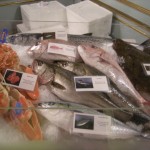
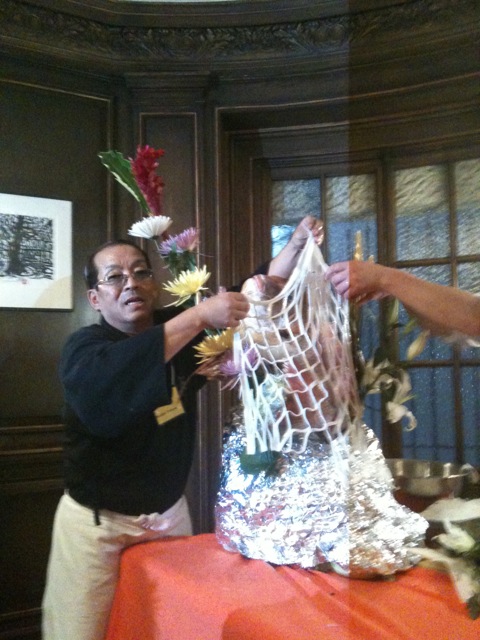
The short and convivial opening remarks by the consul & the governor were followed by an Ikizukuri demonstration/performance by master chefs from the Tottori region: Souichi Chikuma (executive chef at Ryokan Ohashi) and Tetsuyoshi Hada (executive chef at Kouraku). Ikizukuri means “prepared live,” and is the preparation of sashimi from a living animal. In this case the fish was already dead. The master chef skillfully carved the flesh out without damaging the exterior appearance of the fish (that reminded me of the first time I had to debone a quail without breaking the skin, not easy!) The fish was then set on bamboo sticks and adorned with an Ikebana style flower arrangement. The flesh cut into bite size sashimi was laid on top of the fish. While chef Chikuma worked on the huge red sea bass, chef Hada turned a large daikon into lace. We were told that this type of arrangement is very costly and done only for special celebrations like weddings.
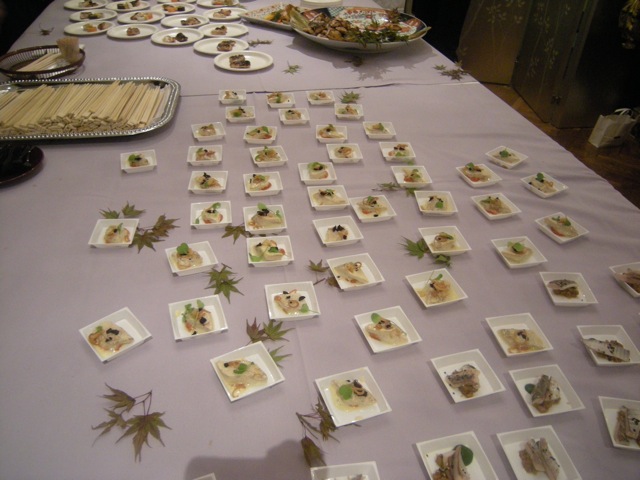
On the second floor Tottori products were displayed for sampling. Tottori’s water is renown throughout Japan for its purity and richness, thus the quality of the local rice, sake, tofu and other products. I tasted delicious sakes from different grades of polished rice, though I need a few more tastings before I can really appreciate the sake subtleties. I was introduced to 20th century pear liquor and vinegar. They didn’t come from the same company but they were both interesting and I will certainly buy them when readily available. The 20th century pear grown in Tottori is the Nijisseiki variety; in Japanese Nijisseiki means “20th century”. I would assume that the link between the name and the date comes from the fact that the cultivar was created in Japan in1898.
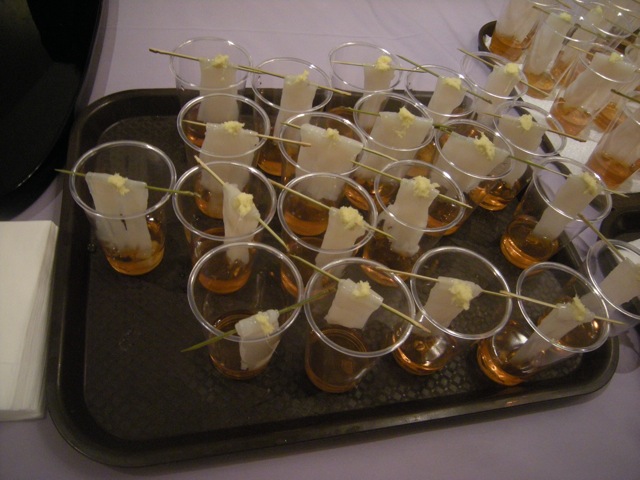
One regret was not to get to try the star crab of Tottori, the Matsuba crab also called Queen crab or snow crab, it is a winter delicacy that was on display (frozen) but not for tasting. We got to try the delicious white squid served raw over a cup with a light broth; a most delicate colored trio of Aji —horse mackerel— wrapped in ribbons of radish, carrot and cucumber.
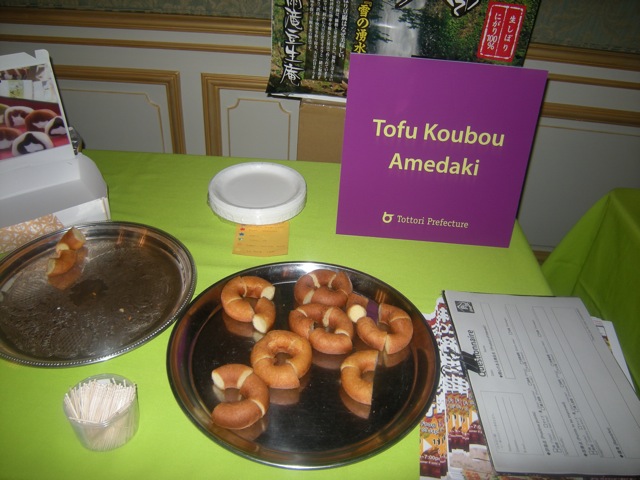
I cannot describe everything I ate as I am running out of time and I will conclude with Tofu Koubou Amedaki, a tofu doughnut! I was not going to try it, but being a fried dough fan I couldn’t resist and I am glad. It looks like a doughnut but tastes like a heavenly doughnut! Very soft inside, crunchy outside, not overly sweet & made with fresh soy milk.
Tottori came to me, now I need to go to Tottori! And thank you Shigeko & Miguel from La Fuente Services & of course Chiaki!
Pinkonobalastic, Pinkonobalistic, Pinconoklastic! That will be the short multimedia performance that I will be offering Wednesday October 28th 7PM at the Emily Harvey Foundation —537 Broadway at Spring street / 2nd floor / Manhattan NYC— Weather permitting I will include an ecumenical organic communion.
The soirée is filled of international performers:
Beatriz Albuquerque
Michel Bulteau
Jacques Halbert
Per Hüttner
M.K.
Patrice Lerochereuil
Larry Litt
Jeffrey Perkins
Nicole Peyrafitte
Ivan Alechine
Taketo Shimada
Joao Simoes
Nicola Sornaga
Valentine Verhaeghe Bblago Bung / is an exploratory device / Blago Bung / blurs all disciplines /
Blago Bung / is a trans-generational mix / Blago Bung / is speed /
Blago Bung / shines performance action sound poetry video
Curated by Michel Collet and Patrice Lerochereuil.
With the support of Emily Harvey Foundation, & Montagne Froide.
Stay tuned for pink recipes & communion ideas. Hope to see you at Blago Bung!
A râgout express is a contradiction in term. A stew should cook as long as possible. This being said let’s move on!
The term râgout covers a lot of territory. A good definition would be “a well-seasoned meat or fish stew usually with vegetables.” The word ragoût comes from old French ra-gouster “to revive the taste”. We already find several ragoût recipes in Apicius’ cookbook De Re Coquinaria (25 AD). The Latin name for ragoût is: offella – a diminutive for offa which means “piece of meat, morsel”. As the name indicates, all those recipes call for some meat cut up into small pieces, a lot of spices and marinating in liquid, often wine or garum. The English equivalent is stew —from middle English stewen, to bathe in a steam bath; from old French estuver, possibly from vulgar Latin extufare, and from the Greek tuphos, source also for typhus and typhoid which provokes very high fevers.
Every cultures have some sort of ragoût. To name but a few: the Italians have ragús, the Mexicans have moles, the Spanish guisados. They all emphasize the use of produce of their area, an illustration of the local food culture. For example let’s take daube, a typical french ragoût made with beef and red wine, in New Orleans it became: “daube de boeuf Créole” where the wine has been replaced by rum. Have you tried it? I have not, but below are Elizabeth Davis ‘ words on it:
“The meat is studded with olives and cooked with rum instead of wine, and the curious point is that although the result is a very rich-tasting dish I think very few people would be able to detect the presence of rum, or to say in what precise way the stew differs from the French original”.
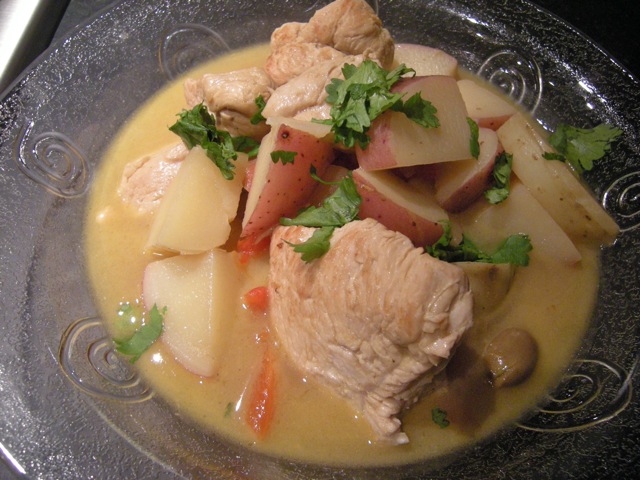
A big advantage of stews is that you can use the less expensive cuts of meat. After marinating over night or for several hours, and after the long simmering on top of the stove or in the oven the meat will be tender. If you use poultry, like in my recipe today, the meat is much leaner and will cook faster. It had too in my case!
So back to the story behind today’s recipe. We had to be out of the house at 7:30pm; it was 6:10pm. Pierre wanted to order out and I really didn’t. Any decent take out in our area takes 45 minutes and it’s expensive. I had a 2 lb turkey breast in the fridge and I had planned to cook and eat it that night! Granted we ate a little fast and to be really honest the dish tasted better the next day, but that’s true of any stew. Please look at the short video below for the recipe. I am still trying to find better ways to cook/film at the same time. Thank you for your patience and suggestions are always welcome!
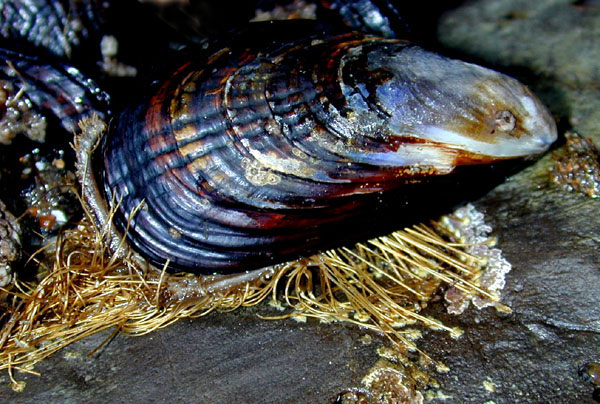
Mussels contain high doses of Omega-3, a fish oil compound that nutritionist say is helpful in reducing cholesterol. Farming mussels is believed to have been invented in France in 1235 by an Irishman named Patrick Walton. The story goes that Patrick Walton left Ireland to escape the police. His boat wrecked on the coast of France. He tried to feed himself by trapping sea birds. To this purpose he planted stakes into the water at the edge of the beach and stretched nets over them. The sea birds ignored the contraption, but after a time he noticed that mussels had attached themselves to the stakes and were growing rapidly. Cute story! But there are some indications that the Gauls had cultivated mussels even before the roman invasion.
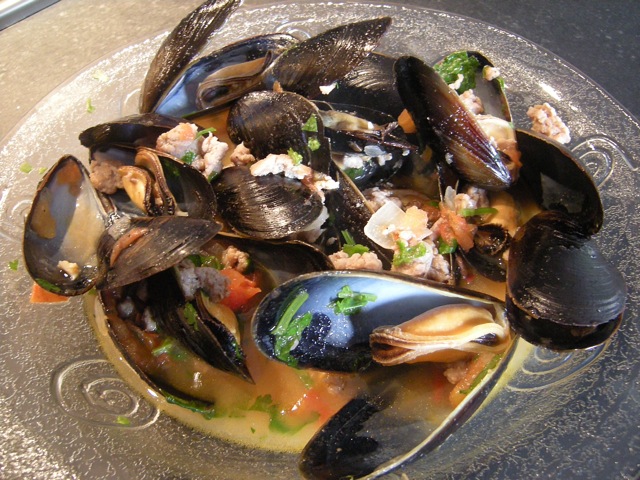
The most common way of preparing mussel is as Moules Marinière; our version today is an extension of this traditional preparation. It is my original version based on several French Southwestern recipes and inspired by what I found at the Bay Ridge Greenmarket this morning and I call it Country Mussel or Moules Paysanne.
First a few tips about mussels:
How much mussels to buy per person?
To serve them as a main dish, get as much as one pound per person. As an appetizer half a pound should do it.
Do’s and Dont’s about store bought mussels
1- Do’s
-Discard dead mussels: that is if one is wide open, it’s probably dead. If they are open only slightly, a quarter of an inch or so it should be fine. How do you tell if a mussel is merely gaping to breathe or if it is dead? Simply put ice on the mussels for 15 minutes then tap them gently. They should begin to close. If they move, they are alive therefore can be eaten – even if they don’t close all the way. If a mussel won’t move, and is gaping widely, it is probably dead, past it’s shelf life and should be discarded.
-Throw out broken-shelled mussels.
-De-beard mussels. Most likely you will not have to do that, and good for you. I remember cleaning kilos of them in my early restaurant time and that’s ain’t fun. Today they are de-bearded before you buy them, but once a while one is missed and you get to see what the beard looks like. The “beard” also known as Byssal, or byssus threads they are the strong, silky fibers made from proteins that are used by mussels to attach to rocks, pilings, or other substrates.-Discard heavy mud filled mussels. Some extra-heavy mussels that are closed may be full of mud. Doesn’t happened very often but worth checking because only one of these unloading its cargo in your kettle of broth will spoil the entire dish. Usually a “mudder” can be discovered by simply squeezing the shells and sliding them apart from each other.
-Rinse them just before using them
2- Don’t
-Do not soak them
-Do not over wrap or purchase over-wrapped mussels. Remember they are alive, do not suffocate them in the fridge or do not store mussels in airtight containers.-Do Not overcook your mussels-Do Not buy mussels that are displayed in live lobster tanks or in shellfish display tanks.
-Do Not eat mussels if you believe you are allergic to shellfish.
Recipe for 2lbs of Mussels
Sauté 4 shallots and 1/2 lb of Italian turkey sausage (or sausage, or Italian sausage or pancetta, or ham) in a tablespoon of butter and oil (addition of oil will keep the butter from browning); when meat has rendered and the shallots are transparent, add 1 or 2 (depending on how you like it) skinned, seeded and diced fresh tomatoes (canned if not in season). Mix it all well, add a generous amount of fresh ground black pepper and salt to taste.
Add all the mussels (that have just been rinsed), mix well. Add about 1 large glass of dry white wine (about a glass per two pound bag). Close the pot tightly and cook over medium heat for about 10 minutes. Add a generous amount of finely chopped parsley or cilantro or basil and also garlic it you would like your dish stronger and especially if your meat was not already spiced.
Mix it all up and let cook for two more minutes. Please do not over cook them, or they will become rubbery. At this point all your mussels are open and ready to be eaten!
Serve in soup plates with a lot of fresh bread to dunk into the broth. Eat them with your fingers and use the shell to scoop out morsels—If you are from Bay Ridge get Country bread at Yanni’s Restaurant on 4th & Ovinton.
Voilà! and now please do watch another one of my homemade videos. The Country Mussel recipe was literally filmed with the left hand while cooking —and then eating, just watch until the end! with the right one. I didn’t know I could do this until today. Honestly tell me if it is watchable and/or helpful.




 Fear Factor Nov. 3, 2004 painting by N.P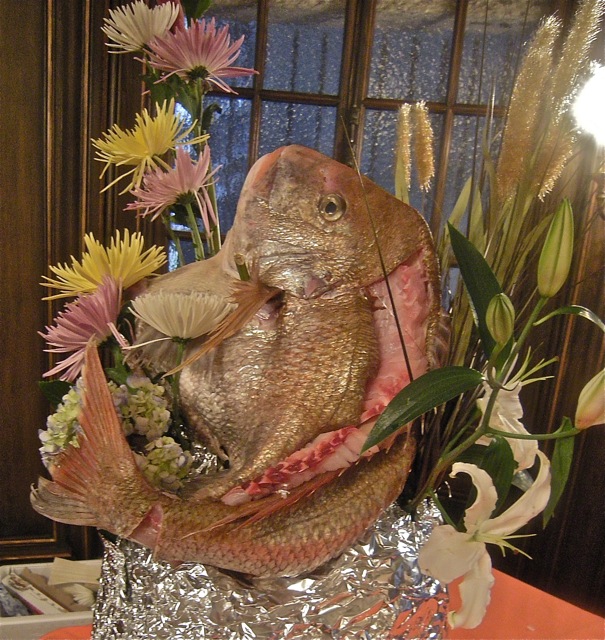

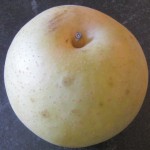 On the second floor Tottori products were displayed for sampling. Tottori’s water is renown throughout Japan for its purity and richness, thus the quality of the local rice, sake, tofu and other products. I tasted delicious sakes from different grades of polished rice, though I need a few more tastings before I can really appreciate the sake subtleties. I was introduced to 20th century pear liquor and vinegar. They didn’t come from the same company but they were both interesting and I will certainly buy them when readily available. The 20th century pear grown in Tottori is the Nijisseiki variety; in Japanese Nijisseiki means “20th century”. I would assume that the link between the name and the date comes from the fact that the cultivar was created in Japan in1898.