Beans & Saint

Beans & Saint

DSCN4030

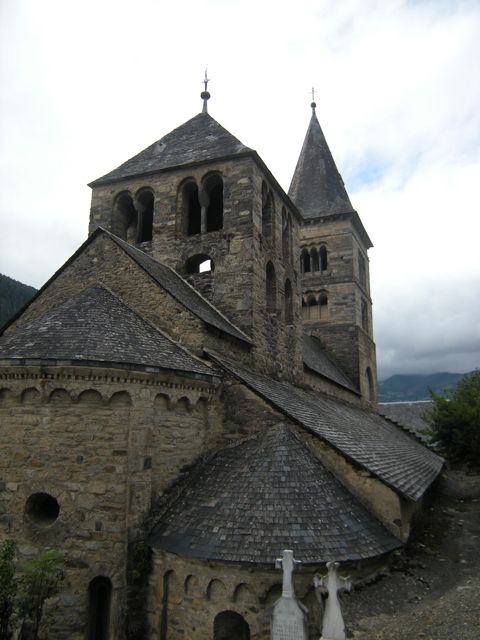
A little culture before briefing you on more food extravaganzas. We are getting ready to go to Pierre Joris’ induction into the “Ordre Pacifique et Souverain de Tastos Mounjetos” or in short: The Pacific Order of the Bean Eaters! My father is a founding member and I was inducted in  1992. This year I will be the godmother of Mr. Brunet who is a scholar in local history. We will certainly report more on the event; meanwhile enjoy the beautiful engraving of a Romanesque gem. The induction starts with a parade in the streets of the town at 4PM and is followed by a banquet attended by more that 300 people. For sure we will eat the “Pistache” — a bean stew with mutton and fresh porc rind.

This is one of the most beautiful Romanesque Churches (11th – 12th cent.) of the Central Pyrenees. It is situated in the village of Saint Aventin about 7 kms west of Luchon on the road going towards the Col de Peyresourde that you might remember if you follow the Tour de France.

There is a version of the legend:
Saint Aventin was an 8th century hermit who had been imprisoned by the Sarrasin invaders in the tower of Castel-Blancat situated on the facing slope of the valley. He freed himself and jumped over the valley to land on the site where the church is established today. He was recaptured and this time decapitated. He picked up his head and walked to the place where is tomb is said to be today. His cult is also celebrated on the Spanish side of the Pyrenées.
Pyrenean Fast Food!

Pyrenean Fast Food!

DSCN4004

The other evening we fell into an aperitif trapère! We stopped at our favorite local bar-restaurant “Le Faisant Doré” to meet my brother Jean-Louis to have an apéritif (before dinner drink) before making our way back up to the montains with our good friends Peter Cockelberg and his wife Delphine Grave for dinner. The one drink turned out to be a round per person. Jean-Louis was already sitting there with his 2 good buddies, that made a total of 7!  Thanks god I was drinking small ballons de rosé & managed to skip a few. It is always one of my great pleasure to hang out with my bro, he is the funniest and the most entertaining guy. Not really a politically correctest dude, but I adore him and put up with his most salacious & sarcastic comments!

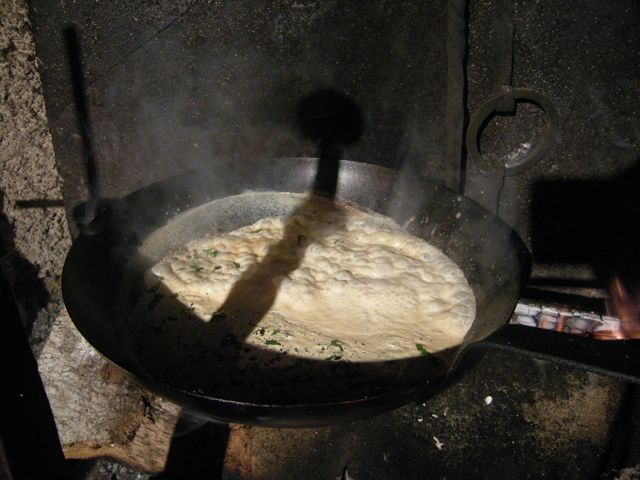
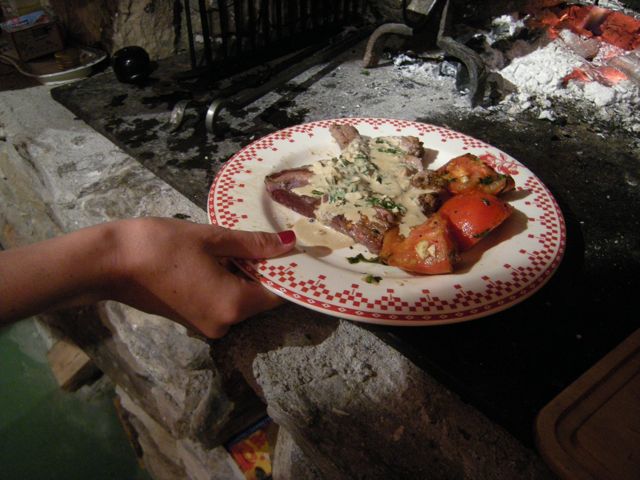
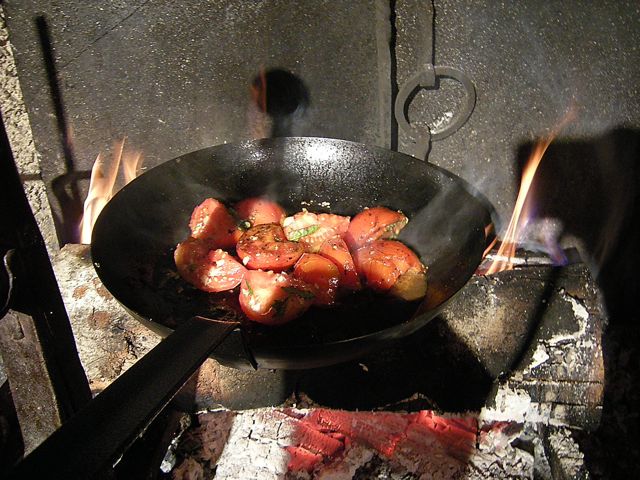
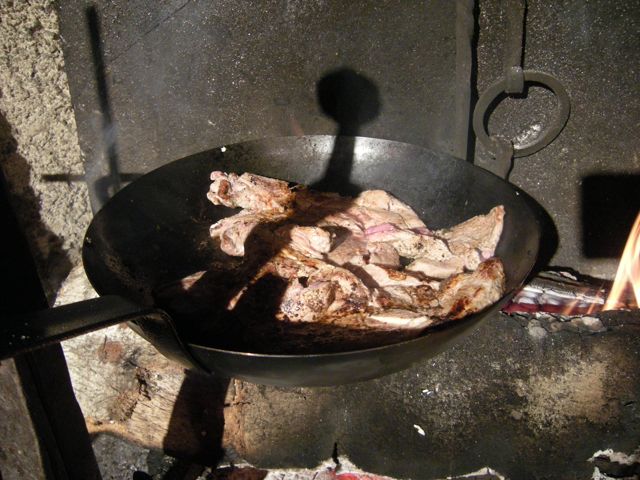
Anyhow we safely returned to the mountains and managed to cook dinner in a flash. Again, no time to wait for the fire to make enough embers to slowly cook the beautiful slab of veal from chez Jammes. I pulled out my frying pan and cooked it all on the open fire.

Tranche de Veau Sauce à l’Ail et au Basilic
Pan fried veal with basil & garlic cream sauce
Tomates Provençales
Pan fried tomatoes with persillade

DSCN4000

Render enough fatback (see previous blog) to lightly coat the pan and cook the meat medium. Reserve and keep covered in a hollow dish.

In the same pan render a little more fatback add the tomatoes cut in half or quartered, depending on their size. Add the persillade when the tomatoes are almost done, sauté a few minutes and reserve.

DSCN4005

Still in the same pan, add some brandy and flambé. Add the juices that have rendered in the meat dish. Add one cup of heavy cream, the garlic and let boil on the fire. Once the cream starts thickening add the freshly (at the last minute or it will darken) chopped basil. Boil a few more seconds, add salt, pepper and some ground piment d’Espelette (see last blog). Pour the sauce over the meat and voilà! Eat and lick your plate!

Veal Tomates

Le Paté de Ken

Le Paté de Ken

We are trying to settle a minimum into our new place before taking off for 6 weeks in France/Luxembourg. We will mostly be in the Southwest though the first week in the Southeast, then a final week in Luxembourg. If you are traveling around these areas come and see us!
Pierre will be at the fabulous Lodève poetry festival : Les Voix de la Mediterranée (July 18-27). He will perform almost every day and we will meet up with him around July 24th. Miles Joris-Peyrafitte and I will debut our duo tour in the streets of Aix, Montpellier, Lodève and we will have 2 concerts in Peyragudes (Thursdays 6 & 13 of August). Peyragudes is a resort next to Luchon.
I do hope to be able to post photos and recipes as often as possible. Meanwhile I have to run to open more boxes in order to repack! I want to leave you on a less frantic note. Below, a beautiful recipe  from Ken Albala. Ken is a food historian, a great investigative cook, and an excellent  writer.  Ken’s books should be on your summer reading list. I am savoring his book on  beans myself and always read his blog, Ken Albala’s. Today I am cross posting my favorite kind of paté. Like Ken, I like chunky patés, and am not a fan of the smoothie spreading kind. This recipe is terrific and I can’t wait to be back in the fall to make it; here is the direct link: http://kenalbala.blogspot.com/2009/07/pate-de-campagne.html.

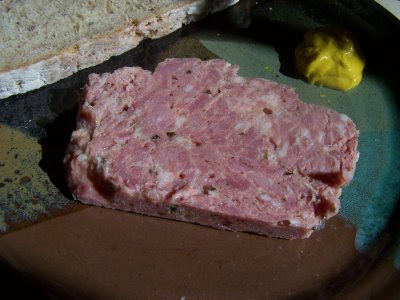
And OUI! this is a what I call a TRUE Paté de Campagne!

Saturday, July 4, 2009

Pate de Campagne?

I have to admit, I was not sure what this would be when I started. And I’m still not sure. A souse, coppa di testa, sulze. Not really, those are all set in gelatin. Nor really a pate, because it isn’t smooth and spreadable. Not that a pate de campagne should be. So there it is. And have to admit, this solid toothsome version is much more interesting than the cream-laden versions one normally sees, covered in bacon. If you want bacon, eat bacon. This one is actually cured pork. Very simply seasoned.
SO, I offer you a recipe! In standard format. Ah me. But technique IS antiquated.
2.5 lbs of boneless pork shoulder, or 4 fatty country ribs.
2 tbs salt
1 tsp coarsely ground pepper
1 tsp thyme or other herb you like, esp. juniper
1 good pinch instacure #1 (pink curing salt)
3 ice cubes
Coarsely chop the pork and pork fat into small nubbins. Add the seasonings. Mix and put in the fridge for 5 days to cure. Then put the mixture into a large mortar and pound the hell out if it for about 15 minutes. Throw in the ice cubes as you go. This is a GREAT upper body workout. I suspect if you kept going with this you would have a smooth bologna. The mixture is very much a sausage mix, with darker, lighter and white fat in a suspension but still separate, which would not work in a grinder or processor. If you have a large beef bung I would stuff it in there. I used a large round porcelain ramekin. Cover it with plastic wrap, and place in a steamer. Steam gently for 40 minutes. Cool and refrigerate at least 24 hours. Slice and serve with mustard, good rye (which I baked yesterday) and cornichons – which alas I had not. You can also slice this very thinly and make sandwiches. The next time I do this I am going to pour in a glug of cognac, or maybe vinegar. Gin would be lovely too.

Encore des Sardines!

Encore des Sardines!

labelleiloiseopen

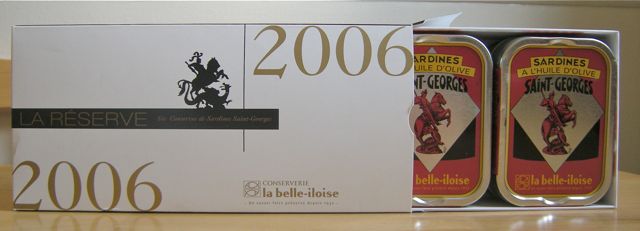
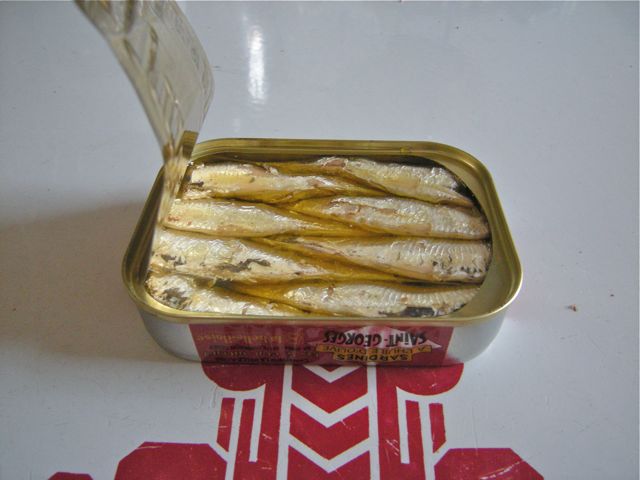
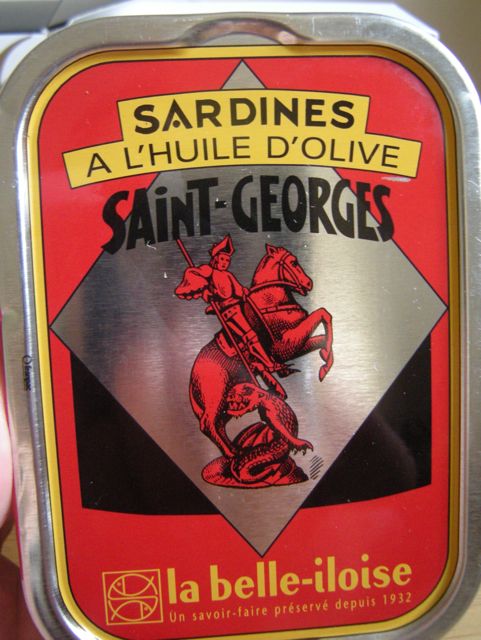
Encore des sardines! First came the sardine tartine blog, were I mentioned that King Henri IV loved sardines and introduced them to the court; then came the sardine paté at the 5c café performance; and on  Friday our friend Claire arrived from Brittany with a boxed set of a 6 cans Saint-Georges sardines “La Reserve” 2006.  Like wine, great sardines improve with time. Sardines millesimées, or vintage sardines, can be kept for up to 10 years.  Cans need to be turned over every 6 months so they are equally bathed in oil.  I decided not to wait 7 years to try them as I am too curious &  have never had “vintage” sardines before.
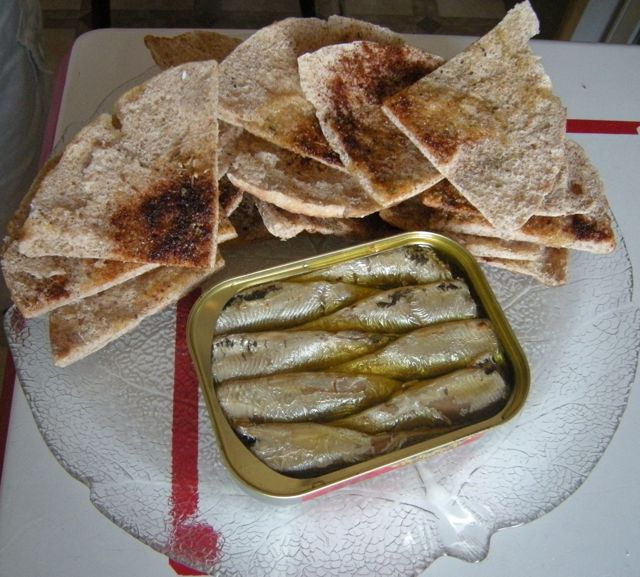
Claire and her family are true sardine aficionados so I knew it was going to be good. In fact it was a crescendo of goodness.  It started out when pulling up the tin ring and discovering the silvery little fishes perfectly aligned while resting in fragrant & subtle golden extra virgin olive oil. Then the smell trapped in the can quickly revealed a fresh ocean breeze.  So inviting!  My daughter-in-law prepared some spiced pita bread, and it proved to be a perfect support, though I grabbed my first vintage sardine with my fingers and put it whole in my mouth. The dainty fish flesh sent out 3D emotions to my neurons, and these were indeed the best sardines I ever had. I sure will not make sardines paté with these — too good, too beautiful to do anything to them but eat them whole.
A word about the can factory:
La Belle Iloise is a family affair. The company was created in 1932 by Georges Hilliet, thus the naming of the sardines: Saint Georges. His grandson Bernard Hilliet is still running the factory and his daughter is scheduled to continue the tradition and take over the operations in a few years. The factory is located in Quiberon. They operate their own retail stores and that is why they were able to survive. When mass distribution set  in, they decided to cut out the middle man and operate their own stores.  They have several of them where they sell their various products. I have tried only the sardines but according to Claire it is all good. All this info is available on their (french only) website.

We ate the sardines while watching the soccer game USA-Brasil. USA lost honorably but for me the sardines where definitely the highlight of the day. Joseph (my elder son) complemented the special sardines with a pleasant iced cold Lalande chardonnay from Gascony.  We ate 2 cans, I gave one to Joseph and will save the other 3 for a couple of years. Stay tuned — I’ll report. Meanwhile: vive les sardines!
DSCN3464saint george sardines

Poor’s Man Lobster & Garlic Scapes

Poor’s Man Lobster & Garlic Scapes

Lotte Nicole!

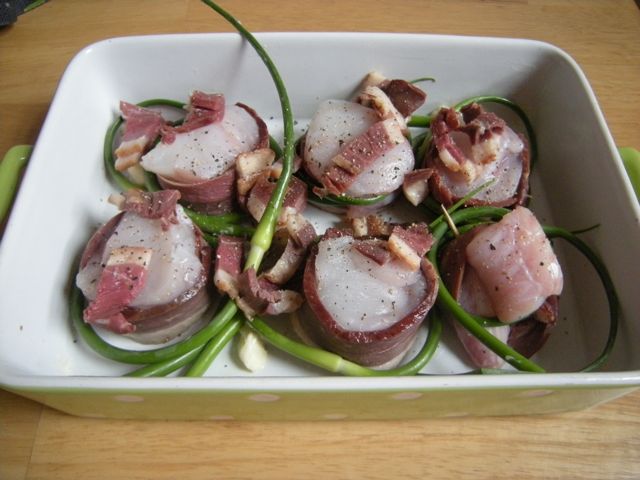
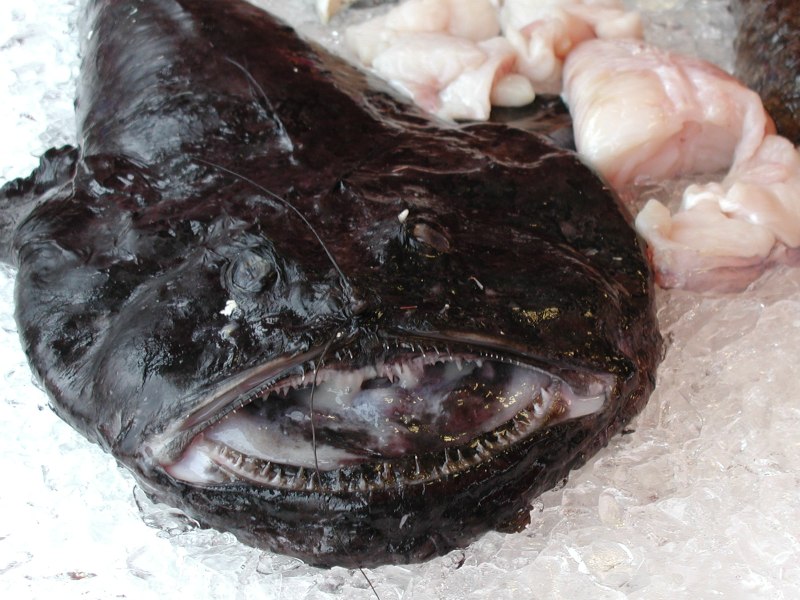
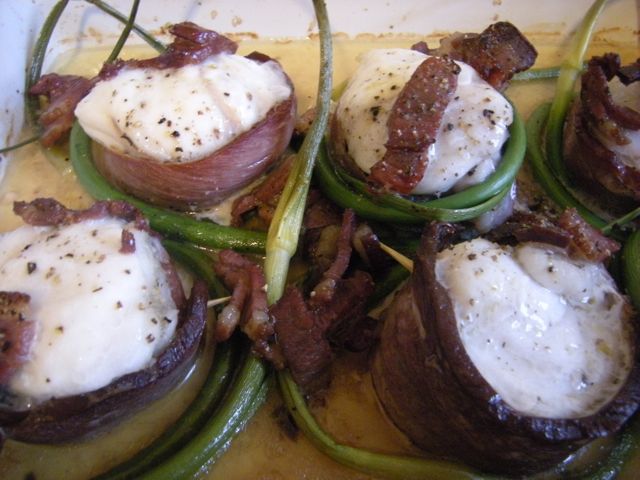
Also called monkfish, lotte or baudroie in French, this excellent  —not so good looking— fish belongs to the Lophius family. The firm consistency of its flesh resembles lobster meat. The liver, cheek and tail are eaten. The head is rarely seen at the fish store. The tail is the piece most often available for purchase. I got mine at the Bay Ridge Green Market and it was beautiful. Monkfish has been my favorite sea fish since I was young. Back then it was because there were “no” bones  — only one big central bone that is easily removed, but none of those little sneaky ones.  The meat can be roasted whole or cut into chunks. It can also be sautéed, skewered, poached, broiled, pan fried & served with all kinds of sauces. My choice today was: roasted, wrapped in duck bacon, tied with garlic scape.


Monkfish or Lophius
Piscatorius


I shared this dish with my friend, poet Patricia Spears Jones, and I would appreciate it if she would comment on it. Meanwhile you can read one of her great poems here.

Recipe:
Preheat oven 375º
Cut the fish into equal chunks.
Coat an oven proof dish with extra virgin olive oil.
Wrap the pieces with duck bacon, or regular pork bacon (though the duck bacon gives it an interesting flavor)
Tighten with a garlic scape ( if already a little hard peel the scape)
Cut little pieces of bacon, sprinkle on top.
Add salt and fresh ground pepper.
Put into the oven for about 20/25 minutes.
Serve with boiled potatoes if it is a main course.

Garlic Scapes
Garlic scapes

Note on Garlic Scape:
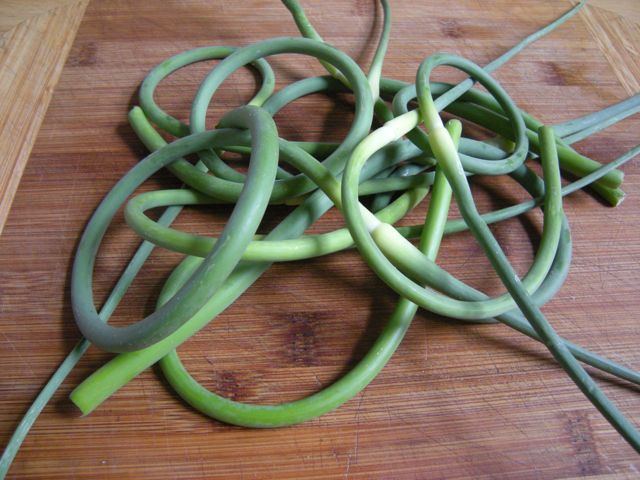
Often just called “scapes”, these beautiful curly  greens are the flower stems that are snapped off the garlic in early summer in order to give more energy to the bulb to grow. Their taste is
milder than garlic bulbs. They can be chopped and used in stir fry like green beans or asparagus. A real delicacy, and I look forward to see them at the Farmers Market or Food Coop every June. (For more info read this article on Mother Hearth News).

lotte aux pousse d'ail

1 5 6 7 8 9 12