Soupe, Chorba, Çorba, Suppa, Soup, Sopa…..

Soupe, Chorba, Çorba, Suppa, Soup, Sopa…..

Pierre Joris' Chorba

Soups are made everywhere in the world with all kinds of ingredients. Many appealing adjectives can describe them: healthy, earthy, cheap, restorative, easy to make, filling, convenient, the list is infinite. First lets clarify some terminology:
At the beginning the “soupe” was the bread dunked into the broth. This tradition remains ­– think for example of how in this country crackers or bread are inseparable from a bowl of soup.

If you are a beginner cook, soups are great to experiment with as it is rather difficult to ruin a soup.
Though all soups aren’t born equal and here are a few examples from the fanciest to simplest:
Consommé: a clarified meat or fish broth.
Bisque: puréed shellfish with cream soup.
Velouté or Crème: vegetable or meat based thickened with eggs yolks, butter and cream
Potage: falls somewhere in between velouté & soup texture and thickness.
Soup: refers to a thick, earthy chunky melange; think of French Onion soup, Bouillabaisse (fish stew soup), and last but not least the Garbure! also the title of my performance The Garbure Transcontinentale/The Bi-Continental Chowder where I cook this original recipe on stage, mirror the ingredients with songs and then share the soup with the audience. I am including the 10-minute video at the end of this post.

Today I will pass on a North African soup or chorba recipe that my partner Pierre Joris learned while living in Constantine, Algeria. This is one of our favorite winter dinners and we always eat it as a “plat unique”, or only course, and eat several plates. Follow it with a salad of fresh oranges with cinnamon, mint and chopped almonds for dessert.La Chorba de Pierre
Ingredients :

for 8 people

2 lbs of Lamb – shoulder cut into small pies & save bones
1 big Onion, finely chopped
1 heaped spoon of sweet Paprika
Salt-Pepper

1 big bunch of Fresh Cilantro/coriander; 1/2 cup finely chopped. The rest of the bunch divided in half. The first half will be tied and dropped in the pot once all the other ingredients and the water will be in. Second half chopped and served as garnish at the table
2 cloves of Garlic, finely chopped
2 quarts of Water
1 diced fresh Tomato in summer; or 1/2 cup of canned organic diced tomato in winter
1 Cup of washed Freekeh (green wheat available at middle eastern markets and some health food stores, Bulgur can be substituted, but will not have as rich and complex a taste)
Harrissa
: 1 tube or can (a North African hot red sauce or paste made from chili peppers, garlic, coriander and caraway or cumin. It may also contain tomatoes.You can get Harrissa du Cap Bon by clicking on the link or you can make your own.)
Lemon (2): quartered to serve at the table as garnish

Preparation:

Generously coat a large sauce pan with olive oil –the Le Creuset 7 1/4-Quart Round French Oven is the one we do prefer, a once in a life time investment!– when oil is warm, sauté the onions until translucent. Add the meat and bones, sauté thoroughly. While the meat is browning, add the Paprika, Salt, fresh ground Pepper and the 1/4 cup of Fresh Cilantro, mix well and keep sautéing for a few minutes. When nicely browned add the water and the tied bunch of Cilantro, bring it to a boil, lower the heat and simmer for 1 1/2 hour.
At that point remove the Cilantro bunch and the bones (if you wish). Add the cup of Freekeh and the chopped tomato. Bring to a boil, reduce and simmer for about 1/2 hour or until Freekeh is cooked.
Bring garnishes (Lemon, Harrissa, Chopped Fresh Coriander/Cilantro) & Chorba at the table. Each person fills a plate, adds their desired amount of Harrissa (I use 1/2 a teaspoon but be careful you can always add some but it is difficult to take it out!)

Enjoy: it will warm the cockles of your heart!

La Garbure Trancontinentale-The Bi-Continental Chowder
a performance written, cooked, filmed and sung by Nicole Peyrafitte.
Video Elizabeth Germa
James Beard Foundation

James Beard Foundation

Pierre Landet, Executive Chef at Cercle Rouge,
featured at The James Beard Foundation

Pierre Landet @ James Beard Foundation
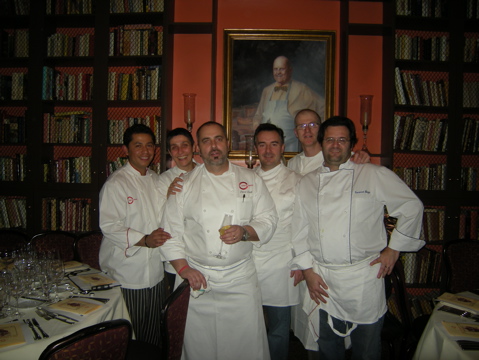
Pierre's crew for the occasion. From left to right: Fernando Merino (sous chef at Cercle Rouge), Nicole Peyrafitte (Voilà Nicole), Pierre Landet, Pascal Pettiteau (Chef at Jubilee), Martial Gaspar(Private Chef), Régis Courivaud (Chef at Le Monde)

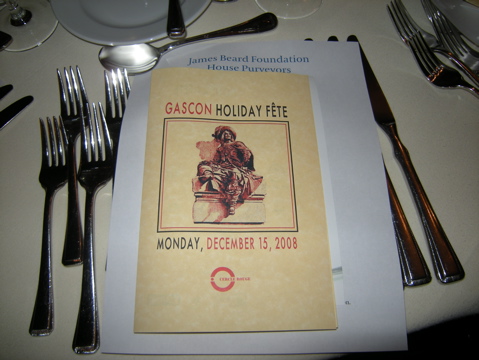
On December 15th 2008, I was very honored to be one of the assistant cooks at The James Beard Foundation Cercle Rouge in NYC for a dinner featuring my friend and Gascon mate: Executive Chef Pierre Landet accompanied by Wine Director Dominique Drevet both from Restaurant Cercle Rouge. 65 members/guests were delighted by Pierre’s menu untitled: A Gascon Holiday Fête and voilà ze menu:


Hors d’Oeuvres

Crispy Salsify Rolls with Bayonne Ham and Laguiole Cheese

Pan-Seared Foie Gras with Parsnip Purée and Green Tomato Preserve

Smoked Salmon Purses with Asparagus Bavarois

Pousse Rapière

Dinner

Chestnut Cream Soup with Crispy Pancetta and Chanterelles
Château Tour des Gendres, Bergerac Rouge 2007

Pan-Seared Brook Trout with Porcini, Baby Artichokes, Duck Fat–Confited Fennel, and Jus
Château Haute Lavigne, Côtes de Duras Bordeaux 2007

Milk-Fed Roasted St-Canut Farm Porcelet with Cassoulet-Style Tarbais Beans
Domaine des Deux Ânes, L’Enclos 2005-Corbières

Bleu de Basque Cheese with Celery, Fig, Frisée, and Walnut Dressing
Domaine La Tour, Vieille Banyuls 2005

Millas Toulousain
White Cornmeal Cake with Homemade Plum Preserves
Charles Hours, Uroulat Jurançon 2006

It is truly difficult to say what tasted the best. Every dish was hearty & subtle at once. The chestnut cream soup might have been my very favorite, but then the porcelet -suckling pig- and the Tarbais beans had all the ever so satisfying Gascon flavors, and the Millas with the Homemade Plum Preserve made you feel as if you were in a farm house in Southern France during the pig’s feast.

Dominique Drevet’s selection of wines -from Banuyls to Bordeaux- perfectly matched every dish. The Catalan Banyuls & the Bleu de Basque Cheese was a match in haven.

The “service” went like a breeze. The crew was impressively efficient and Pierre’s “mise en place” impeccable. The full time staff was impressed. Below are some of the professional photographs of the dishes taken by the James Beard Foundation Geoff Mottram :

Pan-Seared Brook Trout with Porcini, Baby Artichokes, Duck Fat–Confited Fennel, and Jus

The 35th Annual New Year’s Day Marathon Reading

The 35th Annual New Year’s Day Marathon Reading

An announcement from the Poetry Project:
Is there a better place to be on New Year’s Day in New York City? Please join the Poetry Project for our benefit, the 35th Annual New Year’s Day Marathon Reading! Ron Padgett will kick us off at 2pm and about 140 performances will lead us into the euphoric early morning. Other things to look forward to: Nicole Peyrafitte making crepes in the Parish Hall, pierogis from Veselka, an abundance of newly donated small press poetry books, and of course, charming and well-dressed hosts.

Note that our office will be closed the week of the 22nd. See below for complete information:
January 1, 2 PM
The 35th Annual New Year’s Day Marathon Reading

Poets and performers include Bruce Andrews & Sally Silvers, Arthur’s Landing (Ernie Brooks, Steven Hall, Yvette Perez & Peter Zummo), Vyt Bakaitis, Jim Behrle, Martine Bellen, Anselm Berrigan, Edmund Berrigan, Barbara Blatner, Justin Bond, Donna Brook, Franklin Bruno, Tisa Bryant, Peter Bushyeager, Reuben Butchart (w/ John Carroll), Steve Cannon, Yoshiko Chuma, Todd Colby, John Coletti, CAConrad, Corina Copp, Brenda Coultas, Geoffrey Cruickshank-Hagenbuckle, Mónica de la Torre, Katie Degenetesh, Barry Denny, Maggie Dubris, Douglas Dunn, Marcella Durand, Steve Earle, Will Edmiston, Marty Ehrlich, Joe Eliot, Laura Elrick, Avram Fefer, Bonny Finberg, Jess Fiorini, Corrine Fitzpatrick, Foamola, Merry Fortune, Tonya Foster, David Freeman, Ed Friedman, Joanna Fuhrman, Cliff Fyman, Drew Gardner, John Giorno, John Godfrey, Abraham Gomez-Delgado, Sylvia Gorelick, Stephanie Gray, Ted Greenwald, John S. Hall, Janet Hamill, Diana Hamilton, David Henderson, Bob Hershon, Mitch Highfill, Bob Holman, Erica Hunt, Brenda Iijima, Lisa Jarnot, Hettie Jones, Patricia Spears Jones, Pierre Joris, Erica Kaufman, Lenny Kaye, Evan Kennedy, Aaron Kiely, Paul Killebrew, David Kirschenbaum, Bill Kushner, Paul La Farge, Susan Landers, Denize Lauture, Joseph Legaspi, Joel Lewis, Rachel Levitsky, Brendan Lorber, Filip Marinovic, Susan Maurer, Gillian McCain, Tracy McTague, Taylor Mead, Jonas Mekas, Jennifer Monson, Rebecca Moore, Tracie Morris, Gina Myers, Eileen Myles, Marc Nasdor, Murat Nemet-Nejat, Jim Neu, Richard O’Russa, Akilah Oliver, Geoffrey Olsen, Dael Orlandersmith, Yuko Otomo, Ron Padgett, Julie Patton, Nicole Peyrafitte, Wanda Phipps, Kristin Prevallet, Arlo Quint, Chris Rael, Lee Ranaldo, Citizen Reno, Frances Richard, Renato Rosaldo, Bob Rosenthal, Douglas Rothschild, Thaddeus Rutkowski, Tom Savage, Michael Scharf, Harris Schiff, David Shapiro, Elliott Sharpe, Frank Sherlock, Nathaniel Siegel, Samita Sinha, Hal Sirowitz, Patti Smith, Christopher Stackhouse, Stacy Szymaszek, Anne Tardos, Cecil Taylor, Steven Taylor (w/ Debra Salvo), Susie Timmons, Rodrigo Toscano, David Vogen, Anne Waldman, Nicole Wallace, Jo Ann Wasserman, Phyllis Wat, Karen Weiser, Dustin Williamson, Max Winter, Don Yorty, Emily XYZ and more.
Become a Poetry Project Member! http://poetryproject.com/membership.php

Calendar: http://www.poetryproject.com/calendar.php

The Poetry Project is located at St. Mark’s Church-in-the-Bowery
131 East 10th Street at Second Avenue
New York City 10003
Trains: 6, F, N, R, and L.

www.poetryproject.com

Admission is $8, $7 for students/seniors and $5 for members (though now
those who take out a membership at $95 or higher will get in FREE to all
regular readings).

We are wheelchair accessible with assistance and advance
notice. For more info call 212-674-0910.

Dîner de Fêtes / Festive Dinner

Dîner de Fêtes / Festive Dinner

Les Croquettes de Morue sur un Lit de Verdure
Salt-cod cakes served with greens

Le Chapon de Noêl aux Marrons
Stuffed Christmas Capon with Chestnuts
&
Les “Racines” d’Hiver Braisées
Braised Winter Root Vegetables

La Crème Paysanne
&
Les Pescajous du Luchonnais

This is a festive winter dinner menu I made several time. I wrote it many years ago for a series of cooking classes untitled “The Demystification of French Cuisine” that I taught at the Café Capriccio Cooking School in Albany N.Y — someday I will retrieve my notes on that topic and will share them with you. Meanwhile here are the recipes for this menu. I think you will agree that it is a well balanced, not heavy, fun to cook & fun to eat menu! So try it and let me know. I have also included some historical background for dinner conversation!

First Course:
Les Croquettes de Morue sur un Lit de Verdure

Salt-cod cakes served with greens

Morue, a.k.a. baccalaú or salt-cod, is my favorite fish. I like the texture, the taste, the convenience, the flexibility. The use of cod can be traced as far back as the Upper-Paleolithic. And closer to us there is evidence that Basque fishermen came to the coast of Newfoundland to fish for cod way before Columbus had set foot on the American continent. Their first motivation had been to catch whales, but then they switched to fishing cod. It was safer and more lucrative.
There are many different ways to accommodate salt-cod; today we will make croquettes. This is a basic recipe that you will be able to reuse with other ingredients.
I like to serve the “croquettes” with a tossed mixed green salad dressed with a simple vinaigrette. (see my famous simple salad)

Ingredients:
1 small chopped red pepper
1/2 chopped Jalapeño pepper (optional)
1 cup chopped fresh parsley
2 eggs
1 bay leaf
3 cloves of garlic
1 whole medium onion
1 chopped medium onion
2 grated (raw) big russet potatoes
1 tablespoon saffron
salt and pepper to taste

The day before:
Rinse the filets and soak in plenty of cold water for about 12 hours, changing water three or four times.

The next day:
Place desalted cod, one onion and one bay leaf in a stock pot with plenty of water, bring to a boil. Reduce heat and simmer for 10 minutes. Drain and discard onion and bay leaf.
Mix all raw ingredients in a bowl, shred the cod in it. Mix it well. Shape the mixture into little cakes, use a ramekin if texture is too loose, and fry in a hot pan in olive oil about 5 minutes on each side (but that is going to depend on the thickness of the croquettes. I usually eat the first one to check texture and seasoning, and to judge the doneness).

Entrée
Le Chapon de Noêl aux Marrons

Stuffed Christmas Capon with Chestnuts

&

Les “Racines” d’Hiver Braisées

Braised Winter Root Vegetables

Our main course is going to be a capon stuffed with chestnuts, sausage and all kinds of delicacies. Capon is such exquisite poultry that it is saved for special occasions. Good, real capons are rare and difficult to raise and therefore difficult to get. Capons are a very ancient tradition: the creature came to us via the Romans, and the Romans learned how to fatten chickens from the Island of Kos in Greece — were Hippocrates (460-377 BC) lived and worked. The people from Kos, unlike the Romans, kept their chickens inside and gave them only selected grains and milk so they were getting fat quickly and their flesh incredibly delicate. Everybody in Rome started doing the same, keeping their chickens inside and so on, but it got to the point where so many people were doing this that Consul Caius Favius was obliged to pass a decree forbidding this practice for sanitary reasons. So now all the chickens were put back in the streets where they were easily distracted and didn’t focus on eating anymore, so they were not getting fat. Along came a veterinarian who had the idea to castrate the chicks so they would get bigger — and it worked!
Today we will serve the capon with winter root vegetables ­­ — they are delicious though much neglected and I also believe in using seasonal produce.

Le Chapon de Noêl aux Marrons
Stuffed Christmas Capon with Chestnuts
(You can find capon at the very fine purveyor D’Artagnan. A 12 pounds Capon will feed about 12 people.)

Ingredients:
1 Capon
1 Cheesecloth
1/2 stick Butter

Farce/Stuffing:
1 LB very good Bacon (no nitrates)
1 LB thin Sausage (plain)
1/2 LB ground veal
1 LB Mushrooms
25 Chestnuts cooked and peeled
2 medium onions diced
1/2 cup Armagnac (or cognac)
2 eggs
1/2 cup chopped Parsley
Salt & Pepper to taste
Lightly sauté onions, then add mushrooms, then bacon, then sausage, then 1/2 of the chestnuts. Flambé with the Armagnac. Place in a bowl, add the ground veal, the parsley, the eggs, salt and pepper. Mix well and stuff the Capon and saw it back.

Roasting:
Preheat Oven to 450 º
Butter or oil the roasting pan, place the capon in the oven and roast at this heat for 30 minutes. In a sauce pan melt 1/2 stick of butter and let it cool. Reduce the oven temperature to 325º, baste the capon with pan juices, and drape it with a piece of cheesecloth, soaked in the melted butter. Roast the bird, lifting the cheesecloth and basting every 20 minutes for about 2 1/2 hours or until thermometer registers 180ºF and when juices run clear when thighs are pierced with a skewer. Then remove from oven and from pan and let stand while you make your “jus.”

Jus:
1/2 cup Armagnac (or cognac)
2 cup chicken broth
2 finely chopped Shallots
30 Chestnuts
Remove all fat and burned pieces (if any) from roasting pan. Put the pan on top of a warm burner. Spread shallots in the pan and move around quickly. Flambé with 1/2 cup of Armagnac (make sure the fan is off when you flambé). Add the two cups of chicken broth, make sure all the caramelized juices are lifted off the bottom of the pan then add the chestnuts. Let simmer gently for a few minutes. Carve the Capon, display on a nice dish with the stuffing. Transfer the sauce to a dish, and serve!

Les “Racines” d’Hiver Braisées
Braised Winter Root Vegetables

This is a very simple dish that will enhance the flavor of your capon.
When I want to be fancy I “turn” the vegetable into olive shapes. Otherwise I cut them into 1/2 inch dice.

Use carrots, turnips or rutabagas, and parsnips -celery root is also an option. Put all your roots in a roasting pan with a little butter and water, salt and pepper, and braise at 300º in the oven until tender but not mushy!

Dessert:
La Crème Paysanne
Light Custard

&
Les Pescajous du Luchonnais

Do you still have a little room for dessert? Sorry, but I will skip the bûche de Noël —
I am not very found of it, I find it too sweet after such a meal. The pescajous will probably remind you of fried dough, they literally mean “little fishes.” This delicacy is unheard of beyond a 25 mile radius of my home town. Pescajous are served on all religious holidays. The biggest challenge about them is to be able to fill up a basket before anybody sees you making them. If just one person sees you, believe me, it will take you a long, long time to fill up that basket! Unless you can convince the little scavengers to wait for the crème paysanne to dunk them in!

Crème Paysanne

Boil 4 cups of whole milk then flavored with vanilla and rum.
In a bowl, separate 12 egg yolks from the whites. Reserve the egg whites and put the yolks in a bowl with 1 1/2 cup of sugar; whisk until it forms a ruban. Gradually add the warm milk. Mix well, keeping the pan on a very low heat and stirring continuously -making a figure 8- with a wooden spoon until the cream coats the spoon. Let cool off, and keep it in the refrigerator; cover to avoid skin formation.

Pescajous du Luchonnais

4 cups of flour
a pinch of salt
2 teaspoon Yeast
3 Eggs ( yolks separated and whites will be beaten)
1/4 cup melted butter
1 cup Milk
1 cup Sugar
2 teaspoon Vanilla and Rum

Put flour, salt, sugar in a bowl.
Proof the yeast in a little bowl.
Beat the egg white.
Mix egg yolks, vanilla, rum, butter and proofed yeast. Mix this into the flour mixture and add the beaten egg whites slowly.
Let the dough rest and rise for a couple of hours.
When ready to cook, heat 1 quart of oil (safflower or peanut oil) in a wok.
Turn the dough onto a generously floured surface, cut small pieces with a knife and shape by hand into 2 inch squares, 1/8 inch thick, and dip them into the hot oil fry them until golden (a few minutes are sufficient). Fry no more than 4 or 5 at a time and you will get best result if you keep moving then around in the oil with a skimmer. Take them out and place on an absorbent paper towel to remove excess oil and start piling them up in a basket; Sprinkle caster sugar as you go along; they are better warm, and do not forget to dunk them in the crème paysanne!
Bon Appetit!

Nymphéas

Nymphéas

Nymphéas

Pour John & Wayne

The sun has set too fast today.
Can a water lily show me the way?
An impression by Claude Monet
Let Giverny bridge Albany.
Wet paint into wet paint
Emphasizes your qualities.
The perception of your movements
Belongs to les effets de soir.
Your blue shadow is a landscape
Your reflection a guide.
Like a painting by Claude Monet
“Impression, Sunrise”
Impression, soleil levant

N.P
Bay Ridge -Sunday, October 26, 2008
Bass: Michael Bisio
Photo/Voice/Text: Nicole Peyrafitte
Recorded Live at Justin’s in Albany N.Y by Sten Isachsen -Bender Studio-November 20, 2008

1 49 50 51 52 53 63