April 20th 1954

April 20th 1954
Hotel Poste & Golf Luchon

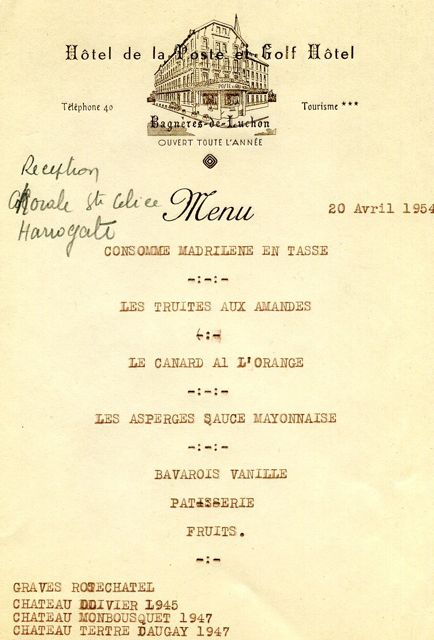
I am in Albany packing our house for our definitive move to Brooklyn. As I was packing my archives I found a batch of old menus from my family hotel that my mother had sent me a few years back. Coincidentally there was one for April 20th 1954. On the left my mother wrote a note: “Reception for the Harrogate St. Cecilia Choir”. I called my parents to inquire  how the Consommé Madrilène was served and stirred up a family disagreement, as my father and mother remembered it differently. My dad insisted that a raw egg yoke was place in the cup of cold clear broth, my mother remembered delicate strips of cold crepes as a garnish on top. Most likely they are both right and it was served one way  and/or the other. I will investigate further, to try and locate the Consommé Madrilène *ur* recipe, once I am reunited with my cookbooks. I will also post the recipes for Truites aux amandes soon. This was one of my grand father signature dishes and that will give me the opportunity to try the Union Square Greenmarket fresh trout stand. I have already posted here the Canard à l’orange recipe. The bavarois is a custard base (crème anglaise) cream with whipped cream and sometimes gelatine added. More details to come, but meanwhile, herewith a translation of the menu:

Menu’s translation
Cold clear broth Madrilène style
Trout in almond sauce
Duck with orange sauce
Asparagus with mayonnaise
Bavarois (vanilla custard)
Pastries
Fruits


Molokhia, Corète potagère, Corchorus Oilitorius,ملوخية

Molokhia, Corète potagère, Corchorus Oilitorius,ملوخية

It can be spelled Molokhia, Mulukhiya, Malukhiya, Molokia; A.k.a: Juteplante in Germany, Jew’s mallow in the UK, corète potagère or chanvre du bengale in France, Crain-Crain or Krin-Krin in francophone’s Africa, Corchorus Olitorius in Latinand finally, in Arabic, ملوخية. Until my trip to a Syrian grocery store yesterday in Bay Ridge, NY, I had never heard of it. It is a very well known Middle Eastern & African mucilaginous leave-vegetable that grows easily; it belongs to the family of the Tiliacea. It as been cultivated for century both in Africa and Asia, it is found wild on both continents.

Same family as jute (white jute is Corchorus capsularis and Tossa jute Corchorus olitorius). Raw jute was exported to the western world to make cordage, ropes and is better known in the USA as burlarp.

Once cooked the leaves produce a viscous or gooey texture similar to okra. I bought a frozen pack and since I knew nothing about it, I just followed the simple recipe on the package, just adding a few pickled chili pepper . Next time I will add a few drops of fresh lemon juice.

Molokhia soup

Molokhia Soup Recipe
Drop frozen molokhia in 2 cups of boiling water or broth.
Mix often until totally unfrozen.
In a sauce pan melt 1 tbsp of butter and lightly brown 6 finely chopped garlic cloves adding a pinch of coriander.
Add the molokhia, stir, adjust seasoning and serve.

So voilà! my dinner last night:  Molokhia soup and a batch of home made French fries. It was a quick, unusual and satisfying dinner.

Bright Yellow Yummy Pears

Bright Yellow Yummy Pears

npyellowpear1

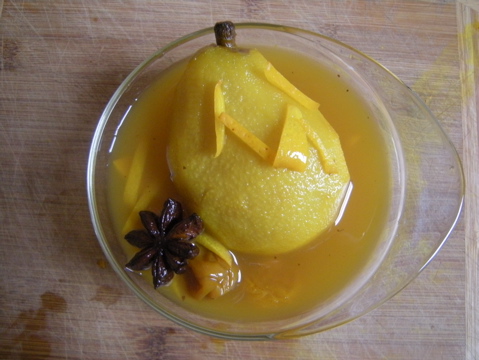
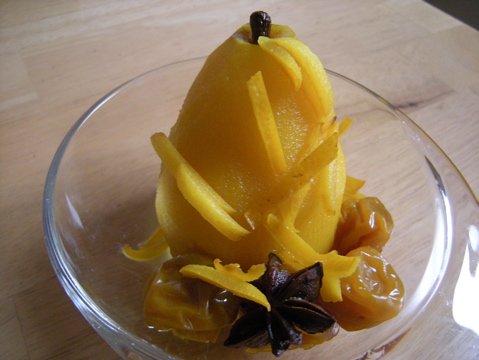
While I was cutting my pear, the bright turmeric (see turmeric blog) yellow stain on the cutting board retained my attention and then an association of visual and cooking ideas occurred: “I have to try to poach pears with turmeric they must become bright yellow”. I was obsessed all day with what else to poach the pears with. Looking good what not enough it had to taste delicious and voilà! to my taste this is a very satisfying and beautiful result.

Bright Yellow Yummy Pears
2 firm pears
1/4 cup of honey
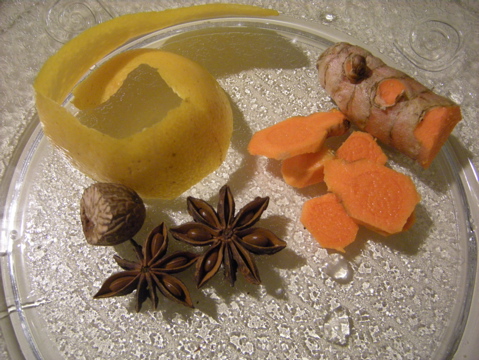
1 long lemon mayer zest (other lemon untreated will work)
2 star anis
1/2 tsp of vanilla extract
1/4 tsp of freshly grounded nutmeg
1 small finger of fresh turmeric (curcuma), peeled and cut into pieces
1 or 2 tbsp of St Germain liquor (elderberry liquor)
a few dried Turkish unsweetened yellow prunes
enough water to cover the pears

dscn2896

Peel the pears, keep the stem on, core it from bottom the best you can without damaging it -personally I do skip that step. In a sauce pan deep enough, so the pears can be immersed, place all the ingredients, lay the pears and add enough water to cover them. Bring liquid to a boil, lower the heat to a gentle simmer for about 30 minutes or until pears are tender but not too soft. Let the pear cool in their juices overnight.
Remove pears from the pan. Save the lemon zest and star anis for decoration, though you will eat the lemon zest, but NOT the star anis. Strain the liquid into a smaller sauce pan, bring it to a boil and let it reduce to about one cup of liquid -about 20 minutes-.
Serve chilled or warm. I like it both way depending of the weather or the time of the day. Can also be served with ice cream, a bed of custard, or brown rice for a healthy breakfast and that was my choice today.

dscn2909


The Food Film Fest Short Report

The Food Film Fest Short Report


Yesterday I attended the first day of Food Film Fest 2009. What started as a dreary, wet, miserable trip to the Action Center at Battery Park ended up as a full, enlightening, insightful and tasty one.

I will not have time to get into too much details but just a few notes about the event. First, this event will repeat next Saturday April 18, 2009 at Columbia University Medical Center Office of Government and Community Affairs. It is a fantastic -and free- opportunity to see these movies which are not so easy to catch. Go and let know your friends about it.

I highly recommend :
Asparagus: Stalking the American Life; Flow; Hotbread Kitchen & the trailer for Fresh.
-The trailer for Flow is above. Follow this link for Asparagus: Stalking the American Life trailer.
You will sure think twice before buying bottled water or a bunch of asparagus after viewing these films.
-The documentary about Hot Bread Kitchen, the New York Social bakery that mixes tradition with social activism. What a great idea!
-And the trailer for
Fresh, a promising documentary partially based on Michael Polland The Omnivore’s Dilemma.

The day ended with a tasty reception. Unforgettable was “Jean-Louis” a New Jersey raw milk cow cheese named in memory of my Gascon fellow chef Jean-Louis Palladin. I am not kidding this cheese is the best I have tasted in the USA so far. You can experience “Jean-Louis” too, the Bobolink dairy & Bakeyard is at Union Square Farmers Market on Fridays, Lincoln Center Greenmarket (66th & Bwy) every Thurs & Sat. If you are not in New York City do not feel excluded shop on their online store (bread not available online). About their breads, the rye is outstanding and though I don’t like flavored bread, their garlic and duck fat loaf is a must with a bbq’d duck breast!

Another great product at the reception was the raw chocolate from Fine & Raw. I can’t wait to make my “Lapin au Chocolat” with it – I don’t mean chocolate Easter bunny, no! I mean rabbit stew in chocolate sauce (a kind of mole), but that will be another post.

Joyeuses Pâques!

Turmeric / Curcuma

Turmeric / Curcuma

dscn2832

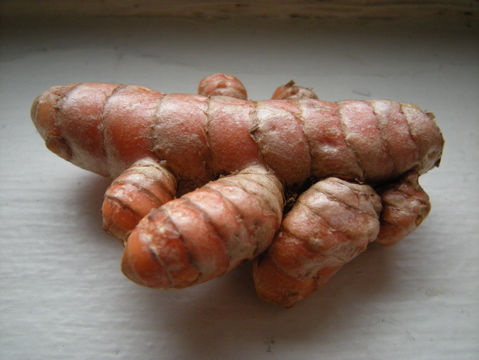
It looks like ginger and belongs to the ginger family. The photo above is a fresh piece of turmeric root or curcuma longa, originally a plant native to Southern Asia and today mostly cultivated in India, China, Indonesia, Jamaica & Haiti. Anglophone countries call it turmeric, while Latin derived languages call it Curcuma and if you want to find out what it is in Chinese or other languages click here.

The word curcuma comes from the arabic khourkoum كم كر; though J.Favre, in the 19th century Dictionaire Universel de la Cuisine et de l’Hygiène Alimentaire, tells us that it comes from the Sanskrit kunkuma. Vijaata-kuGkuma in Sanskrit means *bastard saffron*. Turmeric is often referred to as cheap saffron, faux safron, indian saffron. It is its bright yellow dying agent that associates it with real saffron, but taste-wise one cannot replace the other. The *real* saffron is the stigma of the flower crocus sativa and one of the most pricey spices on the market.

Turmeric doesn’t have the sharp bite ginger has. A must for curry of course, but can be used in many other recipes. I have used it in lentil stew, lamb stew etc. Today I made a simple miso soup.

Miso Turmeric Soup

1/4 cup of finely chopped onion
1 carrot also finely chopped
1 piece of fresh turmeric
1/2 cup of see kelp
2 Tbsp of Miso

Sauté onions, carrots and turmeric in a sauce pan coated with olive oil. Add water, let simmer for 20 minutes. Meanwhile rehydrate your sea kelp. Add the sea kelp when they have softened. Add miso at the end. Serve with brown rice and kimchee. This is a very restaurative dinner.

Turmeric is known to be a potent healing rhizome; it has anti-oxidant & anti-inflammatory properties that are used in alternative medicine. There is an entire book on the subject that I just discovered: Turmeric and the Healing Curcuminoids by Muhammed Majeed.

1 40 41 42 43 44 60