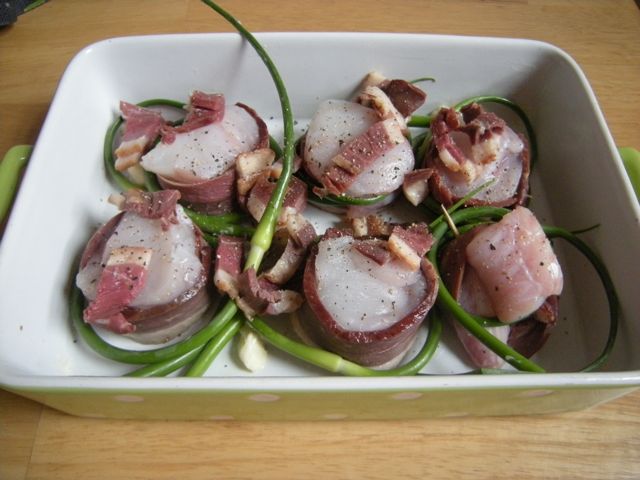
Poor’s Man Lobster & Garlic Scapes

Poor’s Man Lobster & Garlic Scapes

Lotte Nicole!

Also called monkfish, lotte or baudroie in French, this excellent  —not so good looking— fish belongs to the Lophius family. The firm consistency of its flesh resembles lobster meat. The liver, cheek and tail are eaten. The head is rarely seen at the fish store. The tail is the piece most often available for purchase. I got mine at the Bay Ridge Green Market and it was beautiful. Monkfish has been my favorite sea fish since I was young. Back then it was because there were “no” bones  — only one big central bone that is easily removed, but none of those little sneaky ones.  The meat can be roasted whole or cut into chunks. It can also be sautéed, skewered, poached, broiled, pan fried & served with all kinds of sauces. My choice today was: roasted, wrapped in duck bacon, tied with garlic scape.
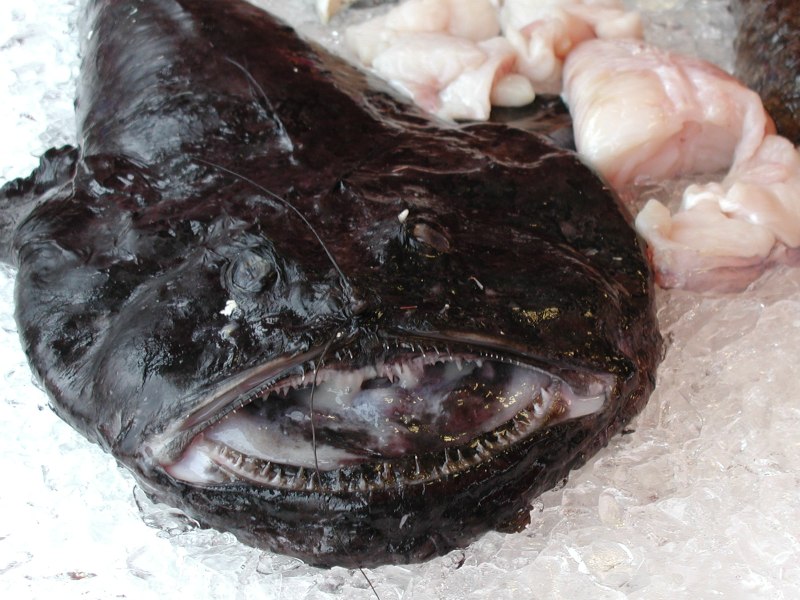

Monkfish or Lophius
Piscatorius


I shared this dish with my friend, poet Patricia Spears Jones, and I would appreciate it if she would comment on it. Meanwhile you can read one of her great poems here.

Recipe:
Preheat oven 375º
Cut the fish into equal chunks.
Coat an oven proof dish with extra virgin olive oil.
Wrap the pieces with duck bacon, or regular pork bacon (though the duck bacon gives it an interesting flavor)
Tighten with a garlic scape ( if already a little hard peel the scape)
Cut little pieces of bacon, sprinkle on top.
Add salt and fresh ground pepper.
Put into the oven for about 20/25 minutes.
Serve with boiled potatoes if it is a main course.
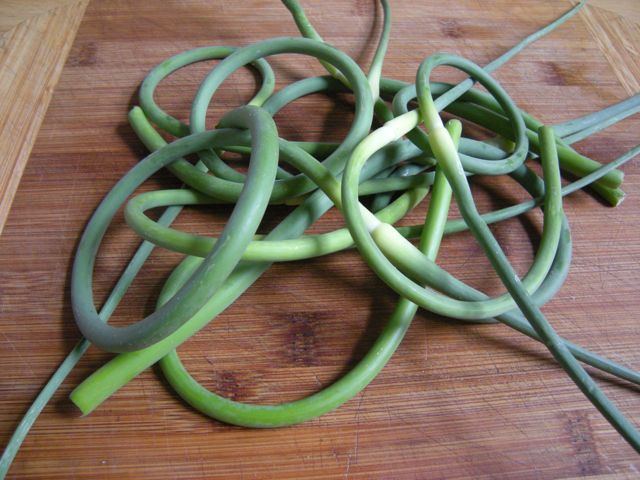
Garlic Scapes
Garlic scapes

Note on Garlic Scape:
Often just called “scapes”, these beautiful curly  greens are the flower stems that are snapped off the garlic in early summer in order to give more energy to the bulb to grow. Their taste is
milder than garlic bulbs. They can be chopped and used in stir fry like green beans or asparagus. A real delicacy, and I look forward to see them at the Farmers Market or Food Coop every June. (For more info read this article on Mother Hearth News).
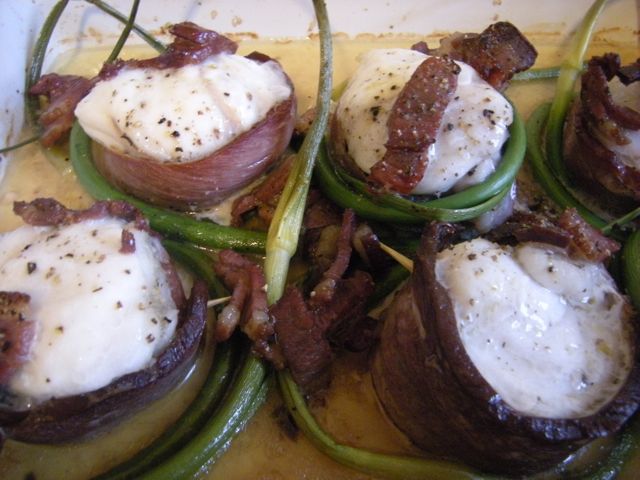
lotte aux pousse d'ail

Water Bottle Drift

Water Bottle Drift

verrazano bridge

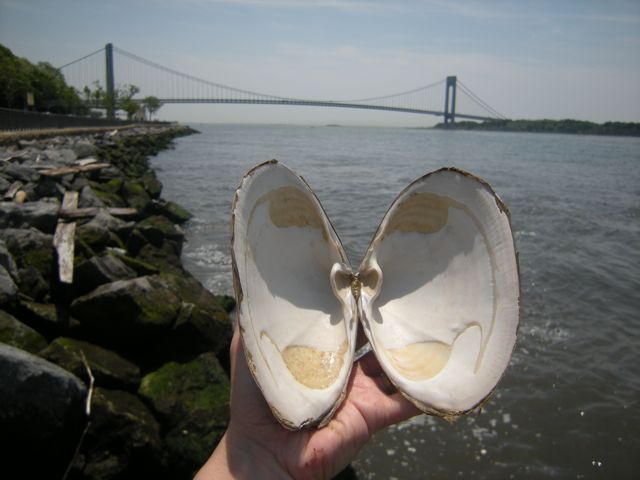
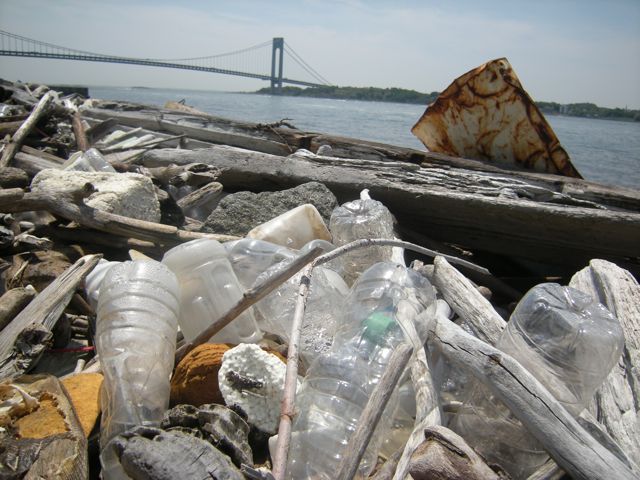
I walk along the Verrazano Narrows on Shore Promenade several times a week. On Memorial Day Shore Promenade was busier than usual so I decided to “catwalk” next to the water on the other side of the fence. It was low tide and I wanted to look at what had drifted into the boulders. Between 68th street and the Verrazano bridge there was only one patch of sea shells, but many, many clusters of empty plastic bottles. There is of course other junk, but the litter is mostly made of individual plastic bottles.
I work seriously on decreasing my use of plastic bottles, bags and packaging in general. I do have a few individual bottles saved, I fill them up with water from my filter carafe, keep them in the fridge and take one along when I leave the house. If I forget, I try to find a water fountain but occasionally I do buy a water bottle. Paying close attention to this insane accumulation along The Narrows increased my awareness and I’ll sure try to avoid the occasional bottle purchase as much as possible.

I try to imagine how did this place looked like before Giovanni da Verrazzano sailed through it in 1524. The Italian explorer, who was at the service of the French crown, wrote his employer King Francois 1er that he believed he had found the opening to the Pacific Ocean, therefore a direct route to China. It is reported that while anchored between Staten Island & Brooklyn, Giovanni da Verrazzano “received a canoe party of Lenape people”  and he called what today is called  The Verrazano Narrows in his honor: New Angoulème. The Lenape where hunter gatherers, not by lack of equipment or sophistication but most likely because the natural resources were so plentiful that they didn’t have to worry about planting, growing  or attending crop. It was all right there available for hunting, fishing & picking  (read Anne Mendelson Chapter “The Lenape” in Gastropolis: Food and New York City).

It is so painful to witness the current destiny of this so unique water-based environment. What was an osmosis between man and nature has became its antonym. Today, despite being one of the major water highways of the world — flanked with litter — The Narrows’ commanding views still moves me deeply. This is the mouth of the Hudson River, and one can feel the incredible elemental forces; remember that the Ocean tide is felt all the way to Albany!

The native name for the Hudson River is Mahicanituck, which means: the river that flows two ways. It was very shortly after I took my first walk there that I wrote the song that was in my CD The Bi-Continental Chowder / La Garbure Transcontinentale. I was still living in Albany and the next day I took the train back and kept filming along the Hudson. The video and the song are part of the live performance of The Bi-Continental Chowder / La Garbure Transcontinentale. Below is the recording and the video:


Percussion: Danny Welchel, Voice over: Ben Chadabe, Text/voice/video: N.P.

Another good reason not to buy bottled water is that beverage companies often take water from municipal or underground local resources: you are probably aware that about 40 percent of bottle water comes from the tap! Other negative factors are: transporting the bottles uses energy, increases landfill and and emits toxic chemicals.

Molokhia, Corète potagère, Corchorus Oilitorius,ملوخية

Molokhia, Corète potagère, Corchorus Oilitorius,ملوخية

It can be spelled Molokhia, Mulukhiya, Malukhiya, Molokia; A.k.a: Juteplante in Germany, Jew’s mallow in the UK, corète potagère or chanvre du bengale in France, Crain-Crain or Krin-Krin in francophone’s Africa, Corchorus Olitorius in Latinand finally, in Arabic, ملوخية. Until my trip to a Syrian grocery store yesterday in Bay Ridge, NY, I had never heard of it. It is a very well known Middle Eastern & African mucilaginous leave-vegetable that grows easily; it belongs to the family of the Tiliacea. It as been cultivated for century both in Africa and Asia, it is found wild on both continents.

Same family as jute (white jute is Corchorus capsularis and Tossa jute Corchorus olitorius). Raw jute was exported to the western world to make cordage, ropes and is better known in the USA as burlarp.

Once cooked the leaves produce a viscous or gooey texture similar to okra. I bought a frozen pack and since I knew nothing about it, I just followed the simple recipe on the package, just adding a few pickled chili pepper . Next time I will add a few drops of fresh lemon juice.

Molokhia soup

Molokhia Soup Recipe
Drop frozen molokhia in 2 cups of boiling water or broth.
Mix often until totally unfrozen.
In a sauce pan melt 1 tbsp of butter and lightly brown 6 finely chopped garlic cloves adding a pinch of coriander.
Add the molokhia, stir, adjust seasoning and serve.

So voilà! my dinner last night:  Molokhia soup and a batch of home made French fries. It was a quick, unusual and satisfying dinner.

Petit Diner Rapide (Fast Food II)

Petit Diner Rapide (Fast Food II)

petit diner

Still not much time to cook due to the last crunch on my next cd with Michael Bisio (title: “Whisk! Don’t Churn”) scheduled to be released on March 12 at Justin’s in Albany where it was recorded live November 20th 2008, remember?
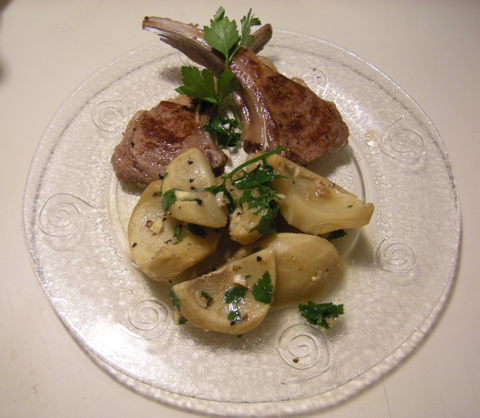
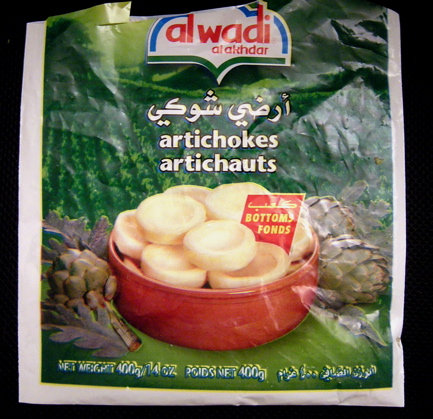
We still had to eat and I must say I like the challenge of having to make something really quick with whatever is available or brought to me. Pierre went shopping; he strolled down to our favorite local store, Aunt Halime’s Halal Meat on 3rd Avenue and Ovinton, and brought back a beautiful rack of lamb, a bag of frozen artichoke bottoms (unusual to find artichokes bottoms, it is usually hearts) and got a nice bottle of Cahors at the local wine store.

artichoke bottoms

We decided that it was too much to make the entire rack for the two of us. I cut out 6 small chops and he took the rest up to Albany. The artichokes bottoms where a great accompaniments to the simply pan fried chops. I was also impressed by their quality; they were firm & flavorful, grown in Egypt and imported via Beirut, Lebanon. Of course I had to go visit the website, and the Alwadi company doesn’t look like a mom and pop’s business, but more like the Goya of Middle Eastern food. Still I can’t complain about the artichoke, au contraire, and they didn’t list any preservatives, which is rare for frozen artichokes. Though I will not use them too often as I am trying to be mindful of my carbon footprint!

dscn25971

This is how I prepared them:
I steamed artichokes for few minutes. I added olive oil & a dollop of butter to the same pan I had fried the lamb chops in, sautéed the bottoms cut an half for few minutes, adding 2 cloves of garlic. Before serving, add chopped parsley. C’est tout!

We shared the bottle of Cahors with the help of my son Joseph who stopped by for a drink and then we returned to our cd designing happy and satisfied!

Nymphéas

Nymphéas

Nymphéas

Pour John & Wayne

The sun has set too fast today.
Can a water lily show me the way?
An impression by Claude Monet
Let Giverny bridge Albany.
Wet paint into wet paint
Emphasizes your qualities.
The perception of your movements
Belongs to les effets de soir.
Your blue shadow is a landscape
Your reflection a guide.
Like a painting by Claude Monet
“Impression, Sunrise”
Impression, soleil levant

N.P
Bay Ridge -Sunday, October 26, 2008
Bass: Michael Bisio
Photo/Voice/Text: Nicole Peyrafitte
Recorded Live at Justin’s in Albany N.Y by Sten Isachsen -Bender Studio-November 20, 2008