Busy Week!

Busy Week!

Les semaines se suivent et ne se ressemblent pas
or in English:
Week follows week; none are alike
.

Here’s the one coming up for me, and wow,  is it busy!

First, this weekend I am preparing for  the shoot of a short independent movie “The Cry” by talented young director James Mehr. I will play the lead, her name is Claudine, a very dramatic French woman (contre emploi total!). The project is shot in super 16mm and I am really excited to get back into acting.

Then on Friday May 1st I will participate in one of the 2 movie nights extravaganza of Neo-Banchi and experimental videos at Dixon Place in Manhattan. Accompanied by Peter Knoll on electric guitar, we will perform an *enhanced* version of “Voyage dans la Lune,” a “Trip to the Moon”, the  George Mélies 1902 sci-fi movie. A detailed program can be found on Brandon Downing’s blog; among the presenters are Bruce Andrew, Nada Gordon, Linh Dinh, Julian Brolaski, Edwin Torres…and more

MAY 1 & 2, 2009    8PM
A Mini-Festival of Live Interactives, Musical Attacks,
Neo-Benshi, Experimental Video and other damages
to the World’s Cinematic Legacy
A Benefit for Dixon Place
Advance Tickets: $12/show ($15 at the door)   Both nights: $20
Advance Tickets Available (and highly recommended) at www.dixonplace.org

Saturday May 2nd is the very anticipated First Brooklyn Food Conference. I will be part of the evening banquet crew and will be working in the kitchen the night of the event and a few days ahead.

While the Brooklyn Food Conference is a FREE event, we would also like to invite you to join us for an evening of fine dining and dance at the end of the conference. The spring menu will be prepared by professional chefs using sustainable foods produced by local farmers and producers. Seating is limited. Wine and beer not included in the $20 ticket. Free childcare and a low-cost child’s meal will be available. Casual attire. Purchase tickets here

And last but not least, I will need to be in great shape for Sunday May 3rd, to assist Joseph Mastantuono in filming & documenting the D’Artagnan 5th Duckathlon. This yearly happening is a culinary competition where top city chefs present their best team to compete in a series of challenges in costume, throughout the meat packing district.  Last year was GREAT FUN — see for yourself: below is the video shot and edited by Joseph.
Voilà, I will collect pictures, stories, recipes and more — and will report as soon as I can. Have a good week!

But before I go, save the date: Saturday May 16 at 6 p.m. @ Bowery Poetry Club for the  concert release of “WHISK! DON’T CHURN”  — my new CD with Michael Bisio

Superweed Explosion

Superweed Explosion


FRANCE 24 report:
French scientist Eric Seralini says research shows Roundup herbicide is highly toxic to human beings.


‘Superweed’ explosion threatens Monsanto heartlands

Sunday 19 April 2009

“Superweeds” are plaguing high-tech Monsanto crops in southern US states, driving farmers to use more herbicides, return to conventional crops or even abandon their farms

The gospel of high-tech genetically modified (GM) crops is not sounding quite so sweet in the land of the converted. A new pest, the evil pigweed, is hitting headlines and chomping its way across Sun Belt states, threatening to transform cotton and soybean plots into weed battlefields.

In late 2004, “superweeds” that resisted Monsanto’s iconic “Roundup” herbicide, popped up in GM crops in the county of Macon, Georgia. Monsanto, the US multinational biotech corporation, is the world’s leading producer of Roundup, as well as genetically engineered seeds. Company figures show that nine out of 10 US farmers produce Roundup Ready seeds for their soybean crops.

Superweeds have since alarmingly appeared in other parts of Georgia, as well as South Carolina, North Carolina, Arkansas, Tennessee, Kentucky and Missouri, according to media reports. Roundup contains the active ingredient glyphosate, which is the most used herbicide in the USA. (read more here)


April 20th 1954

April 20th 1954
Hotel Poste & Golf Luchon

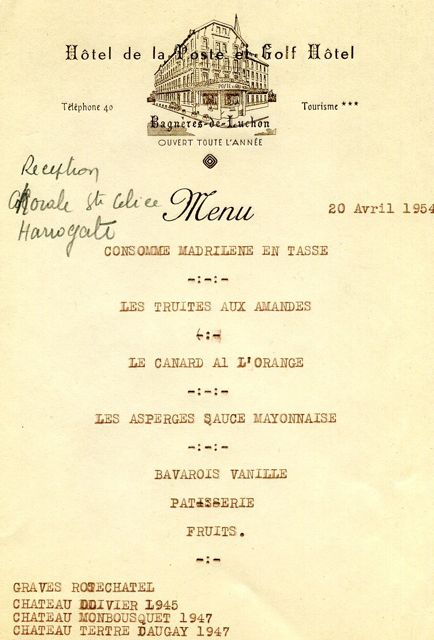
I am in Albany packing our house for our definitive move to Brooklyn. As I was packing my archives I found a batch of old menus from my family hotel that my mother had sent me a few years back. Coincidentally there was one for April 20th 1954. On the left my mother wrote a note: “Reception for the Harrogate St. Cecilia Choir”. I called my parents to inquire  how the Consommé Madrilène was served and stirred up a family disagreement, as my father and mother remembered it differently. My dad insisted that a raw egg yoke was place in the cup of cold clear broth, my mother remembered delicate strips of cold crepes as a garnish on top. Most likely they are both right and it was served one way  and/or the other. I will investigate further, to try and locate the Consommé Madrilène *ur* recipe, once I am reunited with my cookbooks. I will also post the recipes for Truites aux amandes soon. This was one of my grand father signature dishes and that will give me the opportunity to try the Union Square Greenmarket fresh trout stand. I have already posted here the Canard à l’orange recipe. The bavarois is a custard base (crème anglaise) cream with whipped cream and sometimes gelatine added. More details to come, but meanwhile, herewith a translation of the menu:

Menu’s translation
Cold clear broth Madrilène style
Trout in almond sauce
Duck with orange sauce
Asparagus with mayonnaise
Bavarois (vanilla custard)
Pastries
Fruits


Molokhia, Corète potagère, Corchorus Oilitorius,ملوخية

Molokhia, Corète potagère, Corchorus Oilitorius,ملوخية

It can be spelled Molokhia, Mulukhiya, Malukhiya, Molokia; A.k.a: Juteplante in Germany, Jew’s mallow in the UK, corète potagère or chanvre du bengale in France, Crain-Crain or Krin-Krin in francophone’s Africa, Corchorus Olitorius in Latinand finally, in Arabic, ملوخية. Until my trip to a Syrian grocery store yesterday in Bay Ridge, NY, I had never heard of it. It is a very well known Middle Eastern & African mucilaginous leave-vegetable that grows easily; it belongs to the family of the Tiliacea. It as been cultivated for century both in Africa and Asia, it is found wild on both continents.

Same family as jute (white jute is Corchorus capsularis and Tossa jute Corchorus olitorius). Raw jute was exported to the western world to make cordage, ropes and is better known in the USA as burlarp.

Once cooked the leaves produce a viscous or gooey texture similar to okra. I bought a frozen pack and since I knew nothing about it, I just followed the simple recipe on the package, just adding a few pickled chili pepper . Next time I will add a few drops of fresh lemon juice.

Molokhia soup

Molokhia Soup Recipe
Drop frozen molokhia in 2 cups of boiling water or broth.
Mix often until totally unfrozen.
In a sauce pan melt 1 tbsp of butter and lightly brown 6 finely chopped garlic cloves adding a pinch of coriander.
Add the molokhia, stir, adjust seasoning and serve.

So voilà! my dinner last night:  Molokhia soup and a batch of home made French fries. It was a quick, unusual and satisfying dinner.

Turmeric Synchronicity: The Case of the Antioxidant Curcumin

Turmeric Synchronicity: The Case of the Antioxidant Curcumin

Two of my most recent posts were about turmeric (curcuma) and today this piece was posted on the ASFS List server (Association for the Study of Food and Society) by Cara de Silva via Dana Jacobi. A very scientific article on the source of turmeric’s healing power finally uncovered in U Mich lab (American Chemical Society).

Determining the Effects of Lipophilic Drugs on Membrane Structure by Solid-State NMR Spectroscopy: The Case of the Antioxidant Curcumin

Jeffrey Barry, Michelle Fritz, Jeffrey R. Brender, Pieter E. S. Smith, Dong-Kuk Lee† and Ayyalusamy Ramamoorthy*
Biophysics and Department of Chemistry, University of Michigan, Ann Arbor, Michigan 48109-1055

Click here full article

Abstract

Curcumin is the active ingredient of turmeric powder, a natural spice used for generations in traditional medicines. Curcumin’s broad spectrum of antioxidant, anticarcinogenic, antimutagenic, and anti-inflammatory properties makes it particularly interesting for the development of pharmaceutical compounds. Because of curcumin’s various effects on the function of numerous unrelated membrane proteins, it has been suggested that it affects the properties of the bilayer itself. However, a detailed atomic-level study of the interaction of curcumin with membranes has not been attempted. A combination of solid-state NMR and differential scanning calorimetry experiments shows curcumin has a strong effect on membrane structure at low concentrations. Curcumin inserts deep into the membrane in a transbilayer orientation, anchored by hydrogen bonding to the phosphate group of lipids in a manner analogous to cholesterol. Like cholesterol, curcumin induces segmental ordering in the membrane. Analysis of the concentration dependence of the order parameter profile derived from NMR results suggests curcumin forms higher order oligomeric structures in the membrane that span and likely thin the bilayer. Curcumin promotes the formation of the highly curved inverted hexagonal phase, which may influence exocytotic and membrane fusion processes within the cell. The experiments outlined here show promise for understanding the action of other drugs such as capsaicin in which drug-induced alterations of membrane structure have strong pharmacological effects.

J. Am. Chem. Soc., 2009, 131 (12), pp 4490–4498
DOI: 10.1021/ja809217u
Publication Date (Web): March 3, 2009

Copyright © 2009 American Chemical Society

1 … 43 44 45 46 47 … 63